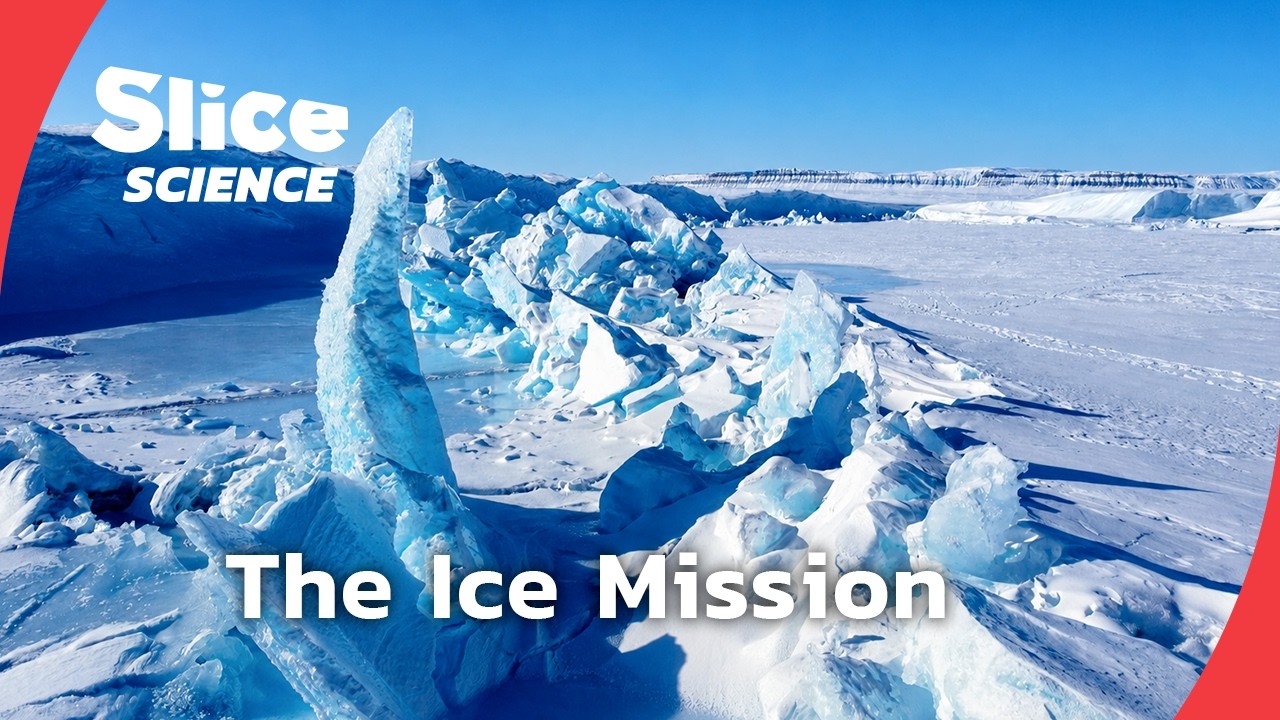
Inside The Polar Ice Mission From Greenland To Antarctica | SLICE SCIENCE | FULL DOC
Keywords
Summary
195 words
Critical Evaluation
The documentary provides a valuable and rare behind-the-scenes look at a complex polar scientific expedition. Its primary strength lies in the authenticity of the field operations, showing the real challenges of logistics, safety, and decision-making in extreme environments. The involvement of Eric Rignot, a leading expert in glaciology, lends credibility to the scientific content. The film effectively communicates key concepts, such as the importance of the ice-ocean interface and the use of sonar to map subglacial cavities, in an accessible manner without oversimplifying. The distinction between hypotheses and confirmed observations is clearly made, which is a hallmark of good scientific communication. However, the documentary lacks explicit references to specific scientific publications, which would have strengthened its educational value for those seeking further information. The pacing is sometimes slow, and some technical details might be challenging for a general audience, but the visual imagery and personal narratives help maintain engagement. The title promises coverage of both Greenland and Antarctica, but the Antarctic segment is brief and not as detailed, which could be seen as a minor discrepancy. Overall, the documentary is a commendable piece of science communication that offers genuine insights into the process of polar research, though it could benefit from more explicit source citation.
205 words
Title / Content Match
The title accurately reflects the content, which covers polar ice missions in both Greenland and Antarctica, though the focus is primarily on Greenland.
Quality & Reliability
8/10
The documentary features leading glaciologist Eric Rignot and presents direct field observations, satellite data, and sonar measurements. It clearly distinguishes hypotheses from confirmed observations, and the production is by a reputable science channel. However, it lacks explicit citations to peer-reviewed papers, and some technical details are simplified for a general audience.
Key Moments
Markers derived by PSI from the transcript: the creator did not define chapters.
- Introduction to the mission and the Petermann Glacier, highlighting its significance.
- Flight to the glacier and landing on the floating ice shelf.
- Reconnaissance on foot to find a suitable drilling site.
- Drilling through the ice to access the ocean cavity.
- Deployment of the submarine and sonar mapping of the subglacial cavity.
Cited Sources
- NASA — Mentioned as the aegis under which the mission is conducted.
Concurring Sources
- NASA's Oceans Melting Greenland (OMG) mission — Related NASA mission studying glacier-ocean interaction, consistent with the documentary's themes.
Contribution & Novelties
The documentary provides an unprecedented look at the logistical and scientific challenges of studying subglacial processes in real-time. It showcases the use of a custom-built autonomous submarine to map the under-ice cavity, a technique that is at the forefront of glaciological research. The film emphasizes the importance of direct observation to confirm hypotheses, such as the tidal pumping of seawater beneath the glacier.
Pour aller plus loin :
- Eric Rignot’s publications — Key papers on glacier dynamics and ice-ocean interaction.
- Petermann Glacier on Wikipedia — Overview of the glacier’s characteristics and recent research.
- NASA’s Oceans Melting Greenland (OMG) mission — Related NASA mission studying glacier-ocean interaction.
- Subglacial cavity research — Educational resource on subglacial processes.
115 words
Radar Profile
The radar profile shows high scores across all dimensions, indicating a well-rounded documentary with strong information content, technical depth, and reliability. The slightly lower score in 'niveau_technique' reflects the simplification of some concepts for a general audience.