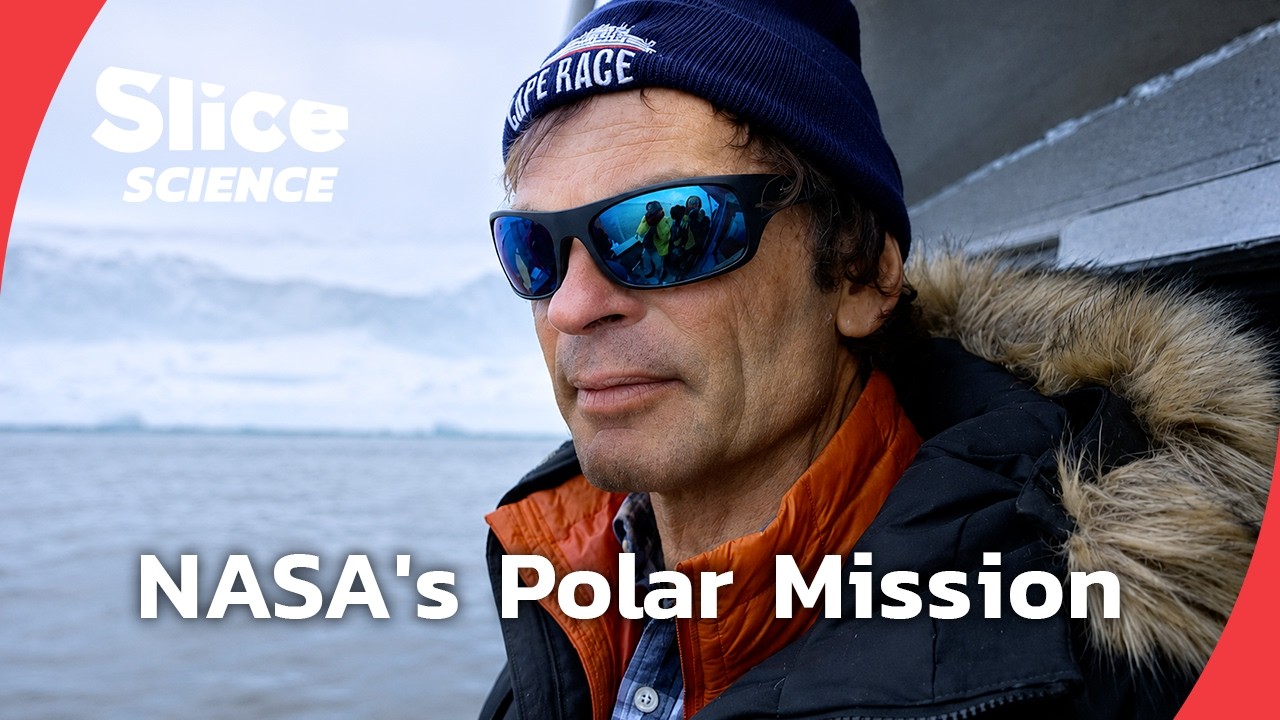
Inside The Polar Ice Mission From Greenland To Antarctica- part 2 | SLICE SCIENCE | FULL DOC
Keywords
Summary
135 words
Critical Evaluation
The documentary provides a compelling and visually engaging overview of polar ice research, featuring interviews with scientists who are actively involved in studying glaciers. The strength of the film lies in its ability to convey complex scientific concepts, such as the grounding line and heat capacity, through clear explanations and demonstrations. The inclusion of field footage from the Petermann Glacier expedition adds authenticity and helps viewers appreciate the challenging conditions researchers face. However, the documentary has some weaknesses. It lacks specific citations to peer-reviewed studies, which limits its scientific rigor. While the scientists mention using satellite data from the GRACE mission and ground-based radar, they do not provide detailed references or data points that viewers could verify. The narrative occasionally veers into personal anecdotes and interactions that, while humanizing, detract from the scientific focus. The segment on AI detecting emissions, while interesting, feels somewhat tangential and is not well-integrated into the main narrative. Overall, the documentary is informative and well-produced, but it would benefit from more explicit references to scientific literature to enhance its credibility. The title accurately reflects the content, and the documentary successfully raises awareness about the importance of polar ice research for understanding climate change.
198 words
Title / Content Match
The title accurately reflects the content, which focuses on polar ice missions in Greenland and Antarctica.
Quality & Reliability
7/10
The documentary features interviews with scientists from NASA and other institutions, presenting real expedition footage and discussing ongoing research. However, it lacks detailed citations or references to specific studies, and some segments are dramatized for effect.
Key Moments
Markers derived by PSI from the transcript: the creator did not define chapters.
- Demonstration of water's heat capacity with balloons.
- Introduction to GRACE satellite mission and its role in measuring ice mass.
- Explanation of the grounding line and its significance.
- Deployment of the ApRES device to measure melt rates.
- Discussion on the potential sea level rise from Petermann Glacier.
- Interview with a scientist about her background and passion for glaciology.
- Segment on using AI to track emissions from oil and gas industries.
- Discussion on the lag time between reaching net zero and temperature stabilization.
Cited Sources
- NASA GRACE Mission — Mentioned as the satellite mission used to study ice sheet changes.
- Petermann Glacier — The glacier is the focus of the expedition.
Concurring Sources
- NASA Climate Change — Provides data and information on polar ice melt and sea level rise.
Contribution & Novelties
The documentary provides an inside look at a NASA expedition to the Petermann Glacier, highlighting the use of ground-based radar (ApRES) to measure melt rates in real time. It emphasizes the importance of the grounding line and the potential for significant sea level rise. The film also touches on the use of AI to track emissions, a relatively new approach.
Pour aller plus loin :
- GRACE mission — Official NASA page for the GRACE mission, which measures ice mass changes.
- Petermann Glacier — Wikipedia article providing background on the glacier.
- ApRES (Autonomous phase-sensitive Radio Echo Sounder) — British Antarctic Survey page describing the ApRES instrument used in the documentary.
- Grounding line — Wikipedia article explaining the concept of the grounding line.
121 words
Radar Profile
The radar profile shows balanced scores across all dimensions, with slightly lower technical depth and source reliability. This suggests a documentary that is informative and engaging but could benefit from more rigorous scientific referencing.
💬 No comments were provided for analysis.