CORE Seminar - February 25, 2026 - Dr. Alan J. Forster
Keywords
Summary
175 words
Critical Evaluation
Value of the Information & Strength of the Argument
The presentation offers valuable insights into a practical application of data-driven quality improvement in a hospital setting. It argues convincingly that reducing length of stay can improve access to care, and presents a structured approach combining top-down and grassroots initiatives. The use of synthetic data is well-justified as a means to democratize data access and accelerate research, with the speaker acknowledging limitations such as small sample sizes. However, the argumentation relies heavily on anecdotal evidence and institutional data without rigorous statistical analysis or external benchmarking. The speaker’s expertise lends credibility, but the lack of detailed methodology and outcome data weakens the overall argument.
Scientific Rigor, Source Quality, Title Accuracy
The presentation is scientifically grounded, referencing internal data and a study comparing synthetic to real data in Ottawa. However, specific sources are not cited in detail, and the reliance on institutional data limits generalizability. The title accurately reflects the content, focusing on the ‘Solve the Stay’ campaign. The speaker does not provide a comprehensive literature review, but the approach aligns with established concepts like learning health systems and advanced care planning. The lack of formal citations and peer-reviewed references reduces the scientific rigor, though the practical experience and institutional context add value.
210 words
Title / Content Match
The title accurately reflects the content, which focuses on the 'Solve the Stay' campaign and its data-driven approach.
Quality & Reliability
7/10
The presentation is based on the speaker's expertise and institutional data, but lacks detailed methodological transparency and external validation.
Key Moments
Markers derived by PSI from the transcript: the creator did not define chapters.
- Introduction and context of the seminar.
- Dr. Forster introduces the 'Solve the Stay' campaign and its goal to reduce length of stay.
- Explanation of how prolonged length of stay affects access to care.
- Discussion on the dual approach: top-down and grassroots initiatives.
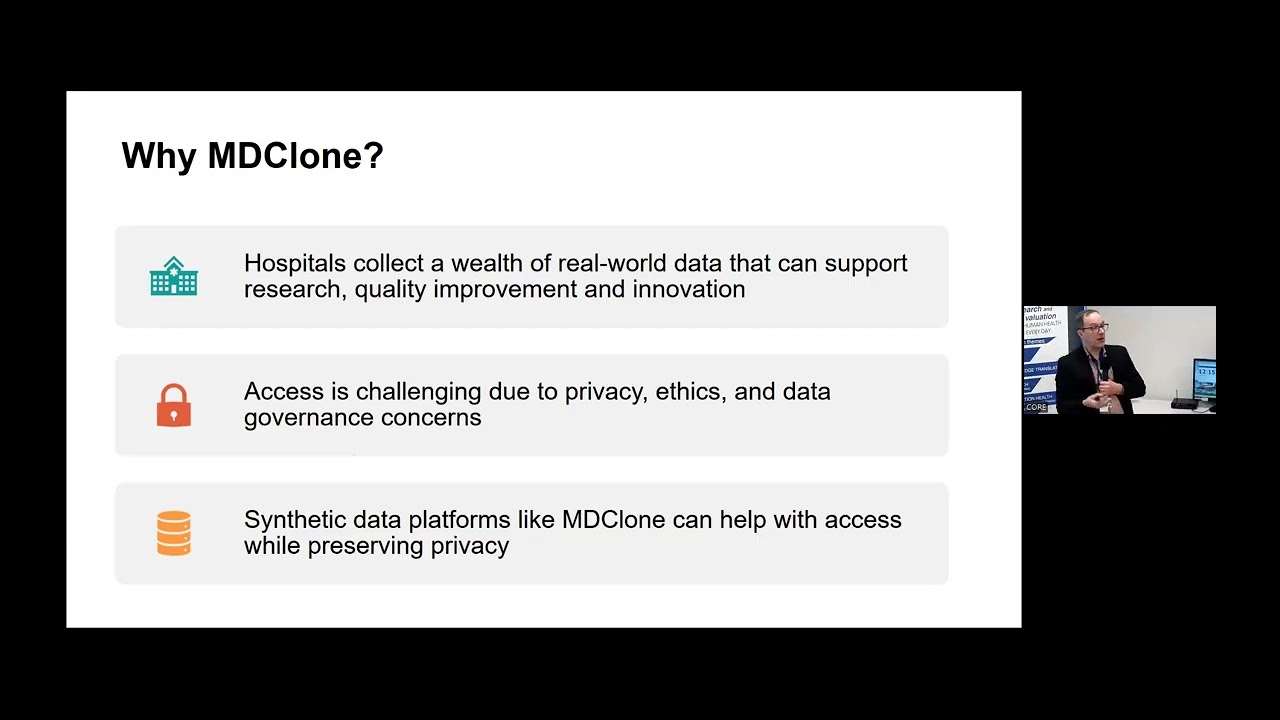
- Introduction to MDClone and its synthetic data capabilities.
- Explanation of synthetic data generation and its advantages for research.
- Limitations of synthetic data and considerations for analysis.
- Details on the data loaded into MDClone and its refresh schedule.
- Focus on end-of-life care and advanced care planning as a top-down initiative.
- Call for grassroots participation and training workshops.
Cited Sources
- MDClone — Platform used for synthetic data generation and analysis.
Concurring Sources
- MDClone — Platform used for synthetic data generation and analysis.
Contribution & Novelties
The presentation provides a novel perspective on applying synthetic data to hospital quality improvement, specifically targeting length of stay. It demonstrates a practical framework for engaging researchers and clinicians in data-driven initiatives, fostering a learning health system. The emphasis on grassroots participation and the use of synthetic data to bypass regulatory barriers is innovative.
Pour aller plus loin :
- Learning health system — Concept central to the campaign’s vision.
- Synthetic data — Overview of synthetic data generation and applications.
- Advanced care planning — Related to the end-of-life initiative.
88 words
Radar Profile
The radar profile shows balanced scores across all dimensions, with slightly higher scores in information quantity and quality, reflecting the informative yet non-technical nature of the presentation. The lower technical level indicates accessibility to a broad audience.