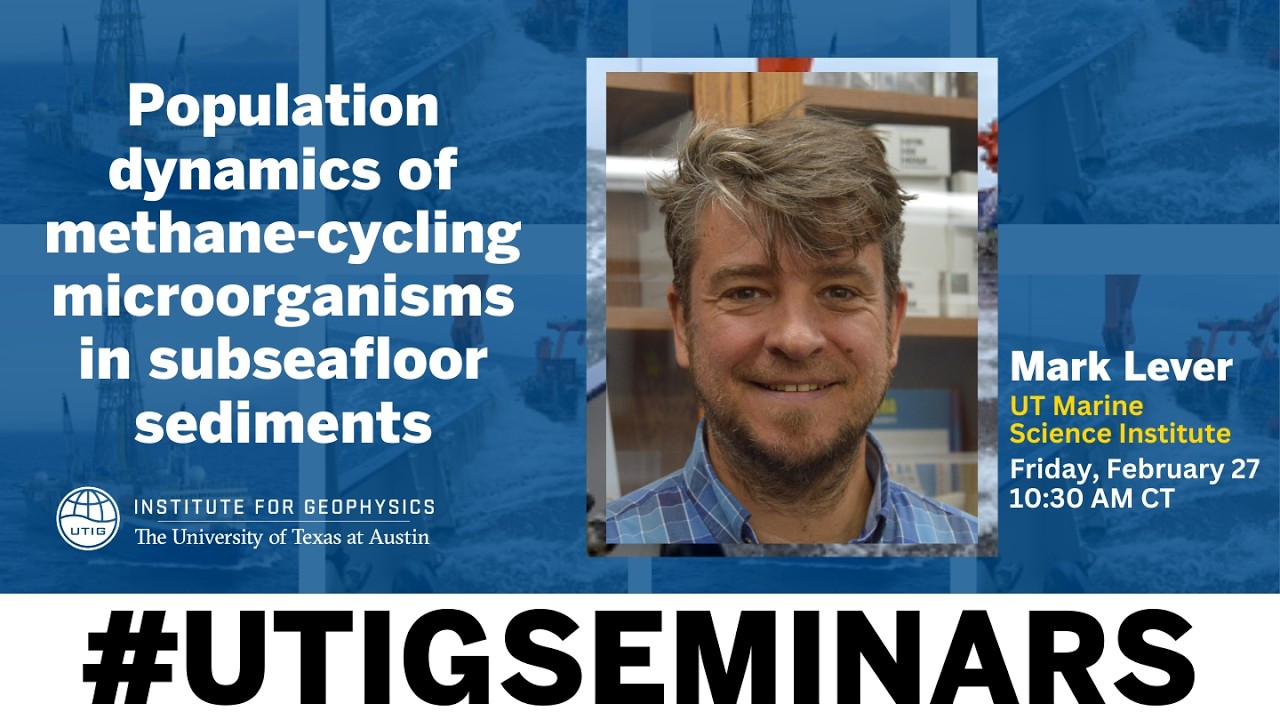
Spring 2026 UTIG Seminar Series: Mark Lever
Keywords
Summary
220 words
Critical Evaluation
Value of the Information & Strength of the Argument
The presentation provides valuable insights into the distribution and ecology of methane-cycling microorganisms in subseafloor sediments. Lever effectively argues that these organisms are rare but important, and that standard metagenomic approaches may miss them. He supports his claims with quantitative data from multiple sites, including gene copy numbers and community composition analyses. The argumentation is logical, building from background to specific case studies, and he acknowledges uncertainties and alternative interpretations. However, some conclusions are based on limited data, such as the inference of growth from geochemical profiles, and he notes that further experiments are needed to confirm physiological interpretations.
Scientific Rigor, Source Quality, Title Accuracy
The presentation is scientifically rigorous, drawing on peer-reviewed publications and original data. Lever clearly describes methods and limitations. The title accurately reflects the content. The sources cited are primarily his own published work and relevant literature, though specific citations are not explicitly listed in the video. The talk is well-structured and the evidence is presented transparently.
170 words
Title / Content Match
The title accurately reflects the content, focusing on population dynamics of methane-cycling microorganisms in subseafloor sediments.
Quality & Reliability
8/10
The presentation is based on original research published in peer-reviewed journals, with clear methodology and data. The speaker is an established researcher in the field. However, some interpretations are speculative and the presentation is a seminar, not a formal publication.
Key Moments
Markers derived by PSI from the transcript: the creator did not define chapters.
- Introduction to the research question: what determines the fate of organic carbon in the seafloor?
- Background on microbial breakdown of organic matter and the role of methanogens.
- Hypotheses: methane-cycling archaea are rare and often missed; they follow sulfate gradients; growth occurs at geochemical transitions.
- Case study at ODP Site 1230: detection of methanogens and ANME-1ab using mcrA gene.
- Case study at Juan de Fuca Ridge flank: same groups found in basaltic crust and sediments, despite wide temperature range.
- Case study in Danish coastal sediments: evidence for growth of methanogens at geochemical transitions.
- Conclusions and implications for understanding the deep biosphere.
Cited Sources
- Lever et al. (2013) Science paper on methane-cycling archaea in oceanic crust — Mentioned as a 2013 Science publication documenting first detection of methane-cycling archaea in basaltic oceanic crust.
Concurring Sources
- Lever et al. (2013) Science paper — Supports the presence of methane-cycling archaea in oceanic crust.
Dissenting Sources
- General metagenomic surveys — These surveys often fail to detect methanogens in subseafloor sediments, contrasting with Lever's targeted approach.
Contribution & Novelties
This seminar provides novel insights into the distribution and ecology of methane-cycling microorganisms in subseafloor sediments, challenging previous assumptions about their rarity and growth potential. Lever’s use of targeted mcrA gene assays reveals a ‘rare biosphere’ of methanogens and ANME that are often missed by general surveys. He also demonstrates that these organisms can tolerate wide temperature ranges and diverse organic matter sources, and provides evidence for active growth at geochemical transitions, contradicting the ‘death curve’ hypothesis.
Pour aller plus loin :
- Methanogenesis — Overview of the biological production of methane.
- Anaerobic oxidation of methane — Process of methane consumption in anoxic environments.
- Deep biosphere — Microbial life in the subsurface.
- mcrA gene — Key enzyme in methanogenesis and anaerobic methane oxidation.
122 words
Radar Profile
The radar profile shows high scores in quantity and quality of information, indicating a well-supported and detailed presentation. The technical level is high, suitable for a specialized audience. The global reliability is strong, reflecting the speaker's expertise and use of published data.