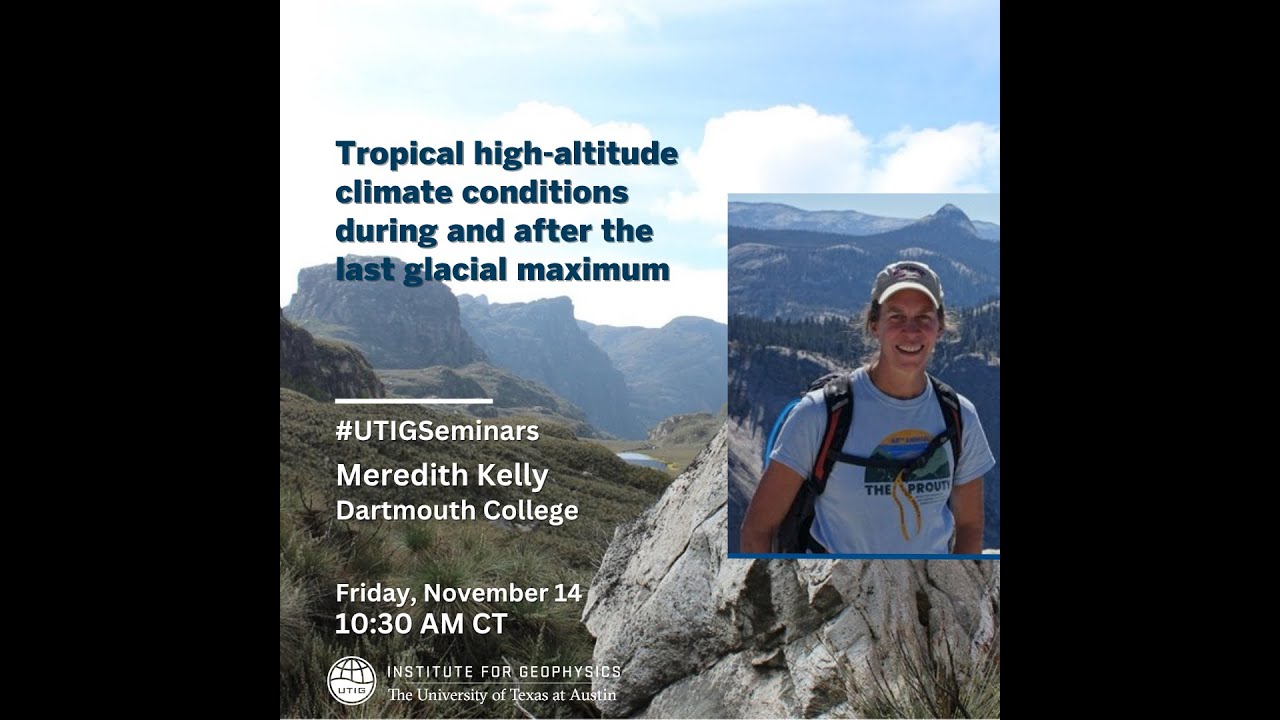
Tropical high-altitude climate conditions during and after the last glacial maximum
Keywords
Summary
140 words
Critical Evaluation
Value of the Information & Strength of the Argument
The talk provides valuable original data from multiple tropical sites, using a consistent methodology to improve intercomparability. The argumentation is solid, building from established theory (Milankovitch) to a critical evaluation of its limitations, and then presenting new evidence that challenges simple northern hemisphere forcing. The use of glacial modeling to infer quantitative temperatures is a strength, as it goes beyond qualitative reconstructions. The speaker clearly explains the methods and their limitations, and the conclusions are well-supported by the data presented.
Scientific Rigor, Source Quality, Title Accuracy
The scientific rigor is high: the research is based on field observations, precise dating techniques, and numerical modeling, with results published in peer-reviewed journals. The sources cited are appropriate and include key papers in the field (e.g., Denton et al., Shakun et al., Tierney et al.). The title accurately reflects the content, and the talk is well-structured. The speaker acknowledges uncertainties and alternative interpretations, which enhances credibility.
162 words
Title / Content Match
The title accurately reflects the content, which focuses on reconstructing tropical high-altitude climate during and after the LGM.
Quality & Reliability
8/10
The talk presents original research based on field mapping, cosmogenic dating, and glacial modeling, with results published in peer-reviewed journals. The methods are well-established and the speaker is a recognized expert. However, the presentation is a seminar talk, not a peer-reviewed publication, and some details are simplified for a general audience.
Key Moments
Markers derived by PSI from the transcript: the creator did not define chapters.
- Introduction and overview of the talk's focus on tropical high-altitude climate during the LGM.
- Discussion of Milankovitch theory and its limitations in explaining glacial-interglacial cycles.
- Introduction of Mercer's paradox and the global nature of glacial periods.
- Presentation of new hypothesis involving southern hemisphere summer duration and circulation changes.
- Overview of methods: glacial mapping, cosmogenic dating, and glacial modeling.
- Focus on the Rwenzori Mountains site and preliminary results.
- Presentation of results from Costa Rica and Colombia sites.
- Discussion of the inferred 7-9°C cooling and steeper lapse rate during the LGM.
- Implications for tropical warming mechanisms and the role of atmospheric moisture.
- Conclusion and future directions.
Cited Sources
- UTIG Seminar Series — Playlist of related seminar talks.
- UTIG Events — UTIG seminar series information.
Concurring Sources
- Shakun et al. 2012 — Global temperature reconstruction showing early warming before CO2 rise.
- Tierney et al. 2020 — Recent global temperature reconstruction for the LGM.
Dissenting Sources
- CLIMAP Project Members 1976 — CLIMAP suggested minimal tropical cooling, contrasting with the larger cooling found in this study.
Contribution & Novelties
The talk presents new, precisely dated glacial records from multiple tropical sites, providing robust quantitative temperature reconstructions for high elevations. The finding of a steeper lapse rate during the LGM is a novel contribution that reconciles terrestrial and marine temperature estimates. This work advances understanding of tropical climate dynamics and their role in global glacial-interglacial cycles.
Pour aller plus loin :
- Milankovitch cycles — Orbital forcing theory relevant to the talk’s discussion.
- Cosmogenic nuclide dating — Method used for dating glacial landforms.
- Last Glacial Maximum — Context for the study period.
91 words
Radar Profile
The radar profile shows high scores in information quantity, quality, and technical level, with slightly lower but still strong reliability. This indicates a well-balanced, informative, and technically sound presentation.