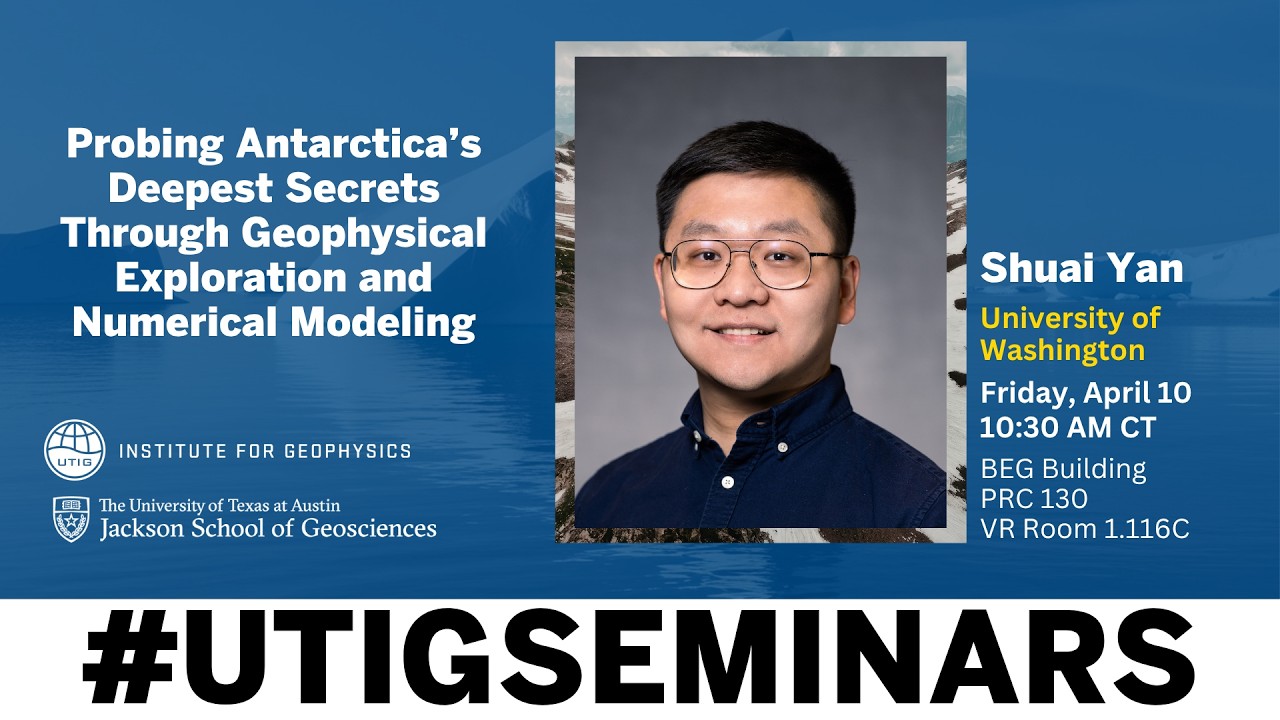
Spring 2026 UTIG Seminar Series: Shuai Yan
Keywords
Summary
176 words
Critical Evaluation
Value of the Information & Strength of the Argument
The presentation provides valuable new geophysical data from a previously under-surveyed region of Antarctica, contributing to the understanding of basal conditions and ice-sheet history. The argumentation is logical and well-structured, moving from observations to hypotheses. The speaker clearly explains the methods, such as delay-Doppler analysis to distinguish specular from scattering reflectors, and uses multiple lines of evidence to support the hypothesis of geothermal heterogeneity. The comparison with existing models and the acknowledgment of alternative explanations strengthen the scientific rigor. However, some conclusions are presented as hypotheses, and the lack of direct ice-core validation limits the certainty.
Scientific Rigor, Source Quality, Title Accuracy
The presentation is scientifically rigorous, based on original data from the COLDEX project, and the speaker references specific datasets and models (e.g., RACMO, Bedmap3). The title accurately reflects the content, focusing on geophysical exploration and numerical modeling. The talk is a seminar presentation, not a peer-reviewed publication, but the methods are transparent and the interpretations are cautious. The speaker acknowledges the collaborative nature of the work and ongoing testing of hypotheses.
182 words
Title / Content Match
The title accurately reflects the content, focusing on geophysical exploration and numerical modeling to probe Antarctica's deep structure and deep-time evolution.
Quality & Reliability
8/10
The presentation is based on original geophysical data collected by the NSF COLDEX project, with clear methodology and integration of multiple datasets. The speaker is a postdoctoral researcher at University of Washington, and the work is part of a large collaborative center. The claims are supported by radar data, modeling, and comparisons with existing models. However, some interpretations are hypotheses awaiting further testing, and the presentation is a seminar talk, not a peer-reviewed publication.
Key Moments
Markers derived by PSI from the transcript: the creator did not define chapters.
- Introduction to COLDEX and the goal of finding oldest ice cores.
- Overview of the Dome A–South Pole corridor and pre-existing data.
- Description of airborne geophysical survey and radar systems.
- Mapping basal topography and roughness from radar data.
- Analysis of basal unit thickness and scattering patterns.
- Hypothesis of geothermal heterogeneity and subglacial geology control.
- Comparison with subglacial hydrology and existing geothermal flux models.
- Inversion of shallow horizon for surface accumulation rates.
- Identification of wind scour unconformities and modeling of their formation.
- Conclusion and ongoing work including potential field analysis and ground-based surveys.
Cited Sources
- NSF COLDEX — The center funding and coordinating the research presented.
- RACMO model — Continental model of surface accumulation used for comparison.
- Bedmap3 — Pre-existing bed topography dataset used for comparison.
Concurring Sources
- COLDEX project website — Provides context and updates on the project's goals and activities.
- RACMO model documentation — Used for comparison of accumulation rates.
Dissenting Sources
- Existing geothermal flux models — The speaker notes that none of the continental-scale geothermal flux models reproduce the observed spatial pattern, suggesting they are missing subglacial geological effects.
Contribution & Novelties
The presentation provides new high-resolution geophysical data from a critical region for finding old ice cores, revealing spatial heterogeneity in basal thermal conditions and evidence for subglacial geological control. The use of radar stratigraphy and modeling to infer past ice-flow stability is innovative. The work contributes to the broader goal of extending the ice-core record beyond 800,000 years.
Pour aller plus loin :
- Antarctic ice sheet — Overview of the Antarctic ice sheet and its dynamics.
- Ice core — Explanation of ice cores and their use in paleoclimatology.
- Radar sounding — Technique used to probe ice sheets.
- Geothermal heat flux — Background on geothermal heat flow and its measurement.
109 words
Radar Profile
The radar profile shows high scores in information quantity, quality, and reliability, with a slightly lower technical level, indicating a well-supported but accessible presentation. The overall high scores reflect the original data and rigorous methodology.