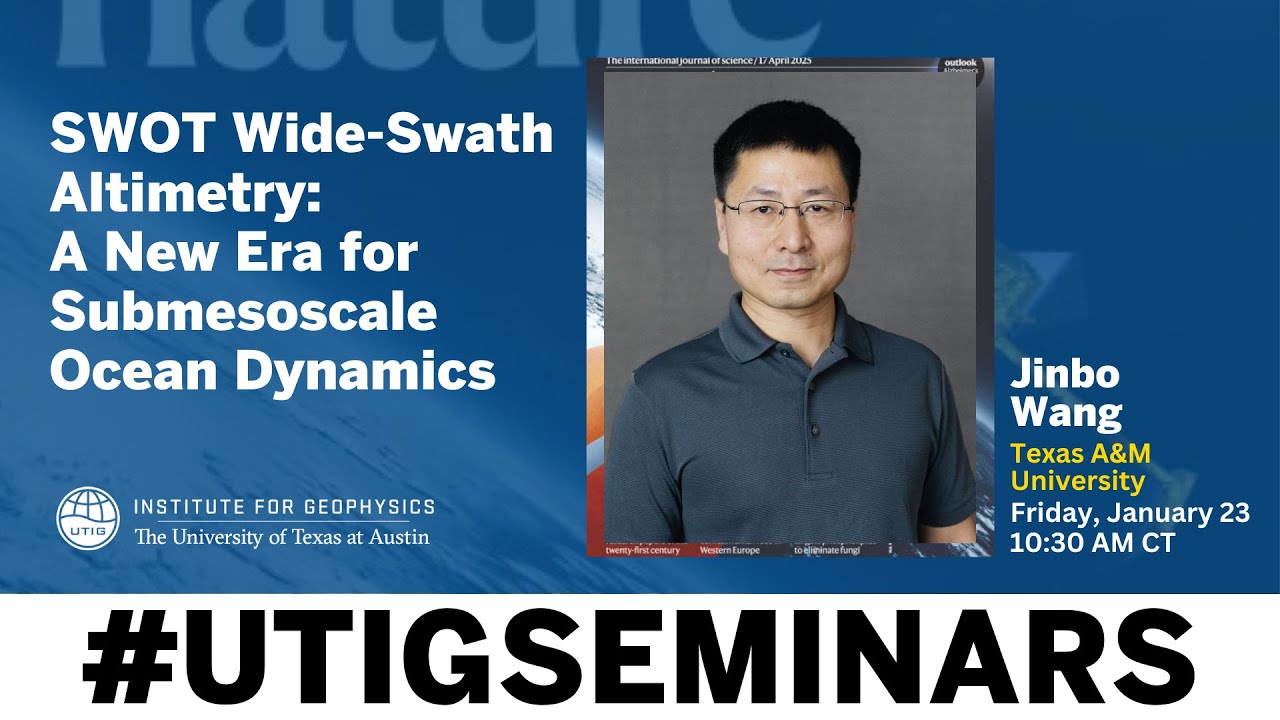
Spring 2026 UTIG Seminar Series: Jinbo Wang
Keywords
Summary
135 words
Critical Evaluation
Value of the Information & Strength of the Argument
The talk provides valuable insights into the SWOT mission’s capabilities and early scientific results. Wang effectively argues for the importance of submesoscale dynamics by linking them to broader climate processes, such as ocean heat uptake and vertical transport. He uses concrete examples and visualizations to illustrate the limitations of conventional altimetry and the advancements offered by SWOT. The argumentation is solid, grounded in mission data and published research, though some technical details are simplified for a general scientific audience.
Scientific Rigor, Source Quality, Title Accuracy
The presentation demonstrates scientific rigor, with references to IPCC reports, peer-reviewed studies, and mission data. Wang, as a project scientist, provides authoritative insights into SWOT’s design and validation. The title accurately reflects the content, focusing on SWOT’s role in observing submesoscale dynamics. The talk is well-structured and credible, though it is a seminar rather than a formal publication, so some details are condensed.
157 words
Title / Content Match
The title accurately reflects the content: a seminar by Jinbo Wang on SWOT wide-swath altimetry and submesoscale ocean dynamics.
Quality & Reliability
8/10
Presentation by a domain expert (Jinbo Wang, Associate Professor at Texas A&M University) with extensive experience in the SWOT mission. Content is based on peer-reviewed research and mission data, but is a seminar talk rather than a formal publication.
Key Moments
Markers derived by PSI from the transcript: the creator did not define chapters.
- Introduction of speaker and topic
- Importance of ocean heat uptake and sea level rise
- Limitations of conventional nadir altimetry
- Introduction to SWOT mission and its objectives
- SWOT measurement principle and data products
- First SWOT cycle and global coverage
- Examples of submesoscale features observed by SWOT
- Validation efforts and scientific insights
- Future opportunities and machine learning applications
- Conclusion and Q&A
Cited Sources
- IPCC Report — Referenced for ocean heat uptake and sea level rise statistics
- Taylor and Thompson 2022 — Referenced for illustration of submesoscale vertical transport
Concurring Sources
- SWOT mission page — Official mission information and data access.
Contribution & Novelties
The talk presents recent findings from the SWOT mission, highlighting its unprecedented capability to observe submesoscale ocean dynamics globally. It showcases specific examples of internal solitary waves and eddies, and discusses the mission’s validation process. The presentation also touches on future research directions, including multi-sensor synergy and machine learning.
Pour aller plus loin :
- SWOT mission page — Official mission information and data access.
- Submesoscale dynamics — Overview of submesoscale processes in the ocean.
- Internal solitary waves — Background on internal waves, including solitary waves.
85 words
Radar Profile
The radar profile shows high scores across all dimensions, with slightly lower technical level due to the seminar format. The balance indicates a well-rounded presentation that is both informative and accessible.