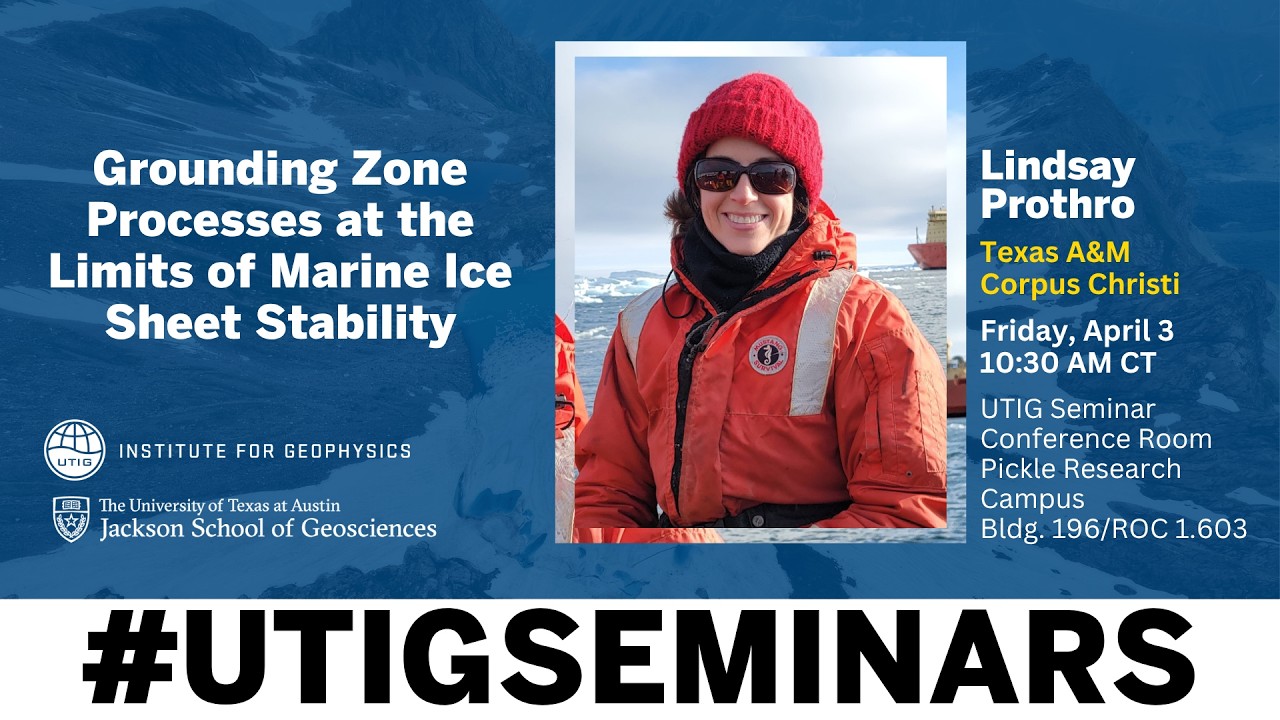
Grounding Zone Processes at the Limits of Marine Ice Sheet Stability
Keywords
Summary
170 words
Critical Evaluation
Value of the Information & Strength of the Argument
The talk provides valuable insights into the use of geological records to understand marine ice sheet dynamics. Prothro effectively argues that the grounding zone is a critical control on ice sheet stability, and that past retreat patterns can inform future behavior. She supports her arguments with a wealth of field data, including high-resolution bathymetry and sediment cores, and demonstrates how these data can be integrated to reconstruct retreat histories. The argumentation is logical and well-structured, building from basic concepts to specific examples and implications.
Scientific Rigor, Source Quality, Title Accuracy
The scientific rigor is high, with the presenter drawing on her own research and that of colleagues, published in peer-reviewed journals. She references specific data sets and methodologies, and acknowledges limitations, such as the difficulty of radiocarbon dating in Antarctica. The title accurately reflects the content, and the talk is well-organized. The presentation is based on a solid foundation of evidence, though as a seminar, it does not include formal citations for all claims.
173 words
Title / Content Match
The title accurately reflects the content, focusing on grounding zone processes and their role in marine ice sheet stability.
Quality & Reliability
8/10
The talk is based on peer-reviewed research and extensive field data, presented by an expert in the field. The methodology is sound, and the interpretations are well-supported by geophysical and sedimentological evidence. However, as a seminar presentation, it lacks the formal peer-review process of a published paper.
Key Moments
Markers derived by PSI from the transcript: the creator did not define chapters.
- Introduction to the importance of ice margins and grounding zones.
- Discussion of potential sea level rise from Antarctic ice sheets.
- Explanation of mass balance and ice sheet stability.
- Introduction to geological records and why they are useful.
- Overview of research methods: seismic, bathymetry, and cores.
- Description of geomorphic features: mega-scale glacial lineations and grounding zone wedges.
- Comparison of retreat scenarios and their sedimentary signatures.
- Presentation of new high-resolution data from the Ross Sea.
- Discussion of targeted coring and sedimentological models.
- Revised chronology of Ross Sea ice retreat, contrasting with 2014 reconstruction.
- Focus on grounding zone processes and their implications for stability.
- Conclusions and future directions, including RAISED 2.0.
Cited Sources
- RAISED reconstruction (2014) — Mentioned as a previous reconstruction of Antarctic ice sheet deglaciation.
- Ruthie Halberstadt's work on Ross Sea retreat pathways — Referenced as the basis for the revised retreat model.
Concurring Sources
- Halberstadt et al. (2016) - Evolution of the Ross Sea continental shelf — Provides geomorphic evidence for complex retreat patterns in the Ross Sea.
Dissenting Sources
- Previous 'swinging gate' model of Ross Sea retreat — The talk presents new data that contradicts the simpler, terrestrial-based model.
Contribution & Novelties
The talk presents a revised, more complex reconstruction of Ross Sea ice sheet retreat based on high-resolution geophysical and sedimentological data, challenging previous simpler models. It emphasizes the role of grounding zone wedges in stabilizing ice sheets and the importance of subglacial meltwater in shaping the seafloor. The integration of geomorphology and sediment cores provides a more detailed understanding of past ice sheet dynamics.
Pour aller plus loin :
- Marine ice sheet instability — This concept is central to the talk’s discussion of grounding zone stability.
- Grounding zone wedge — A key geomorphic feature discussed in the talk.
- Ross Sea — The region of focus for the presented research.
109 words
Radar Profile
The radar profile shows high scores across all dimensions, indicating a well-rounded and reliable presentation. The talk is rich in information, technically sound, and based on credible sources, making it a valuable resource for understanding grounding zone processes.