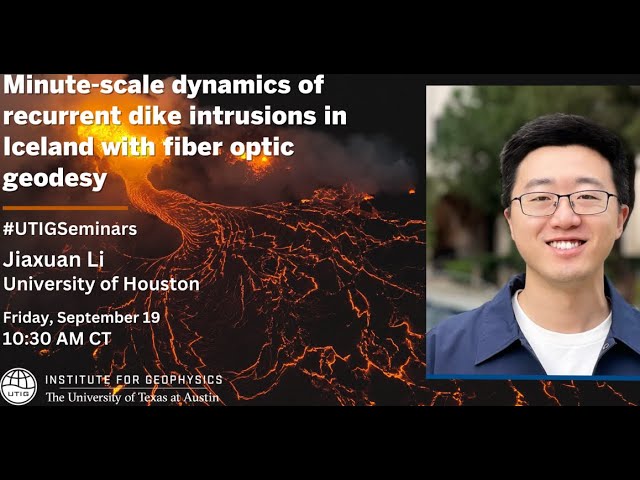
UTIG Seminar Series: Jiaxuan Li, University of Houston
Keywords
Summary
172 words
Critical Evaluation
Value of the Information & Strength of the Argument
The talk presents a novel application of DAS for quasi-static strain monitoring, which is a significant advancement over traditional geodetic methods. The argumentation is strong, supported by detailed data and inversion results. The speaker systematically explains the methodology, from data acquisition to inversion, and validates the results with independent observations such as surface lava features. The early warning capability is convincingly demonstrated with specific examples and timing. The talk also addresses limitations, such as the need for denoising and the impact of fiber breaks. Overall, the value is high, providing new insights into magma intrusion dynamics and eruption forecasting.
Scientific Rigor, Source Quality, Title Accuracy
The scientific rigor is high, with clear methodology and validation. The speaker references their own research and mentions collaborations, but does not cite specific external sources. The title is generic and does not convey the specific topic, but this is common for seminar series. The content is well-structured and technically detailed, suitable for an expert audience. The talk does not include a public Q&A, so no audience feedback is available. The description provides links to the seminar series and institute, but no direct references to the research.
201 words
Title / Content Match
The title accurately reflects the seminar format and speaker, but is generic and does not hint at the specific topic.
Quality & Reliability
8/10
The talk presents original research with detailed methodology, data, and validation, but lacks peer-reviewed publication details and independent verification.
Key Moments
Markers derived by PSI from the transcript: the creator did not define chapters.
- Introduction by host Zhe Jia
- Speaker begins, shows eruption in Iceland
- Overview of volcanic activity and monitoring challenges
- Introduction to DAS technology and deployment in Iceland
- First observations of strain signals from eruptions
- Early warning system implementation and examples
- Geodetic inversion of strain data and results
- Detailed inversion for January 14th eruption
- Detection of small arrested intrusions
- Discussion of implications and future work
Cited Sources
- UTIG Events — Seminar series page
- UTIG Seminar Series Playlist — Playlist of seminar talks
Concurring Sources
- UTIG Events — Seminar series page
Contribution & Novelties
The talk introduces fiber-optic geodesy as a novel method for monitoring volcanic deformation with minute-scale temporal resolution, which is a significant improvement over traditional techniques. The ability to detect small intrusions and provide early warnings is a major contribution. The inversion of strain data to image dike opening dynamics is also innovative.
Pour aller plus loin :
- Distributed acoustic sensing — Overview of the technology.
- Dike (geology) — Background on dike intrusions.
- Reykjanes Peninsula — Context of the study area.
80 words
Radar Profile
The radar profile shows high scores in information quantity, quality, and technical level, with slightly lower reliability due to lack of peer-reviewed publication. This indicates a technically strong presentation with original data, but the reliability is somewhat limited by the absence of external validation.
💬 No comments were provided for analysis.