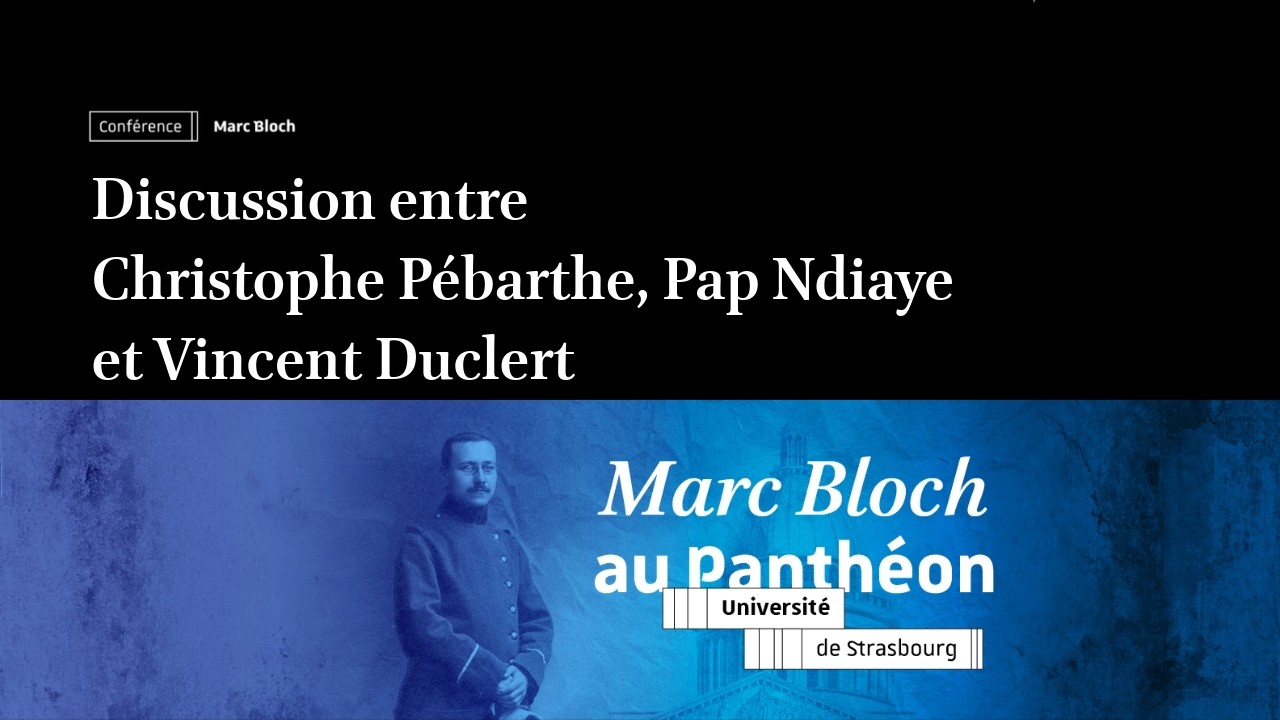
Discussion entre Christophe Pébarthe, Pap Ndiaye et Vincent Duclert
Keywords
Summary
136 words
Critical Evaluation
The discussion provides a rich, nuanced exploration of Marc Bloch’s intellectual legacy, drawing on archival research and historiographical debates. The speakers demonstrate deep expertise, referencing specific letters, works, and scholarly disputes. For instance, they mention Bloch’s correspondence with a Japanese scholar, his subscription to ‘Cahiers de la Russie moderne’, and his engagement with the anthropology of Frazer. The argumentation is solid, with careful attention to evidence and a clear distinction between what is known and what remains speculative. The discussion also addresses the ethical dimension of historical engagement, warning against both the argument from authority and naive scientism. The sources cited are primarily archival and scholarly, though no explicit citations are given. The title accurately reflects the content, and the discussion is well-structured despite its conversational nature. The main limitation is the lack of visual aids or structured presentation, which might make it less accessible to a general audience. Overall, the video offers valuable insights for those interested in historiography and the work of Marc Bloch.
166 words
Title / Content Match
The title accurately reflects the content: a roundtable discussion among three historians.
Quality & Reliability
8/10
Discussion among established historians, grounded in archival research and scholarly debate, with references to primary sources and historiographical context. The content is academic and nuanced, though not peer-reviewed.
Key Moments
Markers derived by PSI from the transcript: the creator did not define chapters.
- Introduction and opening remarks
- Discussion on Bloch's time in Algeria and the gaps in knowledge
- Bloch's international correspondences and his interest in Japan and Scandinavia
- Bloch's engagement with anthropology and the colonial question
- The role of psychology in Bloch's work and his relationship with Febvre
- Discussion on the scientific basis of historical engagement and the risk of argument from authority
- Comparison of Bloch's and de Gaulle's views on the defeat of 1940
- Reflections on the distinction between facts and interpretation
Cited Sources
- L'Étrange Défaite — Referenced as a key work by Marc Bloch on the defeat of 1940.
- Les Rois thaumaturges — Mentioned as an example of Bloch's comparative method and use of anthropology.
- Les Annales d'histoire économique et sociale — Referenced as the journal founded by Bloch and Febvre.
Concurring Sources
- Marc Bloch: A Life in History — Scholarly biography that aligns with the discussion's portrayal of Bloch.
- The Historian's Craft — Bloch's own reflections on historical method, consistent with the discussion.
Dissenting Sources
- Some interpretations of Bloch's engagement — Some scholars argue Bloch's engagement was more politically motivated than the discussion suggests.
Contribution & Novelties
The video offers a nuanced discussion of Marc Bloch’s intellectual legacy, highlighting lesser-known aspects such as his international correspondences and his engagement with anthropology and psychology. It provides insights into the debates between Bloch and Febvre, and the relationship between historical method and civic engagement.
Pour aller plus loin :
- Marc Bloch - Wikipedia — Overview of Bloch’s life and works.
- Annales School - Wikipedia — Context on the historiographical movement.
- L’Étrange Défaite - Wikipedia — Details on Bloch’s seminal work.
81 words
Radar Profile
The radar profile shows high scores in quality of information and reliability, with moderate scores in quantity and technical level. This indicates a focused, expert discussion rather than a broad overview.