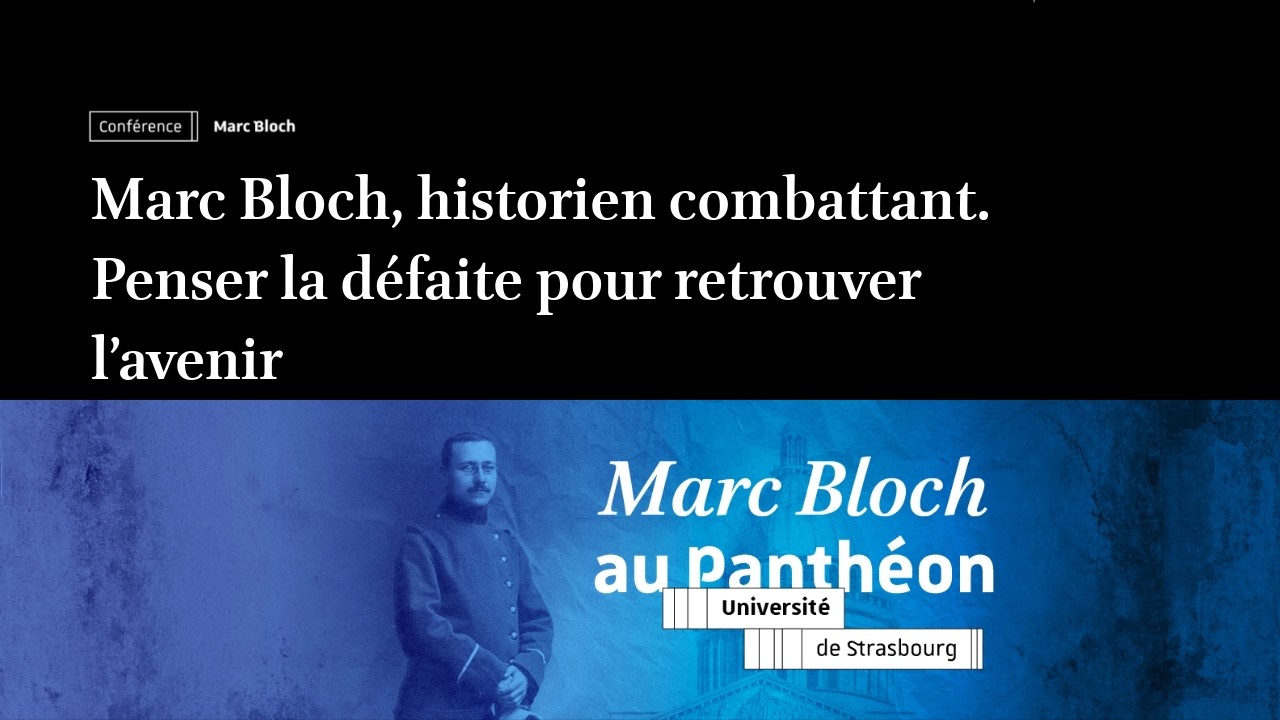
Marc Bloch, historien combattant. Penser la défaite pour retrouver l’avenir
Keywords
Summary
155 words
Critical Evaluation
The talk offers a nuanced and well-argued reinterpretation of Marc Bloch’s ‘The Strange Defeat,’ positioning it as a central work for understanding Bloch’s role as a historian engaged in the public sphere. Duclert, a specialist in the history of genocide and contemporary politics, brings his expertise to bear on the text, drawing on archival research and correspondence to challenge the prevailing view that the book is merely a testimony and not a work of history. He effectively demonstrates that Bloch’s methodological rigor and his commitment to truth are present even in this ’testimony,’ and he argues that the book’s value lies precisely in its combination of personal witness and historical analysis. The argument is well-supported by references to the editorial history, including the various editions and prefaces, and by engagement with other scholars such as Gérard Noiriel and François Bédarida. Duclert’s analysis of Bloch’s ‘regrets’ about intellectual inaction is particularly insightful, linking Bloch’s personal reflections to broader questions about the responsibility of intellectuals. The talk is dense and assumes familiarity with French historiography, but it is accessible to an interested audience. The main limitation is that it is a conference presentation, so it does not provide the full scholarly apparatus, but it offers a compelling and original perspective. The title accurately reflects the content, and the talk successfully achieves its aim of rethinking Bloch’s legacy. Overall, this is a high-quality contribution to Bloch scholarship.
234 words
Title / Content Match
The title accurately reflects the content: the talk focuses on Marc Bloch as a committed historian, analyzing 'The Strange Defeat' as a work that helps think through defeat to recover the future.
Quality & Reliability
8/10
The speaker is a recognized historian (Vincent Duclert, researcher at EHESS), and the talk is based on his own research and archival work. He cites specific sources and editions, and the content is consistent with established historiography. However, as a conference presentation, it is an interpretive essay rather than a peer-reviewed publication.
Key Moments
Markers derived by PSI from the transcript: the creator did not define chapters.
- Introduction: the context of the study day and the pantheonization of Marc Bloch.
- Duclert presents his thesis: 'The Strange Defeat' as a work of history, not just a testimony.
- Discussion of the editorial history of 'The Strange Defeat' and its reception.
- Analysis of Bloch's critique of the French elite and his call for intellectual engagement.
- Examination of Bloch's 'regrets' about inaction and his concept of the historian as combatant.
- Duclert connects 'The Strange Defeat' to Bloch's other works and his role in the Resistance.
- Conclusion: the importance of rethinking Bloch's legacy for today.
Cited Sources
- L'Étrange Défaite (The Strange Defeat) — The main work analyzed in the talk.
- Apologie pour l'histoire ou Métier d'historien — Bloch's methodological work, contrasted with 'The Strange Defeat'.
- Correspondance with Étienne Bloch — Cited to support the interpretation of 'The Strange Defeat' as a testimony.
- Lucien Febvre's inaugural lecture 'L'histoire dans un monde en ruine' — Discussed as a doctrinal influence on the reception of Bloch's work.
- Gérard Noiriel, 'Sur la crise de l'histoire' — Cited as an example of the interpretation that 'The Strange Defeat' is not a work of history.
Concurring Sources
- Marc Bloch, 'The Historian's Craft' — Bloch's methodological work, which supports the idea of history as a critical discipline.
- François Bédarida, 'Marc Bloch et la cité' — Cited in the talk as an example of scholarship that recognizes the importance of 'The Strange Defeat'.
Dissenting Sources
- Gérard Noiriel, 'Sur la crise de l'histoire' — Noiriel argues that 'The Strange Defeat' is not a work of history because it lacks the methodological rigor of Bloch's scholarly works.
Contribution & Novelties
This talk offers a fresh perspective on Marc Bloch’s ‘The Strange Defeat’, arguing that it should be considered a work of history rather than merely a testimony. Duclert challenges the dominant interpretation and provides new insights into Bloch’s engagement as a historian. The talk also highlights the importance of the book for understanding Bloch’s role in the Resistance and his vision for the future.
Pour aller plus loin :
- Marc Bloch (Wikipedia) — Provides background on Bloch’s life and work.
- The Strange Defeat (Wikipedia) — Overview of the book and its significance.
- Annales School (Wikipedia) — Context for Bloch’s historiographical approach.
- Lucien Febvre (Wikipedia) — Relevant to the discussion of the ‘histoire serve’ doctrine.
114 words
Radar Profile
The radar profile shows high scores in information quantity, quality, and reliability, with a slightly lower technical level, reflecting the accessible yet scholarly nature of the talk.