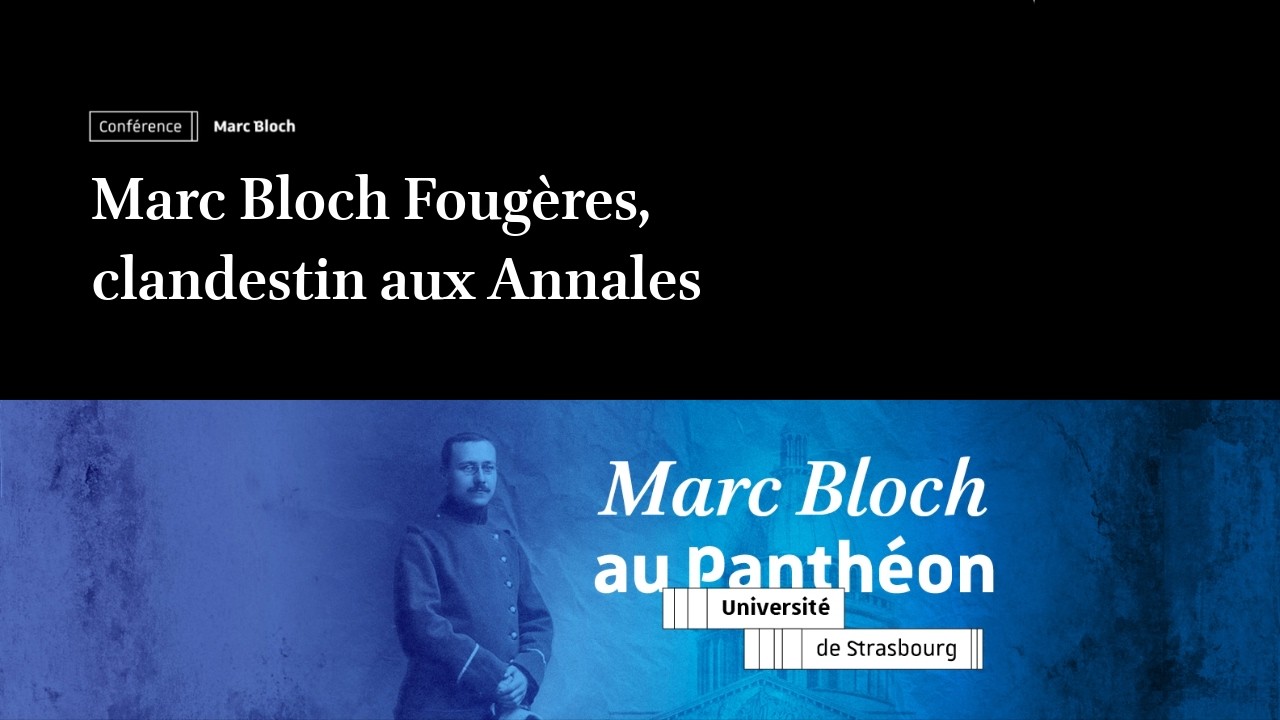
Marc Bloch Fougères, clandestin aux Annales
Keywords
Summary
181 words
Critical Evaluation
The presentation offers a sophisticated and well-argued reinterpretation of a well-known episode in the history of the Annales. Simonin demonstrates deep familiarity with the primary sources, including the correspondence between Bloch and Febvre, and she uses this evidence to challenge the prevailing view, popularized by Philippe Burrin, that Febvre’s insistence on continuing the journal constituted a form of collaboration. Instead, she frames it as a ‘philosophy of maintaining’ – a commitment to preserving intellectual life for the future, even under oppressive conditions. The argument is nuanced, acknowledging the financial and legal pressures that made Bloch’s formal withdrawal necessary, while also highlighting the risks Febvre took, such as his surveillance by the Gestapo. The talk is well-structured, moving from the pre-war context to the specific constraints of the occupation, and it effectively uses visual aids, such as the journal’s masthead and the list of ‘undesirables’ compiled by the Germans. One potential weakness is that the talk is an opinion piece rather than a peer-reviewed study, and some claims, such as the interpretation of Febvre’s motives, are inherently speculative. However, the speaker is transparent about the limits of the evidence, noting, for example, the missing contract. The title accurately reflects the content, and the talk provides valuable insights for historians and students of the period. The discussion of the pseudonym ‘Fougères’ adds a compelling dimension, showing how Bloch remained an active contributor despite his public absence. Overall, the presentation is rigorous, thought-provoking, and contributes to a more nuanced understanding of intellectual life under Vichy.
252 words
Title / Content Match
The title accurately reflects the content, focusing on Marc Bloch's clandestine contributions under the pseudonym Fougères.
Quality & Reliability
8/10
The speaker is a senior researcher at EHESS, and the talk is based on archival evidence and correspondence. The presentation is nuanced and acknowledges complexity, though it is an opinion piece rather than a peer-reviewed study.
Key Moments
Markers derived by PSI from the transcript: the creator did not define chapters.
- Introduction: Anne Simonin sets the stage, discussing the controversy around Febvre and Bloch.
- Context of 1939: Bloch mobilized, Febvre continues the journal alone.
- Financial crisis of the Annales and the new contract with Tissier.
- Impact of anti-Semitic laws: Bloch's status as co-owner and the need for pseudonym.
- Febvre becomes 'directeur responsable' and takes on full responsibility.
- Bloch's clandestine contributions: 82 reviews and 10 articles under 'Fougères'.
- Discussion of the risks taken by Febvre, including Gestapo surveillance.
- Conclusion: Reframing the narrative away from collaboration vs. resistance.
Cited Sources
- Correspondance de Marc Bloch et Lucien Febvre — Referenced as the primary source for the debate between Bloch and Febvre.
- Philippe Burrin, 'La France à l'heure allemande' — Mentioned as the source of the critical view of Febvre's actions.
Concurring Sources
- Marc Bloch, 'L'Étrange Défaite' — Bloch's own account of the defeat, which aligns with his commitment to the journal.
Dissenting Sources
- Philippe Burrin, 'La France à l'heure allemande' — Burrin's interpretation of Febvre's actions as collaboration is directly challenged by Simonin's argument.
Contribution & Novelties
The talk provides a fresh perspective on the Bloch-Febvre relationship during the Occupation, arguing that Bloch’s withdrawal was a strategic necessity rather than a betrayal. It highlights the financial and legal constraints that shaped the journal’s decisions, and it brings to light the extent of Bloch’s clandestine contributions under the pseudonym ‘Fougères’. This adds nuance to the historiography of the Annales and intellectual resistance.
Pour aller plus loin :
- Marc Bloch (Wikipedia) — Overview of Bloch’s life and work.
- Lucien Febvre (Wikipedia) — Context on Febvre’s role.
- Annales School (Wikipedia) — Background on the journal and its significance.
98 words
Radar Profile
The radar profile shows high scores in information quantity, quality, and reliability, with a slightly lower technical level, reflecting the accessible yet scholarly nature of the talk.