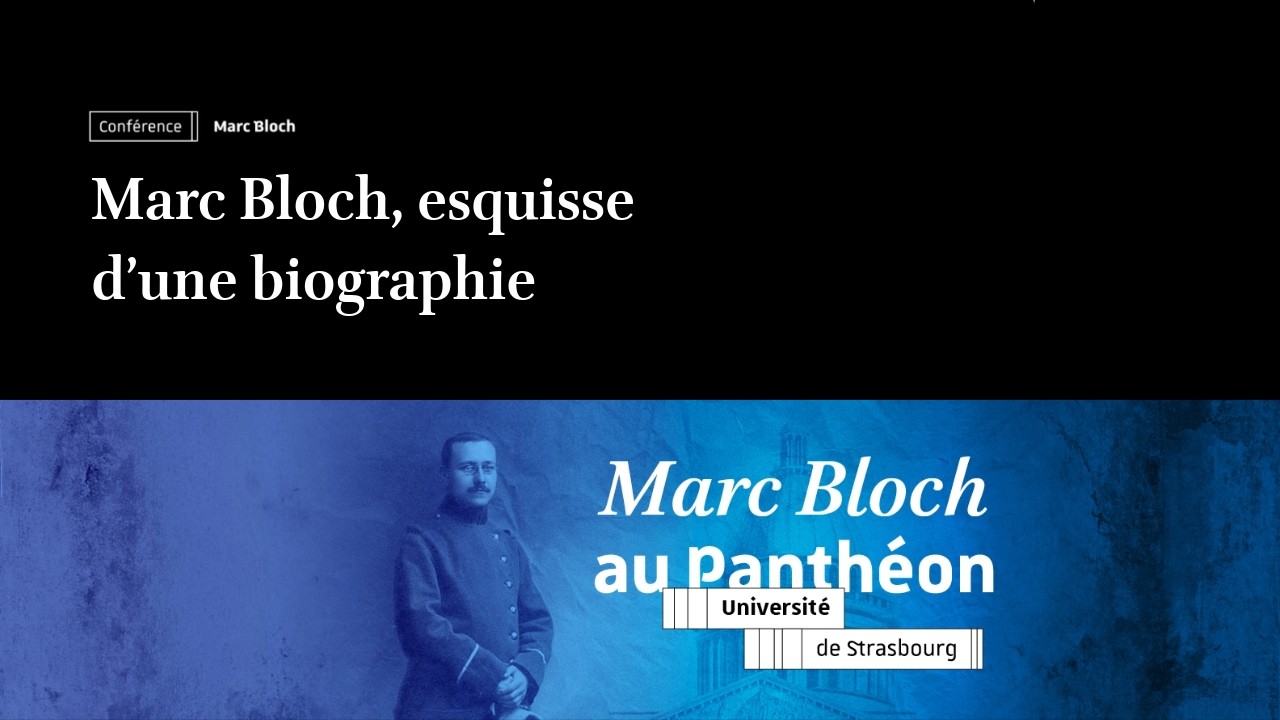
Marc Bloch, esquisse d’une biographie | Catherine Maurer, professeure d'Histoire contemporaine
Keywords
Summary
188 words
Critical Evaluation
The presentation offers a valuable biographical overview of Marc Bloch, focusing on his Alsatian connections and his time at the University of Strasbourg. Catherine Maurer, a professor of contemporary history, brings academic authority and uses archival documents, including administrative notices and library registers, to support her narrative. The talk is well-structured, moving chronologically from Bloch’s family origins to his wartime experiences and his role in the Resistance. However, the presentation is relatively brief (21 minutes) and does not delve deeply into Bloch’s historical methodology or his major works, such as ‘The Historian’s Craft’ or ‘Feudal Society’. The speaker acknowledges time constraints and skips over some details, which may leave viewers wanting more depth. The argumentation is solid, but the reliance on personal anecdotes and family sources, while valuable, could be complemented by more critical analysis of Bloch’s intellectual contributions. The sources cited are primarily archival and family documents, which are appropriate for a biographical sketch, but the lack of explicit references to secondary literature may limit the scientific rigor. The title accurately reflects the content, and the presentation is suitable for an academic audience, though it may also appeal to those interested in local history. Overall, the talk provides a solid introduction to Bloch’s life with a unique regional perspective, but it could benefit from more analytical depth and engagement with his historiographical legacy.
224 words
Title / Content Match
The title accurately reflects the content: a biographical sketch of Marc Bloch by a contemporary history professor.
Quality & Reliability
8/10
Presentation by a university professor, based on archival documents and family sources, with clear academic context. Some technical issues and lack of detailed citations, but overall reliable.
Key Moments
Markers derived by PSI from the transcript: the creator did not define chapters.
- Introduction: Catherine Maurer begins, mentioning the pantheonization of Marc Bloch and his ties to Strasbourg.
- Discussion of Bloch's family origins in Alsace and his father Gustave Bloch's role in the siege of Strasbourg in 1870.
- Marc Bloch's birth in 1886 and his childhood, with limited connection to Alsace.
- Bloch's education at the École Normale Supérieure and his year of study in Germany.
- Bloch's mobilization in World War I and his first arrival in Alsace in November 1918.
- Bloch's appointment at the University of Strasbourg in 1919, with the help of Christian Pfister.
- Bloch's role as director of the Institute of Medieval History and his use of German resources.
- Bloch's family life in Strasbourg and his professional activities until 1936.
- Bloch's return to Paris and his involvement in the Resistance during World War II.
- Conclusion: Bloch's legacy and his execution in 1944.
Cited Sources
- Archives d'Alsace — Administrative notices and documents related to Marc Bloch's career at the University of Strasbourg.
- Étienne Bloch (son of Marc Bloch) — Testimony and family sources about Marc Bloch's life.
Concurring Sources
- Marc Bloch (Wikipedia) — Provides general biographical information consistent with the presentation.
Contribution & Novelties
This presentation offers a unique perspective on Marc Bloch’s life, emphasizing his Alsatian roots and his time at the University of Strasbourg. It provides archival details and personal anecdotes that are not commonly highlighted in standard biographies. The focus on his local connections enriches the understanding of his identity and career.
Pour aller plus loin :
- Marc Bloch (Wikipedia) — For a comprehensive overview of his life and works.
- The Historian’s Craft (Wikipedia) — Bloch’s influential work on historical methodology.
- Annales School (Wikipedia) — The intellectual movement Bloch co-founded, relevant to his historiographical impact.
94 words
Radar Profile
The radar profile shows high scores in quality of information and reliability, reflecting the academic expertise and use of archival sources. The quantity of information is moderate due to the short duration, and the technical level is appropriate for a general academic audience.