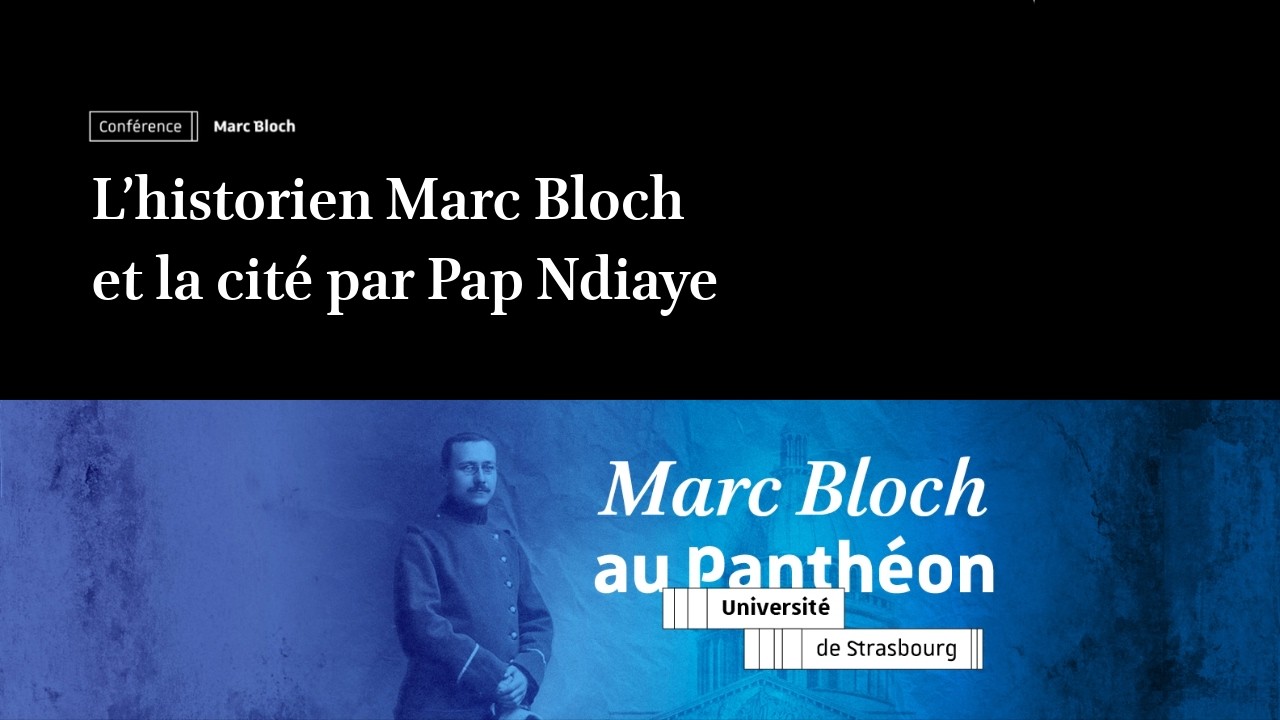
L’historien Marc Bloch et la cité par Pap Ndiaye
Keywords
Summary
132 words
Critical Evaluation
Pap Ndiaye’s presentation offers a thoughtful and well-informed perspective on Marc Bloch’s stance on colonialism, a topic often overlooked in Bloch scholarship. He demonstrates deep familiarity with Bloch’s writings and the political landscape of the era, citing specific texts and petitions. The argument is nuanced, acknowledging the ambiguity of Bloch’s position within the left’s gradualist approach to empire. Ndiaye’s analysis is solid, though it relies on interpretation rather than new archival evidence. He appropriately notes the gaps in Bloch’s work regarding colonial matters, which is a valuable observation. The talk is more of an expert opinion than a systematic study, but it is rigorous in its use of sources and contextualization. The title accurately reflects the content, and the discussion is engaging. However, the talk could have benefited from a deeper exploration of Bloch’s personal experiences, such as his time in Algeria, and a more explicit connection to contemporary debates. Overall, it is a high-quality contribution to understanding Bloch’s civic engagement.
161 words
Title / Content Match
The title accurately reflects the content, focusing on Marc Bloch's role as a historian in society, with a specific emphasis on his colonial stance.
Quality & Reliability
7/10
Pap Ndiaye, a renowned historian and ambassador, delivers a nuanced analysis of Marc Bloch's engagement with colonial issues. He cites specific texts and historical contexts, but the talk is an opinion piece rather than a systematic study, and some claims are based on personal interpretation.
Key Moments
Markers derived by PSI from the transcript: the creator did not define chapters.
- Introduction and thanks, context of the conference.
- Ndiaye states he is not a specialist but has long curiosity about Bloch.
- Discussion of Bloch's political engagement, including petitions and the Comité de vigilance.
- Focus on two texts defending the French colonial empire in 1939.
- Analysis of the left's positions on colonialism, including the Front Populaire's minimal attention.
- Mention of anticolonial intellectuals like Césaire and Senghor, and their isolation.
- Lexical search in 'L'Étrange Défaite' showing absence of colonial references.
- Bloch's military stay in Algeria and lack of intellectual impact.
- Concluding questions about Bloch's relation to non-European worlds and his identity.
Cited Sources
- L'Étrange Défaite — Referenced as Bloch's major work, analyzed for lexical absence of colonial terms.
- Sauvegarde de la plus grande France — A letter open to Daladier in 1939, cited as an example of Bloch's colonial stance.
- Appel des universitaires français pour la défense de notre empire colonial — Another 1939 text co-signed by Bloch, mentioned in the talk.
- La France en face du problème colonial — A pamphlet by Paul Langevin, Paul Rivet, and Alain, cited to illustrate the left's gradualist position.
Concurring Sources
- Marc Bloch: A Life in History — Biography by Carole Fink, likely discusses Bloch's political engagements.
Dissenting Sources
- The Strange Defeat
Contribution & Novelties
This talk provides a focused examination of Marc Bloch’s colonial stance, a relatively underexplored aspect of his thought. Ndiaye highlights the tension between Bloch’s antifascist engagement and his defense of the empire, situating him within the reformist left. The lexical analysis of ‘L’Étrange Défaite’ is a novel contribution, revealing the absence of colonial references. The talk also raises important questions about Bloch’s broader engagement with non-European worlds and his identity as a Jewish republican.
Pour aller plus loin :
- Marc Bloch — Overview of Bloch’s life and work.
- French colonial empire — Context for the colonial debates of the 1930s.
- L’Étrange Défaite — Details on Bloch’s posthumous work.
108 words
Radar Profile
The radar profile shows high scores in information quality and reliability, with moderate scores in quantity and technical level. This reflects a well-argued expert opinion with strong contextualization, but limited in-depth technical analysis.