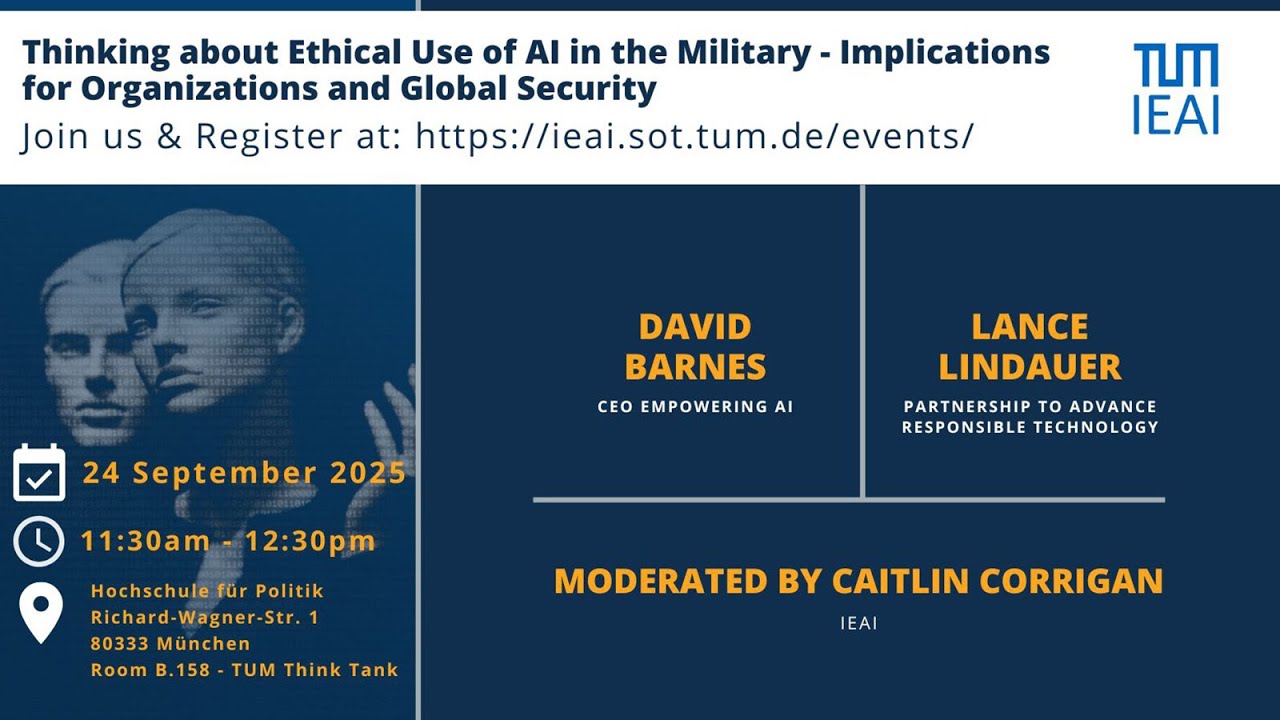
IEAI Panel Discussion - Thinking about Ethical Use of AI in the Military
Keywords
Summary
186 words
Critical Evaluation
Value of the Information & Strength of the Argument
The panel provides valuable insights from experts with direct experience in military AI ethics and policy. Barnes’s background as Chief AI Ethics Officer for the US Army lends authority to his arguments about human oversight and the risks of autonomous decision-making. Lindauer’s perspective on the shifting power dynamics between states and private tech companies is particularly insightful, highlighting a often-overlooked aspect of AI governance. The argumentation is coherent and balanced, acknowledging both benefits and risks. However, the discussion remains at a conceptual level, with limited concrete examples or data. The panelists occasionally diverge into personal opinions without deep evidence, but overall, the reasoning is sound and well-structured.
Scientific Rigor, Source Quality, Title Accuracy
The panel demonstrates scientific rigor through the speakers’ credentials and references to real-world initiatives (e.g., UN call for red lines, NATO, DARPA). However, no formal sources are cited during the discussion, and the arguments rely on anecdotal experience rather than empirical data. The title accurately reflects the content, and the discussion stays on topic. The lack of citations is typical for a panel format, but it limits the verifiability of claims. The presence of a brief sponsorship segment (if any) is not mentioned, but the description includes links to the institute’s website and events, which are relevant for further information.
222 words
Title / Content Match
The title accurately reflects the content: a panel discussion on ethical AI use in military contexts, covering implications for organizations and global security.
Quality & Reliability
8/10
The panel features two experts with substantial backgrounds in AI ethics, military applications, and policy (e.g., former Chief AI Ethics Officer for the US Army, RAND Corporation experience). The discussion is balanced, references concrete examples (UN call for red lines, NATO, regulatory frameworks), and avoids sensationalism. However, it is a panel discussion with opinions and no formal citations or data, so a score of 8 reflects high expertise but not peer-reviewed rigor.
Key Moments
Markers derived by PSI from the transcript: the creator did not define chapters.
- Introduction by Caitlin Corrigan, setting the context of AI in military and global security.
- Discussion on how AI has changed the security landscape, with Barnes emphasizing human oversight.
- Lindauer reframes 'AI arms race' as 'great power competition' and highlights role of private sector.
- Comparison of AI to nuclear weapons, noting AI's ubiquity and accessibility.
- Discussion on government-academia-industry collaboration, with Barnes stressing improved cooperation.
- Regulatory environment and lack of global binding agreements, with Lindauer noting imbalances.
- Audience question on whether new norms are needed, with panelists suggesting building on existing ones.
- Discussion on the role of international organizations like NATO and the need for interdisciplinary research.
Cited Sources
- IEAI - Institute for Ethics in Artificial Intelligence — Mentioned as the hosting institute and source of further information.
- IEAI Events — Referenced for upcoming events and related discussions.
- IEAI Newsletter — Mentioned as a way to receive updates on AI ethics topics.
Concurring Sources
- UN Secretary-General's Call for AI Red Lines — The panel references the UN's call for red lines on AI, aligning with the discussion.
Contribution & Novelties
The panel offers a nuanced perspective on AI in military contexts, moving beyond sensationalism to discuss practical governance challenges. It highlights the shift from state-centric to multi-stakeholder power dynamics, including the influence of private tech companies. The discussion on regulatory fragmentation and the need for international cooperation provides a realistic view of the current landscape.
Pour aller plus loin :
- Lethal Autonomous Weapons — Overview of the debate on autonomous weapons systems.
- AI Arms Race — Context on the competitive dynamics of AI development.
- Responsible AI in the Military — RAND Corporation’s research on AI and national security.
98 words
Radar Profile
The radar profile shows high scores in quality of information and reliability, reflecting the expertise of the speakers. The quantity of information is moderate, as the discussion is conceptual rather than data-heavy. The technical level is moderate, accessible to a general audience. Overall, the profile indicates a well-informed but not highly technical discussion.