Lecture 9 Regulation of Metabolism Ch 13 Pt 2
Keywords
Summary
171 words
Critical Evaluation
The lecture provides a solid conceptual overview of metabolic regulation, focusing on the key pathways of gluconeogenesis and glycogen metabolism. The instructor’s explanations are clear and accessible, making complex biochemical concepts understandable. He effectively uses analogies, such as the dessert example, to illustrate evolutionary pressures on sugar consumption and storage. The content is accurate and aligns with standard biochemistry textbooks, though it lacks direct citations to primary research. The lecture is well-structured, starting with the need for regulation, then discussing specific regulatory mechanisms, and finally introducing gluconeogenesis. However, the depth of coverage is limited; for instance, the regulation of glycogen phosphorylase and glycogen synthase is mentioned but not detailed. The instructor also briefly mentions isozymes but does not elaborate. The lecture would benefit from more specific examples of enzyme regulation and the molecular mechanisms involved. Additionally, the video is part of a series, so it assumes prior knowledge from previous lectures, which may limit its standalone value. The production quality is typical of a classroom lecture, with slides and narration. Overall, the lecture is informative and suitable for students seeking a conceptual understanding of metabolic regulation, but it may not satisfy those looking for in-depth mechanistic details.
197 words
Title / Content Match
The title accurately reflects the content, which covers regulation of metabolism, specifically gluconeogenesis and glycogen synthesis/breakdown.
Quality & Reliability
8/10
The lecture is based on a standard biochemistry textbook (Chapter 13) and presents established metabolic pathways. The content is accurate and well-structured, though it lacks citations to primary literature. The instructor's explanations are clear and align with current biochemical knowledge.
Key Moments
Markers derived by PSI from the transcript: the creator did not define chapters.
- Introduction and overview of the lecture topics
- Explanation of why metabolism needs regulation and the importance of homeostasis
- Discussion of energy storage and the role of glycogen
- Introduction to the concept of metabolic regulation and feedback inhibition
- Explanation of the multiple roles of pyruvate in metabolism
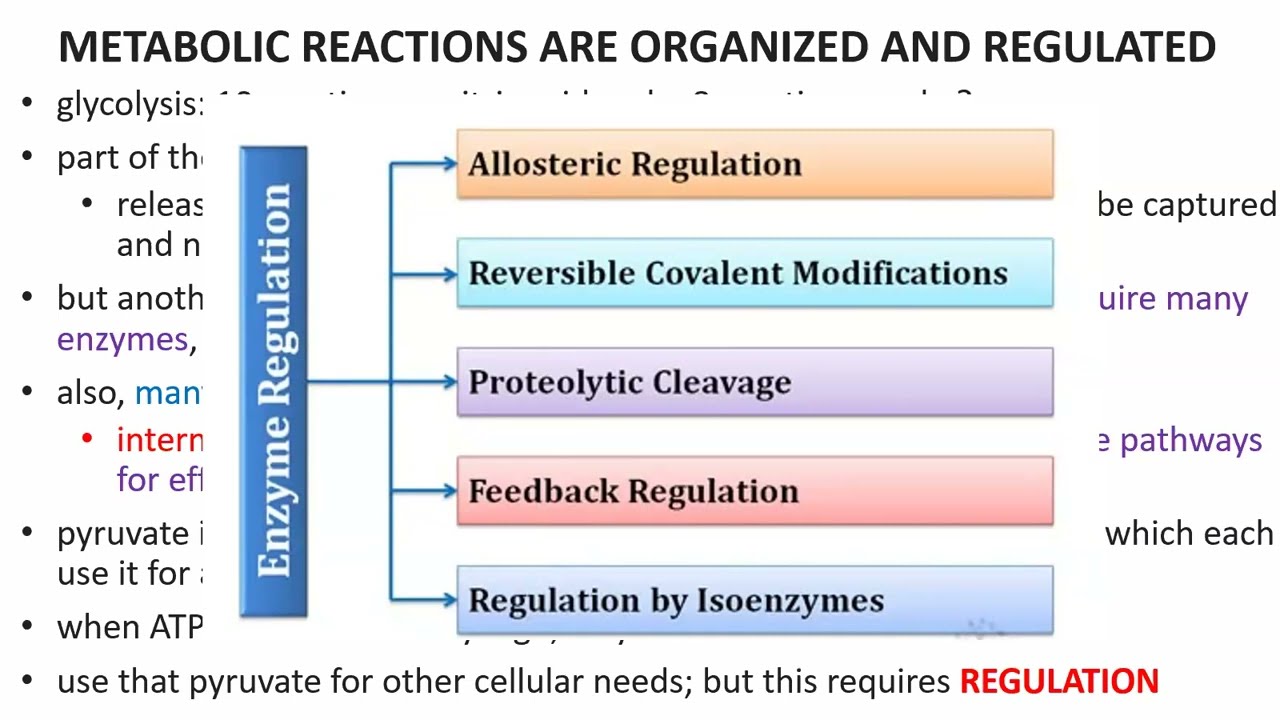
- Overview of regulatory mechanisms: allosteric regulation, phosphorylation, and isozymes
- Introduction to gluconeogenesis and its importance for brain function
- Discussion of glycogen synthesis and breakdown regulation
- Summary and conclusion of the lecture
Contribution & Novelties
This lecture provides a clear conceptual framework for understanding metabolic regulation, particularly the balance between glycolysis, gluconeogenesis, and glycogen metabolism. It emphasizes the evolutionary context of energy storage and the importance of feedback regulation. The lecture is part of a series, so it builds on previous material, but it offers a concise overview of key regulatory mechanisms.
Pour aller plus loin :
- Glycogen — Overview of glycogen structure and function.
- Gluconeogenesis — Detailed pathway and regulation.
- Allosteric regulation — Mechanism of enzyme regulation.
83 words
Radar Profile
The radar profile shows high scores in quantity and quality of information, with a moderate technical level. The lecture is reliable and provides a good conceptual foundation, though it lacks depth in mechanistic details.