Cyclins, Cdks, the Cell Cycle and the p53/p21 Checkpoint
Keywords
Summary
124 words
Critical Evaluation
The video provides a solid overview of cell cycle regulation, focusing on the roles of cyclins and CDKs. The explanation of phosphorylation as a toggle for protein activity is accurate and well-illustrated. The progression from general kinase function to specific cell cycle kinases is logical and builds understanding. The key concept that CDKs are constitutively present but require cyclin binding for activity is correctly emphasized. The discussion of the p53/p21 checkpoint is accurate, explaining how DNA damage leads to p53 stabilization, which then transactivates p21, a CDK inhibitor, to arrest the cell cycle. However, the video lacks depth in certain areas: it does not detail the various cyclin-CDK complexes (e.g., Cyclin D-CDK4/6, Cyclin E-CDK2) or the degradation of cyclins via ubiquitin-proteasome pathway. It also simplifies the checkpoint to only induced mutations, omitting other aspects like cell size and growth signals. The presentation is clear, but the lack of citations to primary literature reduces its scientific rigor. The video is a tutorial, not a research presentation, so it is appropriate for educational purposes. The title accurately reflects the content. Overall, the video is informative and reliable for introductory understanding, but it could be enhanced by incorporating more molecular details and referencing sources.
201 words
Title / Content Match
The title accurately reflects the content, covering cyclins, CDKs, cell cycle phases, and the p53/p21 checkpoint.
Quality & Reliability
8/10
The video provides a clear and accurate explanation of cell cycle regulation, cyclin-CDK complexes, and the p53/p21 checkpoint. The content aligns with established molecular biology knowledge. However, it lacks citations to primary literature and is based on a lecture format, which limits its depth for advanced audiences.
Key Moments
Markers derived by PSI from the transcript: the creator did not define chapters.
- Introduction and overview of the video's content.
- Explanation of phosphorylation and its role in protein regulation.
- Introduction to the cell cycle phases and their functions.
- Discussion of the need for stage-specific kinases.
- Discovery that CDKs are constitutively expressed but only active when bound to cyclins.
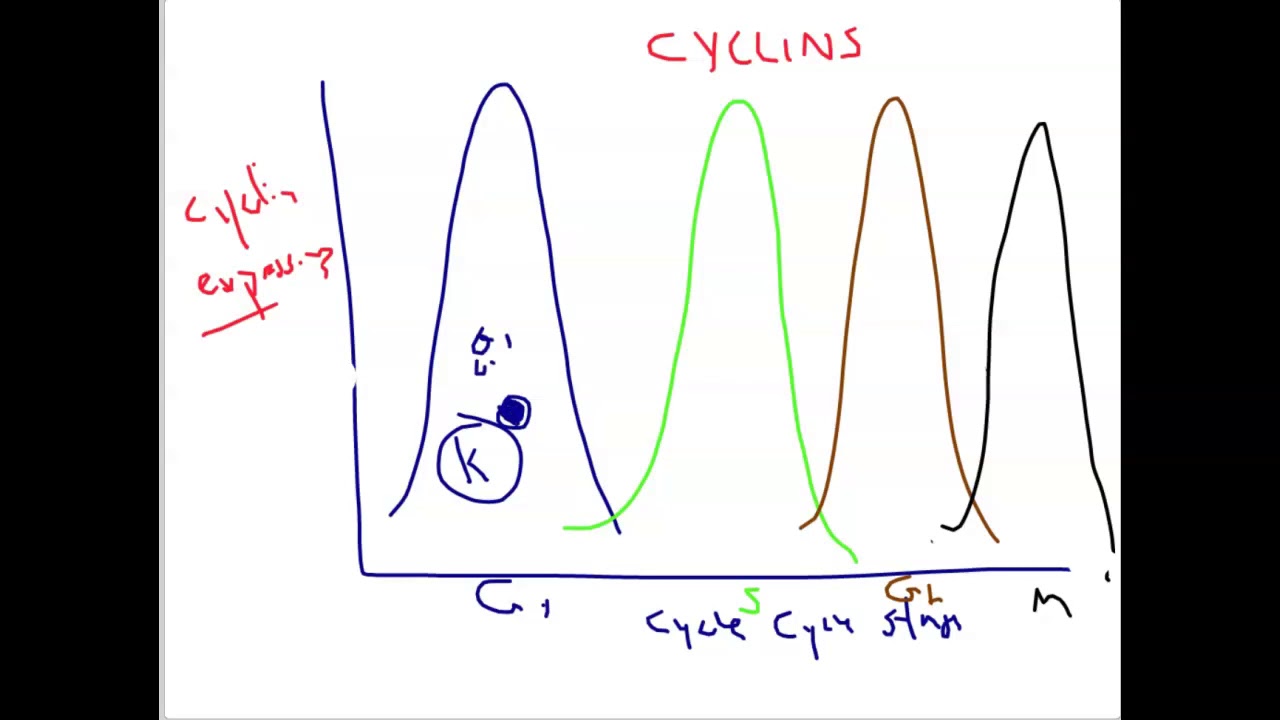
- Explanation of cyclin expression patterns and their role in activating CDKs.
- Focus on the G1 checkpoint and the role of p53 in DNA damage response.
- Description of p53 as a transcription factor and its activation of p21.
- Summary of the p53/p21 checkpoint mechanism.
- Conclusion and final remarks.
Contribution & Novelties
The video provides a clear and accessible explanation of the cyclin-CDK system and the p53/p21 checkpoint, making it a useful educational resource. It emphasizes the conceptual framework of how CDKs are regulated by cyclins, which is fundamental to understanding cell cycle control. The video does not present new research but synthesizes existing knowledge in a pedagogical manner.
Pour aller plus loin :
- Cell cycle regulation on Wikipedia — Provides a comprehensive overview of the cell cycle and its regulation.
- Cyclin-dependent kinase on Wikipedia — Detailed information on CDKs and their roles.
- p53 on Wikipedia — Overview of p53’s function in DNA damage response.
103 words
Radar Profile
The radar profile shows high scores in quantity and quality of information, moderate technical level, and high reliability. This indicates a well-structured educational video with accurate content, though it may not delve into advanced molecular details.
💬 Sur les 0 commentaires analysés, aucune tendance n'est disponible.