Lecture 5C - Enzyme Inhibition
Keywords
Summary
198 words
Critical Evaluation
The lecture provides a solid introduction to enzyme inhibition, a fundamental topic in biochemistry. The instructor’s explanations are clear and logically structured, building on previous lectures on Michaelis-Menten kinetics. He effectively uses analogies (e.g., the coin flip for competitive inhibition) and graphical representations to illustrate the concepts, which aids comprehension. The content is accurate and aligns with standard biochemistry textbooks. However, the lecture lacks depth in certain areas; for instance, it does not discuss the mathematical derivations of the kinetic equations or the experimental methods used to distinguish between inhibitor types. Additionally, the instructor does not cite specific scientific sources, relying instead on general knowledge, which is typical for an educational lecture but limits its value for advanced learners seeking original references. The discussion of non-competitive inhibition is brief and could benefit from more detail on the molecular mechanisms. The lecture’s strength lies in its pedagogical approach, making complex concepts accessible. The absence of any mention of the public’s level is noted, but the content is suitable for undergraduate students. Overall, the lecture is a valuable resource for learning the basics of enzyme inhibition, though it could be enhanced by incorporating more quantitative details and references.
196 words
Title / Content Match
The title accurately reflects the content, which focuses on enzyme inhibition mechanisms and their effects on enzyme kinetics.
Quality & Reliability
8/10
The lecture is a clear, well-structured educational presentation on enzyme inhibition, grounded in established biochemical principles. The instructor explains concepts accurately and uses appropriate analogies and graphical representations. However, it lacks citations to specific scientific literature, and the content is based on textbook knowledge rather than original research.
Key Moments
Markers derived by PSI from the transcript: the creator did not define chapters.
- Introduction to enzyme inhibition and its importance in biology.
- Explanation of reversible vs. irreversible inhibitors.
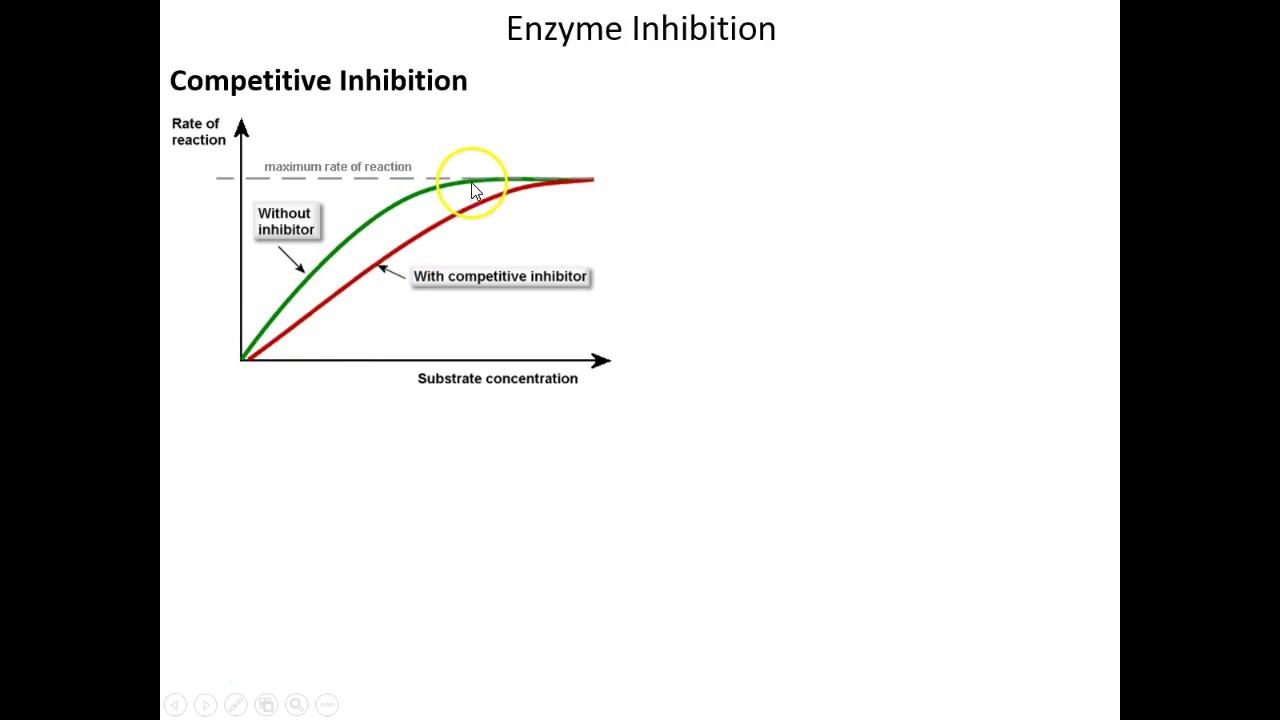
- Introduction to competitive inhibitors and their mechanism.
- Discussion on how substrate concentration can overcome competitive inhibition.
- Graphical representation of competitive inhibition on Michaelis-Menten and Lineweaver-Burk plots.
- Introduction to uncompetitive inhibitors and their binding to ES complex.
- Effects of uncompetitive inhibitors on Vmax and Km.
- Introduction to non-competitive inhibitors and their mechanism.
- Summary of the effects of different inhibitors on kinetic parameters.
Contribution & Novelties
This lecture provides a clear and systematic overview of enzyme inhibition, which is a core concept in biochemistry. It offers a pedagogical approach that helps students understand the differences between competitive, uncompetitive, and non-competitive inhibitors, and their effects on Michaelis-Menten kinetics. The lecture emphasizes the practical importance of enzyme inhibitors in drug development, linking basic science to real-world applications.
Pour aller plus loin :
- Enzyme inhibitor - Wikipedia — Provides a comprehensive overview of enzyme inhibition, including types and mechanisms.
- Michaelis-Menten kinetics - Wikipedia — Explains the kinetic model underlying the discussion.
- Lineweaver-Burk plot - Wikipedia — Details the graphical method used to analyze enzyme kinetics.
106 words
Radar Profile
The radar profile shows high scores in quantity of information, quality of information, and reliability, with a slightly lower score in technical level, indicating a well-structured and accurate lecture that is accessible to a broad audience.