Lecture 4B - Transition State and Kinetics
Keywords
Summary
168 words
Critical Evaluation
The lecture provides a solid conceptual foundation for understanding enzyme kinetics, particularly the transition state and activation energy. The instructor uses clear analogies, such as the bread machine, to illustrate abstract concepts, making the material accessible. The explanation of reaction order is accurate and well-structured, with practical examples. However, the lecture lacks depth in several areas: it does not discuss the mathematical derivation of the rate equation, nor does it explore the factors affecting enzyme kinetics such as pH, temperature, or enzyme concentration. The content is primarily qualitative, which may be insufficient for advanced students. The instructor explicitly states that he will not test on the rate equation, which might limit the rigor of the course. The sources are not cited, and the lecture relies on general biochemical knowledge. The adéquation between title and content is good, as the lecture focuses on transition state and kinetics. Overall, the lecture is a useful introductory resource, but it would benefit from more quantitative details and references to primary literature.
167 words
Title / Content Match
The title accurately reflects the content, focusing on transition state and kinetics.
Quality & Reliability
7/10
The lecture is a clear and accurate introduction to enzyme kinetics, covering transition state, activation energy, and reaction orders. The content aligns with established biochemical principles, though it lacks citations and depth for advanced learners.
Key Moments
Markers derived by PSI from the transcript: the creator did not define chapters.
- Introduction to the lecture and recap of enzyme function
- Explanation of transition state and activation energy
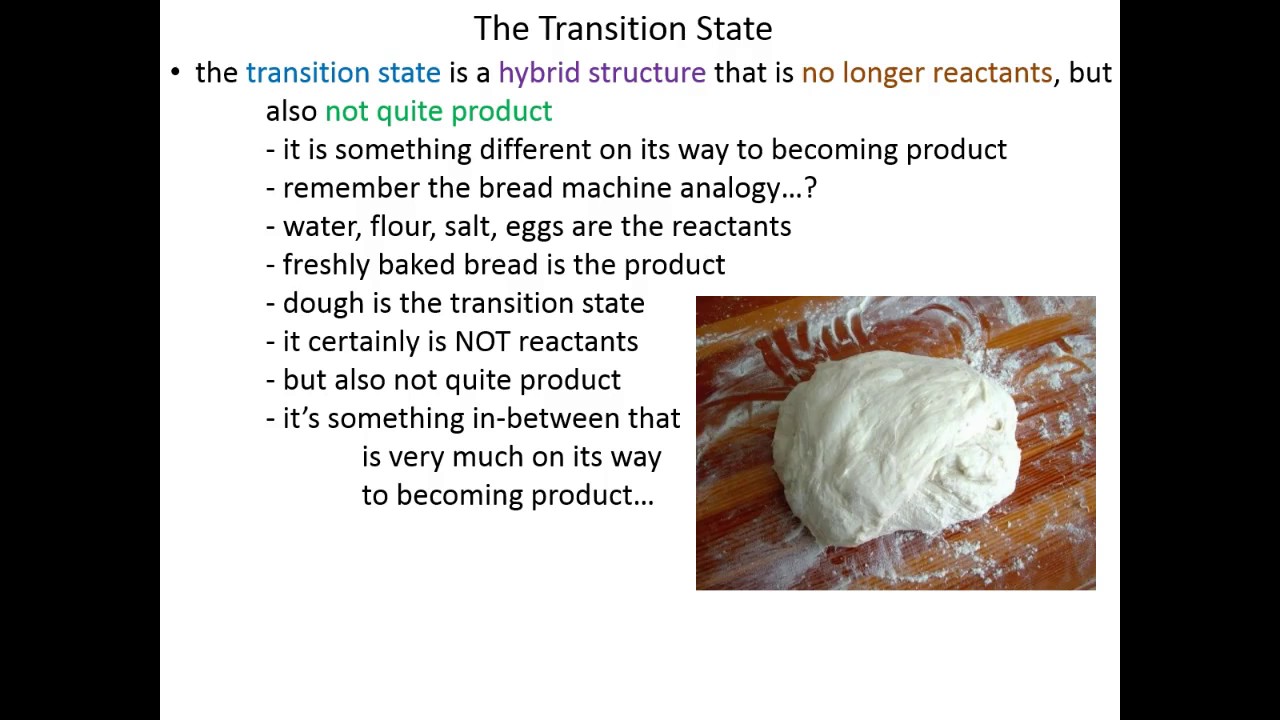
- Analogy of bread making to illustrate transition state
- Definition of enzyme kinetics and reaction rates
- Introduction to reaction order and first-order reactions
- Explanation of second-order reactions with examples
- Discussion of zero-order reactions and their significance
- Summary and conclusion of the lecture
Contribution & Novelties
The lecture provides a clear and engaging introduction to enzyme kinetics, emphasizing the physical nature of the transition state and the concept of activation energy. It offers a unique perspective by using the bread-making analogy to explain the transition state, which may help students visualize the process. The lecture also clarifies the distinction between reaction order with respect to individual reactants and overall reaction order, which is often confusing for students.
Pour aller plus loin :
- Enzyme kinetics - Wikipedia — Provides a comprehensive overview of enzyme kinetics, including Michaelis-Menten equation and factors affecting reaction rates.
- Transition state theory - Wikipedia — Explains the theoretical basis of transition states and activation energy.
- Reaction order - Wikipedia — Detailed explanation of reaction orders and rate laws.
125 words
Radar Profile
The radar profile shows a balanced score across all dimensions, with slightly higher scores in quality of information and fiabilité, indicating a reliable and well-structured lecture. The lower score in technical level suggests that the content is accessible to beginners but may lack depth for advanced learners.