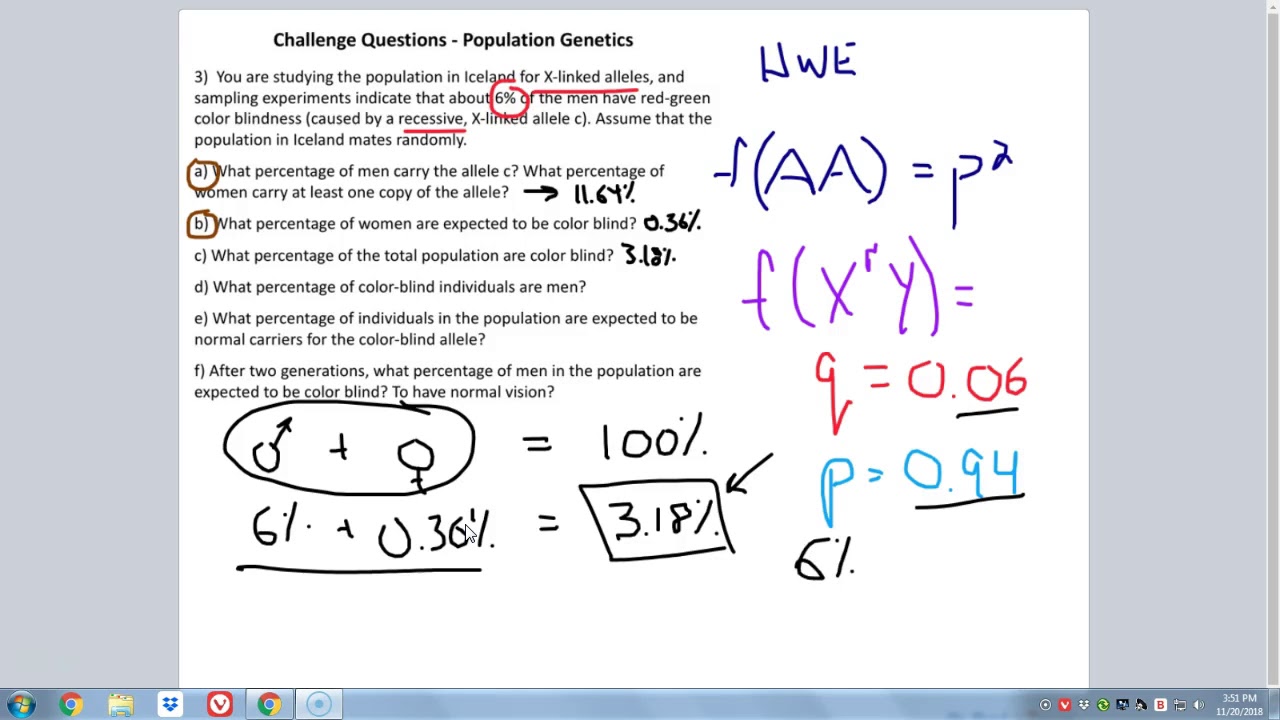
CQs 3 & 4 - Population Genetics
Keywords
Summary
237 words
Critical Evaluation
The video provides a thorough and pedagogically effective explanation of population genetics concepts, specifically Hardy-Weinberg equilibrium applied to sex-linked traits and the consequences of population bottlenecks. The instructor’s step-by-step calculations are clear and accurate, making complex mathematical concepts accessible. The reasoning is logically sound and aligns with established genetic principles. However, the video lacks explicit citations to scientific literature, relying instead on textbook examples and hypothetical scenarios. The Florida panther case is based on real events, but the instructor does not provide specific sources or data, which would enhance the scientific rigor. The presentation is well-structured, with a clear progression from problem statement to solution, and the instructor anticipates common pitfalls, such as the need to adjust percentages when considering the total population. The adéquation between title and content is good, as the video directly addresses the challenge questions. The main weakness is the absence of references, which limits its utility for viewers seeking verifiable sources. Additionally, the video does not discuss potential criticisms or alternative interpretations of the Hardy-Weinberg model, such as the assumptions of random mating and no selection, which are briefly mentioned but not critically examined. Overall, the video is a valuable educational resource for students, but it would benefit from incorporating citations and a more critical discussion of the model’s limitations.
215 words
Title / Content Match
The title accurately reflects the content, which covers challenge questions 3 and 4 on population genetics.
Quality & Reliability
7/10
The video provides a clear, step-by-step explanation of population genetics concepts applied to sex-linked traits and bottleneck effects. The reasoning is logically sound and aligns with standard Hardy-Weinberg principles. However, it lacks citations to primary literature and is based on a simplified textbook scenario.
Key Moments
Markers derived by PSI from the transcript: the creator did not define chapters.
- Introduction to challenge questions 3 and 4 on population genetics.
- Explanation of sex-linked traits and Hardy-Weinberg equilibrium.
- Calculation of allele frequencies from male colorblindness rate.
- Calculation of carrier and affected female frequencies.
- Calculation of total population colorblindness and proportion of males.
- Discussion of carrier frequency in total population.
- Explanation of Hardy-Weinberg stability across generations.
- Introduction to Florida panther bottleneck problem.
- Explanation of bottleneck effect and inbreeding depression.
- Discussion of potential solutions, including genetic rescue.
Contribution & Novelties
The video provides a clear pedagogical approach to applying Hardy-Weinberg equilibrium to sex-linked traits, which is often a challenging topic for students. It also illustrates the concepts of bottleneck effect and inbreeding depression using a real-world example. The step-by-step calculations help demystify the mathematics involved.
Pour aller plus loin :
- Hardy–Weinberg principle — Foundational concept for allele frequency calculations.
- Sex linkage — Explains inheritance patterns of X-linked traits.
- Population bottleneck — Relevant to the Florida panther example.
- Inbreeding depression — Explains the detrimental effects of inbreeding.
86 words
Radar Profile
The radar profile shows high scores in quality of information and technical level, indicating a solid educational resource. The quantity of information is moderate, and reliability is good but not exceptional due to lack of citations.