Lecture 24 Tissues and Cell Junctions Chap 20 Pt 1
Keywords
Summary
158 words
Critical Evaluation
The lecture provides a solid overview of the extracellular matrix and its role in tissue formation. The instructor’s explanation is clear and well-structured, using analogies to make complex concepts accessible. The content is accurate and aligns with standard cell biology textbooks. However, the lecture lacks direct citations to primary research, relying instead on textbook knowledge. The argumentation is logical, progressing from the need for ECM in animals to its composition and function. The instructor effectively contrasts plant and animal strategies for structural support, highlighting the importance of flexibility in animals. The discussion of collagen as the main structural protein is accurate, and the analogy to intermediate filaments is helpful. The lecture also touches on the diversity of ECM across tissue types, which is a key concept. One minor weakness is that the lecture does not delve into the molecular details of ECM components, such as the specific structure of collagen or the role of integrins, which might be expected at a higher level. Additionally, the lecture does not address potential controversies or recent advances in ECM research. Overall, the lecture is a valuable educational resource for introductory cell biology, but it is not a comprehensive or critical review of the topic. The title accurately reflects the content, and the lecture is well-suited for its intended audience.
216 words
Title / Content Match
The title accurately reflects the content: the lecture covers tissues and cell junctions, specifically the first part of Chapter 20.
Quality & Reliability
8/10
The lecture is based on a standard cell biology textbook (Chapter 20, pages 717-735), presented by an instructor with clear expertise. The content is accurate and well-structured, though it lacks direct citations to primary literature. The video is an educational resource, not a peer-reviewed source, but it is reliable for introductory cell biology.
Key Moments
Markers derived by PSI from the transcript: the creator did not define chapters.
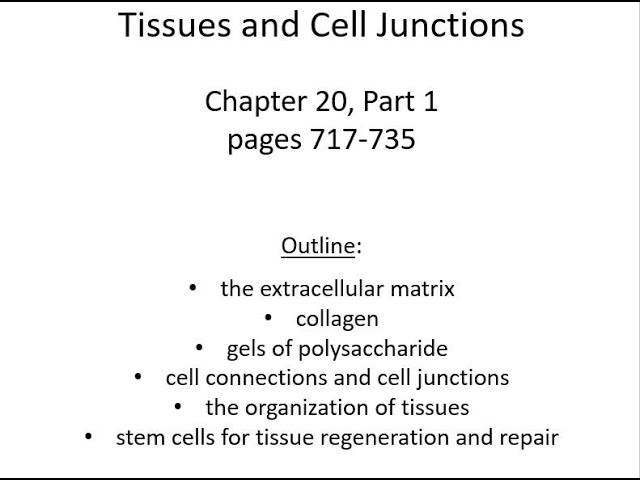
- Introduction to the lecture and overview of topics: ECM, cell junctions, tissues, stem cells.
- Explanation of hierarchical organization of multicellular organisms from cells to organ systems.
- Introduction to the four types of tissues and the role of ECM in tissue support.
- Comparison of plant cell walls and animal ECM, emphasizing the need for flexibility in animals.
- Discussion of ECM composition: collagen, elastin, and GAGs, and their roles in different tissues.
- Explanation of how ECM varies among tissue types, with connective tissue having the most ECM.
- Analogy of 'raisins in pudding' to illustrate the cell-ECM ratio in connective tissue.
- Introduction to cell junctions as direct cell-to-cell connections, to be covered in the next part.
Cited Sources
- Molecular Biology of the Cell (textbook) — The lecture is based on Chapter 20 of the textbook, pages 717-735.
Concurring Sources
- Molecular Biology of the Cell (textbook) — The lecture follows the content of the textbook, which is a standard reference in cell biology.
Contribution & Novelties
This lecture provides a clear and accessible introduction to the extracellular matrix and its role in tissue formation, using analogies and examples to illustrate key concepts. It emphasizes the importance of ECM in animal tissues and contrasts it with plant cell walls. The lecture also highlights the diversity of ECM composition across tissue types.
Pour aller plus loin :
- Extracellular matrix - Wikipedia — Overview of ECM components and functions.
- Collagen - Wikipedia — Detailed information on collagen structure and types.
- Cell junction - Wikipedia — Overview of cell junctions, including tight junctions, gap junctions, and desmosomes.
97 words
Radar Profile
The radar profile shows high scores in quantity and quality of information, with a moderate level of technical depth. The reliability is also high, reflecting the educational nature of the content. The lecture is well-balanced, with strengths in providing comprehensive information and clear explanations.