Lecture 9 - Analyzing Genes and Genomes
Keywords
Summary
146 words
Critical Evaluation
The lecture provides a solid overview of core molecular biology techniques for gene and genome analysis. The explanation of Sanger sequencing is particularly clear, with a step-by-step description of the dideoxy method, including the role of dideoxynucleotides in terminating DNA synthesis. The instructor correctly notes that this method was used for the Human Genome Project and that it has been largely superseded by next-generation sequencing. However, the treatment of next-generation sequencing is brief and lacks technical depth, such as the specific mechanisms of Illumina sequencing or nanopore sequencing. The discussion of comparative genomics is somewhat superficial, focusing on the idea of comparing sequences to known genes without delving into specific tools or algorithms. The sections on reporter genes and microarrays are informative but could benefit from more concrete examples of their applications. The lecture does not cite specific sources, but the content is consistent with standard textbooks, such as ‘Molecular Biology of the Gene.’ The instructor’s credibility is supported by his role as an educator, though the lack of citations limits the ability to verify claims independently. The title accurately reflects the content, and the lecture is well-structured, progressing logically from sequencing to functional analysis. Overall, the lecture is valuable for students seeking a foundational understanding, but it does not offer novel insights or critical evaluation of the techniques.
219 words
Title / Content Match
The title accurately reflects the content, which covers methods for analyzing genes and genomes, including sequencing, gene expression analysis, and protein studies.
Quality & Reliability
8/10
The lecture is based on established molecular biology techniques (Sanger sequencing, next-gen sequencing, reporter genes, microarrays, protein overexpression) and is consistent with standard textbook content. The instructor explains concepts clearly and provides mechanistic details, but the content is not peer-reviewed and may contain simplifications typical of an undergraduate course.
Key Moments
Markers derived by PSI from the transcript: the creator did not define chapters.
- Introduction to the lecture and overview of topics: DNA sequencing, comparative genomics, reporter genes, microarrays, protein overexpression.
- Discussion of the challenge of studying genes with unknown functions, noting that many human genes are uncharacterized.
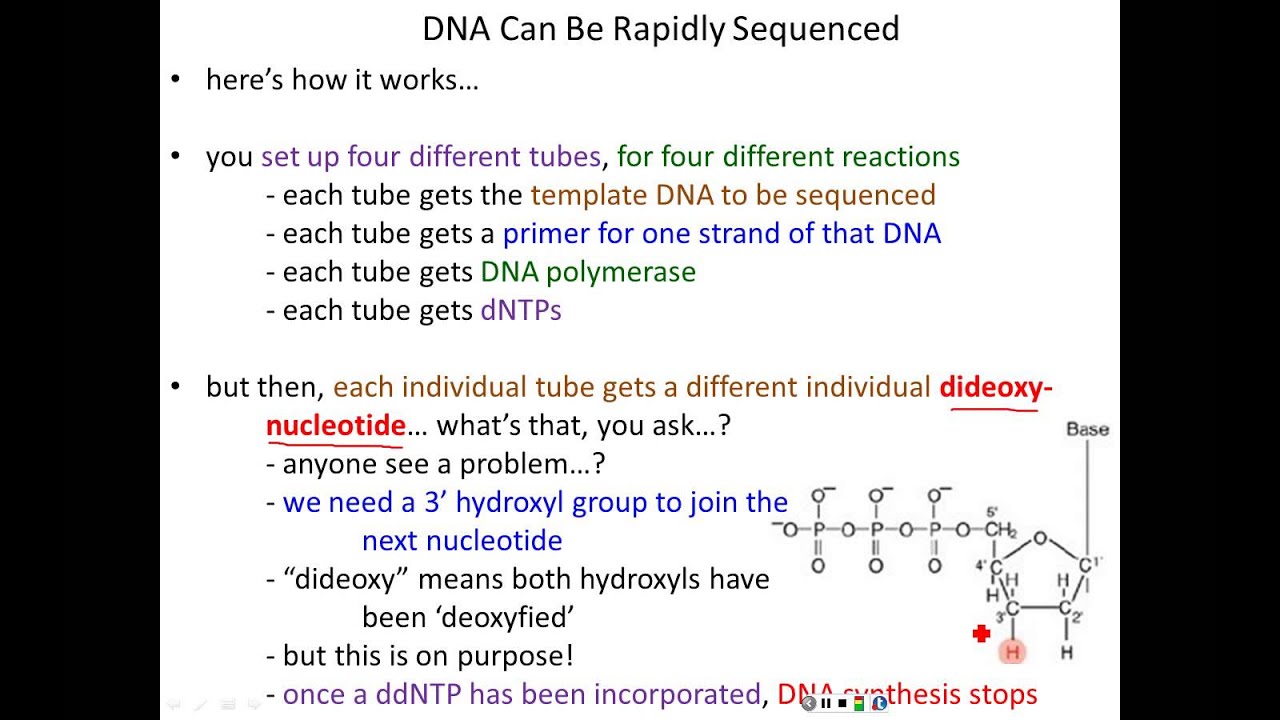
- Explanation of Sanger sequencing principles, including the use of dideoxynucleotides to terminate DNA synthesis.
- Detailed walkthrough of the four-tube setup for Sanger sequencing and how fragments are separated by gel electrophoresis.
- Introduction to next-generation sequencing (second and third generation) and its advantages over Sanger sequencing.
- Discussion of comparative genomics as a method to infer gene function by comparing sequences to known genes.
- Explanation of reporter genes and how they are used to study gene expression.
- Introduction to microarrays for genome-wide expression profiling.
- Brief overview of protein overexpression and its applications in biochemical studies.
- Conclusion and transition to the next topic on transgenic animals.
Contribution & Novelties
The lecture provides a comprehensive introduction to techniques for analyzing genes and genomes, with a focus on the logic behind each method. It emphasizes the challenge of studying genes with unknown functions and presents a range of approaches, from sequencing to functional analysis. The explanation of Sanger sequencing is particularly pedagogical, making it accessible to students. The lecture also touches on modern next-generation sequencing, though in less detail.
Pour aller plus loin :
- Sanger sequencing — Provides a detailed overview of the method, including its history and applications.
- Next-generation sequencing — Discusses various NGS technologies, such as Illumina and Ion Torrent.
- Microarray — Explains the principles and applications of DNA microarrays in gene expression analysis.
- Reporter gene — Describes how reporter genes are used to study gene expression.
- Protein overexpression — Provides information on the production of large quantities of proteins for research.
143 words
Radar Profile
The radar profile shows high scores in quantity and quality of information, reflecting the lecture's comprehensive coverage and accurate explanations. The technical level is moderately high, suitable for an undergraduate audience. Overall, the lecture is reliable and informative, with a balanced profile.