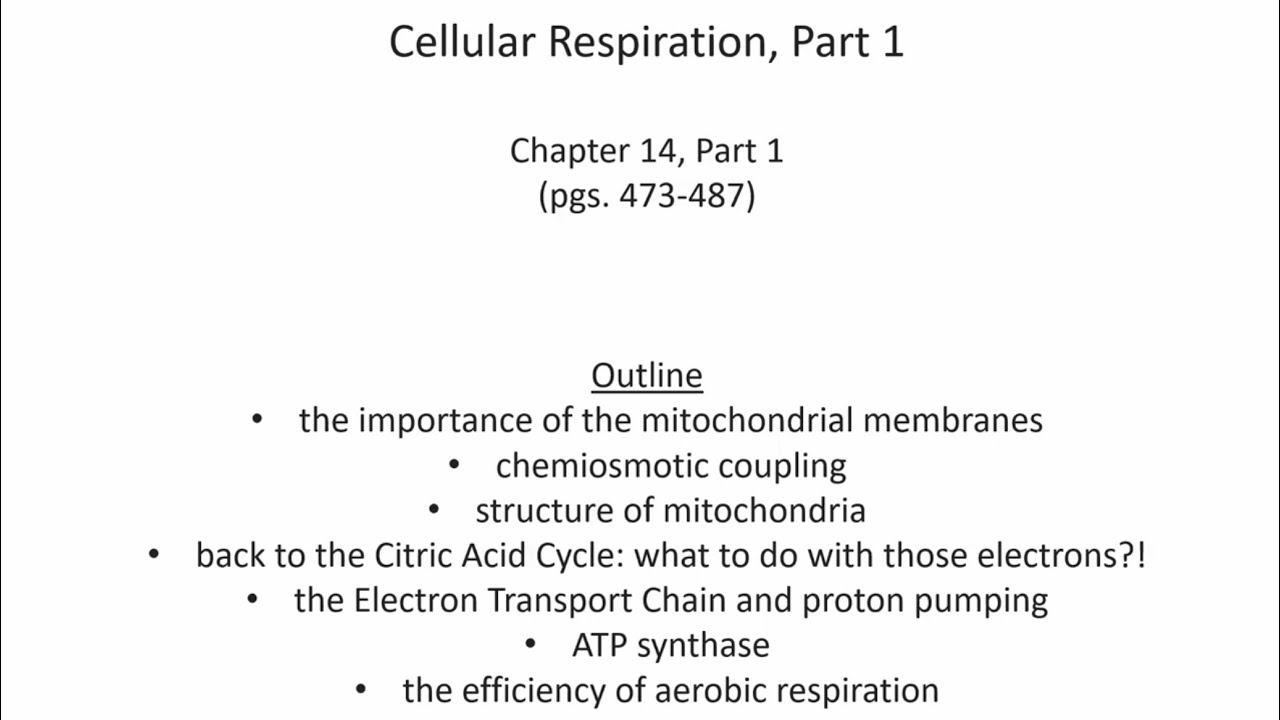
Lecture 10 Cellular Respiration Ch 14 Pt 1
Keywords
Summary
144 words
Critical Evaluation
The lecture provides a thorough and engaging explanation of the electron transport chain and oxidative phosphorylation, which are complex topics in cellular respiration. The instructor uses analogies, such as a battery and a hydroelectric dam, to illustrate the concept of proton motive force, making the material accessible. The scientific content is accurate and aligns with standard biochemistry textbooks. The argumentation is logical, building from the structure of mitochondria to the mechanism of ATP synthesis. However, the lecture lacks citations to specific scientific literature, relying instead on general knowledge. The instructor’s enthusiasm is evident, which aids in maintaining viewer interest. The title accurately reflects the content, and the lecture is well-structured. The main limitation is the absence of visual aids or animations, which could enhance understanding of the dynamic processes. Overall, this is a high-quality educational resource for students of cell biology.
141 words
Title / Content Match
The title accurately reflects the content, which covers cellular respiration, specifically the electron transport chain and oxidative phosphorylation.
Quality & Reliability
8/10
The lecture is based on established biochemistry and cell biology concepts, presented by an educator. The content aligns with textbook knowledge, but no external sources are cited, and it is a single instructor's perspective.
Key Moments
Markers derived by PSI from the transcript: the creator did not define chapters.
- Introduction to the lecture and overview of topics to be covered.
- Discussion of mitochondrial anatomy and the importance of the inner membrane.
- Explanation of chemiosmotic coupling and the proton gradient.
- Detailed walkthrough of the electron transport chain and proton pumping.
- Introduction to ATP synthase and how it uses the proton gradient to make ATP.
- Discussion of the efficiency of oxidative phosphorylation and comparison to glycolysis.
- Evolutionary perspective: mitochondria as endosymbiotic prokaryotes.
- Summary of aerobic respiration and the overall ATP yield.
Contribution & Novelties
The lecture provides a clear and engaging explanation of oxidative phosphorylation, emphasizing the role of chemiosmotic coupling and the evolutionary significance of mitochondria. It effectively uses analogies to explain complex concepts.
Pour aller plus loin :
- Chemiosmosis — Overview of the process and its discovery.
- Oxidative phosphorylation — Detailed description of the electron transport chain and ATP synthesis.
- Endosymbiotic theory — Explains the origin of mitochondria from prokaryotes.
68 words
Radar Profile
The radar profile shows high scores in information quantity, quality, and reliability, with a slightly lower technical level, indicating a lecture that is comprehensive and accurate but not overly technical, suitable for an introductory cell biology course.