Week 7 Review Video: Twin Concordance, Pedigrees and Linked Genes
Keywords
Summary
172 words
Critical Evaluation
The video serves as an effective educational review, particularly for students who have already been introduced to these concepts. The instructor’s explanations are clear and methodical, breaking down complex ideas into manageable steps. The use of examples, such as the handedness concordance example, helps solidify understanding. The emphasis on the concordance differential as the key metric is scientifically sound, as it is a standard method in quantitative genetics to estimate heritability. However, the video lacks citations to primary research or textbooks, which would enhance its credibility for a more advanced audience. The pedigree analysis section is particularly well-structured, with a systematic approach to determining inheritance patterns. The instructor’s heuristic of using ‘clades’ to identify recessive traits is a useful pedagogical tool, though it may oversimplify real-world pedigrees where penetrance and expressivity can complicate patterns. The gene linkage section is brief and may leave some students wanting more depth, but it provides a foundation for further study. Overall, the video is a valuable resource for students, but it would benefit from references to scientific literature and a more nuanced discussion of exceptions to the rules presented.
185 words
Title / Content Match
The title accurately reflects the content, which covers twin concordance, pedigree analysis, and gene linkage.
Quality & Reliability
7/10
The video is an educational tutorial by a biology instructor, providing clear explanations of genetic concepts. The content is accurate and aligns with standard genetics principles, but it lacks citations to primary literature and is based on the instructor's expertise.
Key Moments
Markers derived by PSI from the transcript: the creator did not define chapters.
- Introduction and overview of topics: twin concordance, pedigrees, and gene linkage.
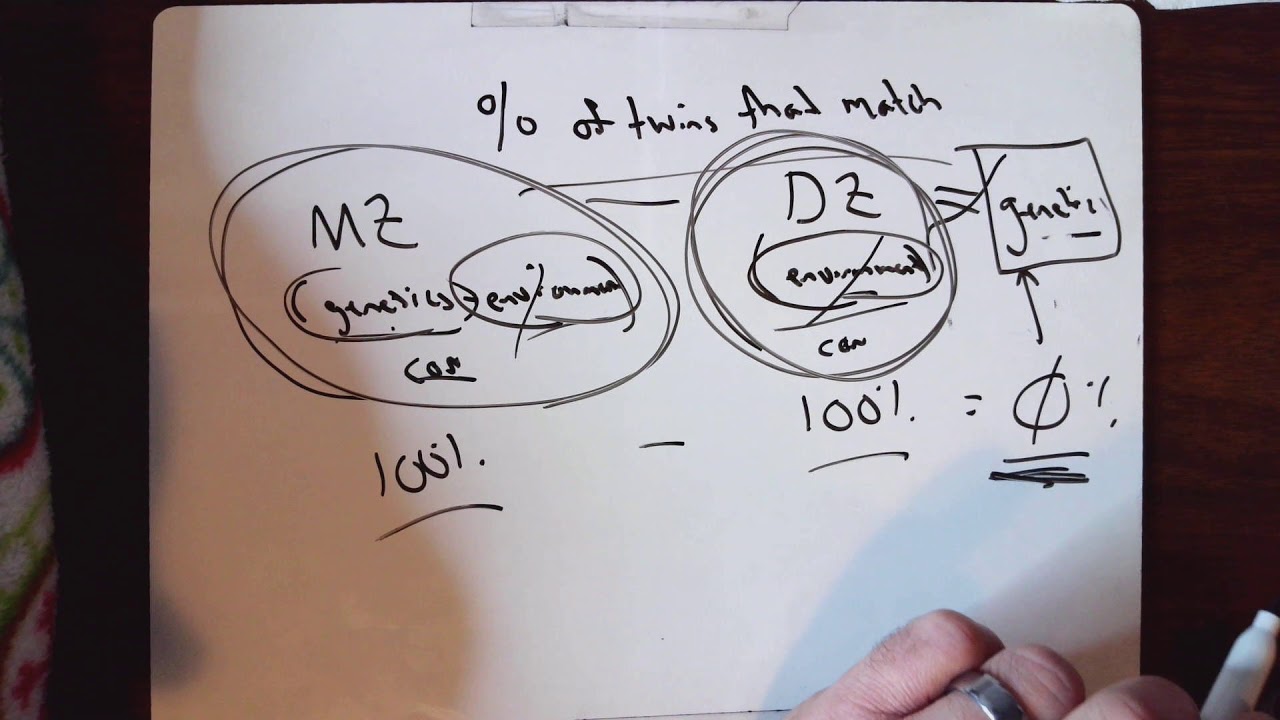
- Definition of concordance as the percentage of twins that match for a trait.
- Explanation of how to calculate concordance using an example with handedness.
- Discussion of monozygotic vs. dizygotic twins and their genetic and environmental similarities.
- Introduction of the concordance differential as a measure of genetic component.
- Example of 100% concordance in both twin types, illustrating environmental traits.
- Guidelines for interpreting concordance differentials: >50% genetic, <15% environmental.
- Introduction to pedigree analysis: determining dominant vs. recessive traits using clades.
- Explanation of X-linked recessive inheritance: mothers pass to sons.
- Explanation of X-linked dominant inheritance: fathers pass to daughters.
- Introduction to gene linkage, coupling, and repulsion.
- Summary and closing remarks.
Contribution & Novelties
The video provides a clear pedagogical framework for understanding twin concordance and pedigree analysis, which is particularly useful for students. It introduces the concept of ‘clades’ as a heuristic for identifying recessive traits, which is a novel teaching approach. The emphasis on the concordance differential as the key metric is a valuable takeaway.
Pour aller plus loin :
- Heritability — For a deeper understanding of how twin studies contribute to heritability estimates.
- Pedigree analysis — For more on the standard symbols and methods used in pedigree analysis.
- Genetic linkage — For a more detailed explanation of linkage, recombination, and mapping.
100 words
Radar Profile
The radar profile shows a balanced performance across all dimensions, with slightly higher scores in quality of information and reliability, reflecting the accurate but non-cited content. The lower score in technical level indicates that the video is accessible to beginners, while the quantity of information is moderate, covering key concepts without excessive depth.