Lecture 3 Cellular Macromolecules Chap 2, Pt 2
Keywords
Summary
115 words
Critical Evaluation
The lecture provides a solid introduction to cellular macromolecules, grounded in the Alberts et al. textbook. The instructor’s explanations are clear and well-organized, making complex concepts accessible. He effectively uses examples like spearmint and rye to illustrate isomerism, and he emphasizes the importance of three-dimensional shape in determining molecular function. The content is accurate and aligns with standard cell biology curricula. However, the lecture lacks depth in certain areas: for instance, the discussion of lipids is brief, and the instructor does not delve into the detailed structures of proteins and nucleic acids, which are covered in later lectures. The reliance on a single textbook, while reliable, means that the lecture does not incorporate recent research or alternative perspectives. Additionally, the instructor mentions a technical issue with a black box on the screen, which could be distracting but does not detract from the overall quality. The lecture is well-suited for students with some background in chemistry, as it builds on concepts like covalent bonds and functional groups. Overall, the lecture is informative and pedagogically sound, though it could benefit from more visual aids and interactive elements.
185 words
Title / Content Match
The title accurately reflects the content, which covers cellular macromolecules as part of Chapter 2.
Quality & Reliability
8/10
The lecture is based on the Alberts et al. textbook, a standard reference in cell biology. The content is accurate and well-structured, with clear explanations of macromolecules. The instructor is knowledgeable and provides examples. Minor issues: no citations to primary literature, but the textbook basis is solid.
Key Moments
Markers derived by PSI from the transcript: the creator did not define chapters.
- Introduction and overview of the lecture topics.
- Discussion of organic chemistry and the importance of carbon.
- Explanation of functional groups and their roles.
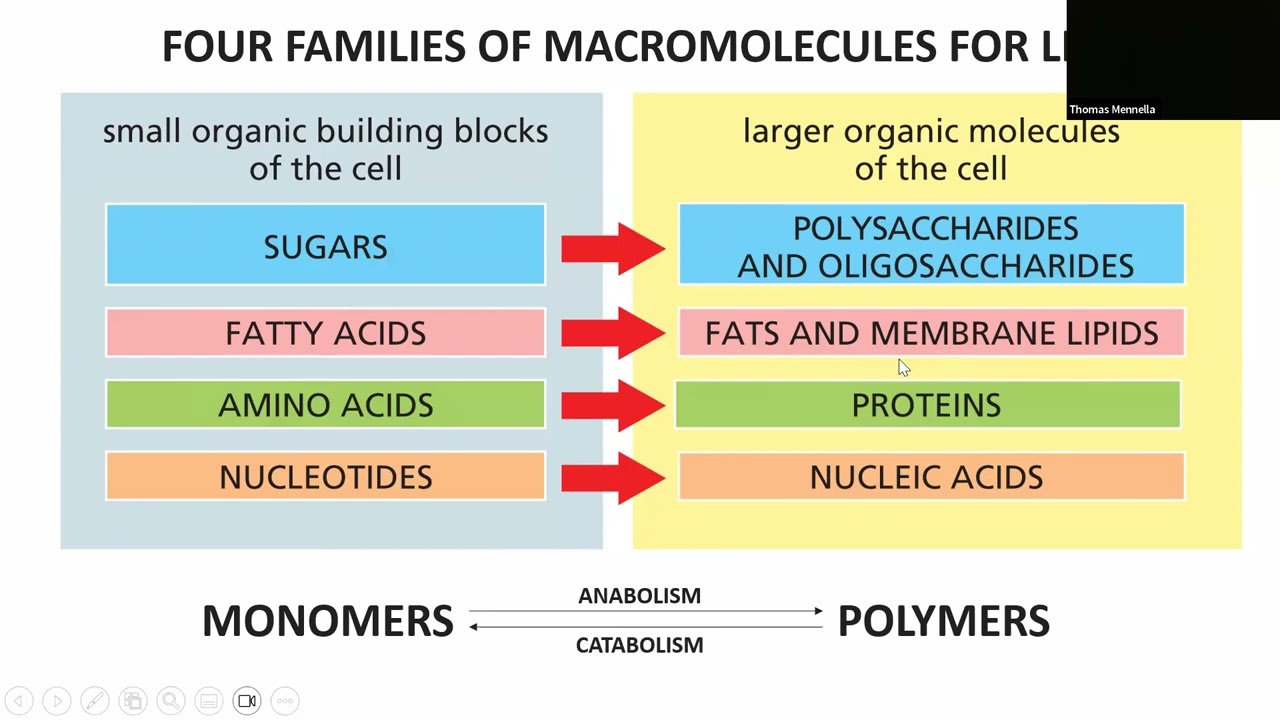
- Introduction to the four families of macromolecules.
- Definition of anabolism and catabolism.
- Detailed discussion of carbohydrates and monosaccharides.
- Explanation of isomers and their significance.
- Ring structures of sugars and their three-dimensional forms.
Cited Sources
- Alberts et al., Molecular Biology of the Cell — The lecture is based on this textbook, specifically Chapter 2, pages 54-68.
Concurring Sources
- Alberts et al., Molecular Biology of the Cell — The lecture follows the textbook's content closely.
Contribution & Novelties
The lecture provides a clear and structured overview of cellular macromolecules, emphasizing the importance of carbon and functional groups. It effectively explains the concept of monomers and polymers and introduces metabolism. The use of examples like spearmint and rye to illustrate isomerism is pedagogically effective.
Pour aller plus loin :
- Monosaccharides — For more details on simple sugars.
- Isomerism — To understand different types of isomers.
- Anabolism and Catabolism — For further reading on metabolic pathways.
76 words
Radar Profile
The radar profile shows high scores in quantity and quality of information, with a moderate level of technical depth. The lecture is comprehensive and accurate, but not highly specialized, making it suitable for introductory cell biology students.