Lecture 16 - Cytoskeleton - Part 2 - Chapter 17
Keywords
Summary
197 words
Critical Evaluation
The lecture provides a comprehensive and accurate overview of actin filaments and myosin, consistent with standard cell biology textbooks. The information is presented in a clear, logical sequence, building from basic properties of actin to its role in cell motility and muscle contraction. The lecturer effectively uses analogies and repetitions to reinforce key concepts, such as the similarity between actin and microtubules in terms of polarity and dynamic instability. The scientific rigor is high, as the content is well-established and widely accepted in the field. However, the lecture lacks direct citations to primary research articles, relying instead on textbook knowledge. This is acceptable for an educational lecture but limits its value as a source for advanced research. The lecturer’s explanations of complex processes, such as the myosin power stroke and muscle contraction, are simplified but accurate. The use of diagrams and microscopy images (though not visible in the audio) likely enhances understanding. The adéquation between title and content is excellent, as the lecture precisely covers the announced topics. Overall, this is a high-quality educational resource for students learning cell biology, though it does not offer novel insights for experts. The absence of a public discussion or comments analysis is noted, but the lecture’s clarity and accuracy make it a reliable reference for its intended audience.
215 words
Title / Content Match
The title accurately reflects the content: it is the second part of a lecture on the cytoskeleton, covering Chapter 17, focusing on actin filaments and myosin.
Quality & Reliability
8/10
The lecture is based on a standard cell biology textbook (Chapter 17, pages 590-604) and presents established scientific knowledge about the cytoskeleton. The information is accurate and well-structured, though it lacks direct citations to primary literature. The lecturer is an academic, and the content aligns with current understanding of actin filaments and myosin.
Key Moments
Markers derived by PSI from the transcript: the creator did not define chapters.
- Introduction to the lecture, covering actin filaments and myosin.
- Discussion of actin's role in cell motility and its abundance.
- Comparison of actin filaments to microtubules, highlighting polarity and dynamics.
- Explanation of actin polymerization and the role of ATP.
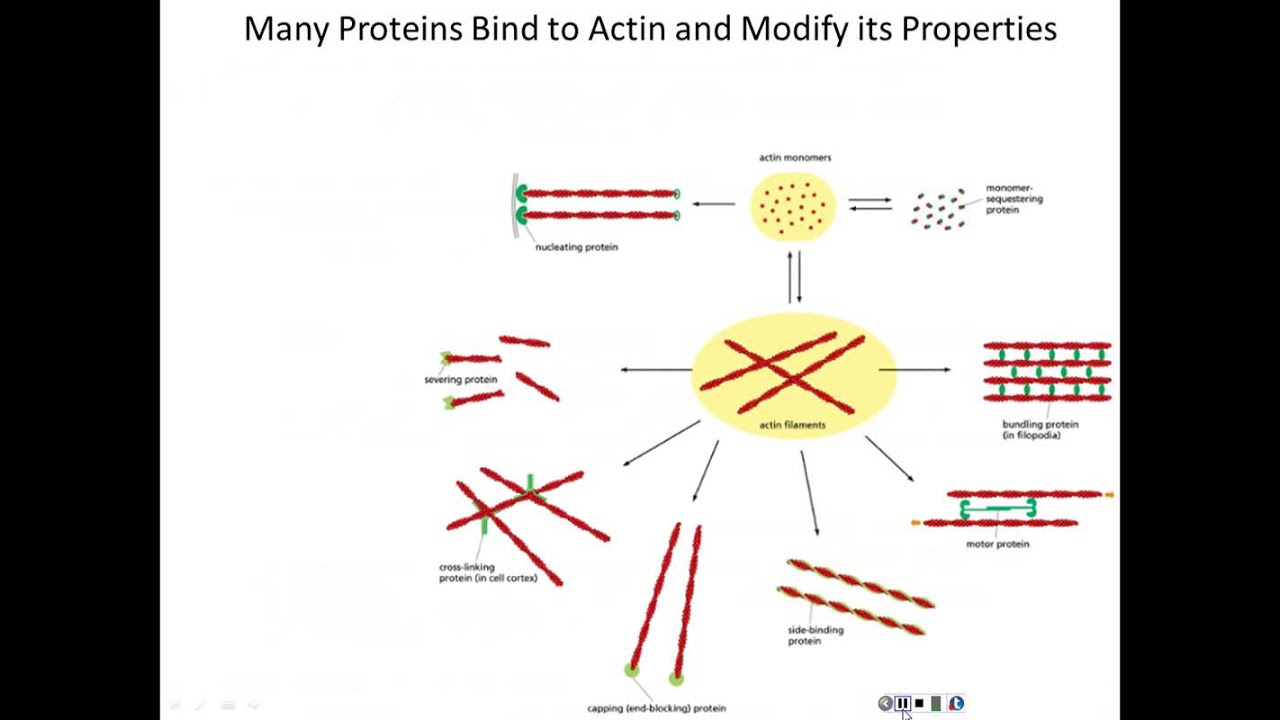
- Overview of actin-binding proteins and their functions.
- Introduction to myosin and its interaction with actin.
- Detailed mechanism of myosin power stroke and ATP hydrolysis.
- Structure of muscle sarcomere and sliding filament model.
- Regulation of muscle contraction by calcium and troponin.
- Summary and conclusion of the lecture.
Concurring Sources
- Molecular Biology of the Cell (Alberts et al.) — Standard textbook reference for cytoskeleton and actin.
Contribution & Novelties
This lecture provides a thorough educational overview of actin filaments and myosin, synthesizing textbook knowledge into a coherent narrative. It does not present new research findings but offers a valuable pedagogical resource. For further exploration, the following concepts and references are relevant:
Pour aller plus loin :
- Actin — Wikipedia article on actin, covering its structure, function, and dynamics.
- Myosin — Wikipedia article on myosin, detailing its types and role in muscle contraction.
- Sliding filament theory — Explanation of the mechanism of muscle contraction.
- Cell motility — Overview of cellular movement mechanisms.
- Cytoskeleton — General resource on the cytoskeleton components.
100 words
Radar Profile
The radar profile shows high scores in quantity and quality of information, with a moderate technical level. The lecture is comprehensive and accurate, making it a reliable educational resource. The fiabilité is high due to alignment with established knowledge.