Lecture 13A - Intro to the Citric Acid Cycle
Keywords
Summary
172 words
Critical Evaluation
The lecture provides a solid introduction to the citric acid cycle, building on prior knowledge of glycolysis. The instructor’s explanations are clear and pedagogically effective, using analogies and emphasizing key concepts. The content is accurate and aligns with standard biochemistry textbooks. The lecture is well-structured, starting with a review of glycolysis, then introducing the cycle’s role, and finally discussing mitochondrial structure. The emphasis on the cycle as an electron-harvesting process is appropriate and helps students understand its significance. However, the lecture lacks citations to primary literature or specific sources, which is typical for introductory lectures but limits its use as a standalone reference. The instructor does not address potential controversies or alternative viewpoints, but this is not expected at this level. The visual aids, though not described in detail, likely enhance understanding. The lecture is suitable for undergraduate students and provides a strong foundation for further study. The adéquation between title and content is excellent. Overall, the lecture is informative and reliable, though it could benefit from including references for further reading.
172 words
Title / Content Match
The title accurately reflects the content, which introduces the citric acid cycle and its role in metabolism.
Quality & Reliability
8/10
The lecture is a well-structured educational presentation by an academic instructor, providing accurate biochemical information consistent with standard textbooks. The content is clear and logically organized, with appropriate emphasis on key concepts. However, it is a lecture without citations or references, and no external sources are provided, limiting its verifiability.
Key Moments
Markers derived by PSI from the transcript: the creator did not define chapters.
- Introduction and overview of the lecture topics.
- Review of glycolysis: from glucose to pyruvate.
- Explanation of pyruvate conversion to acetyl-CoA.
- Discussion of the citric acid cycle as an electron-harvesting process.
- Role of the cycle in metabolism: catabolism and anabolism.
- Importance of aerobic respiration for multicellular life.
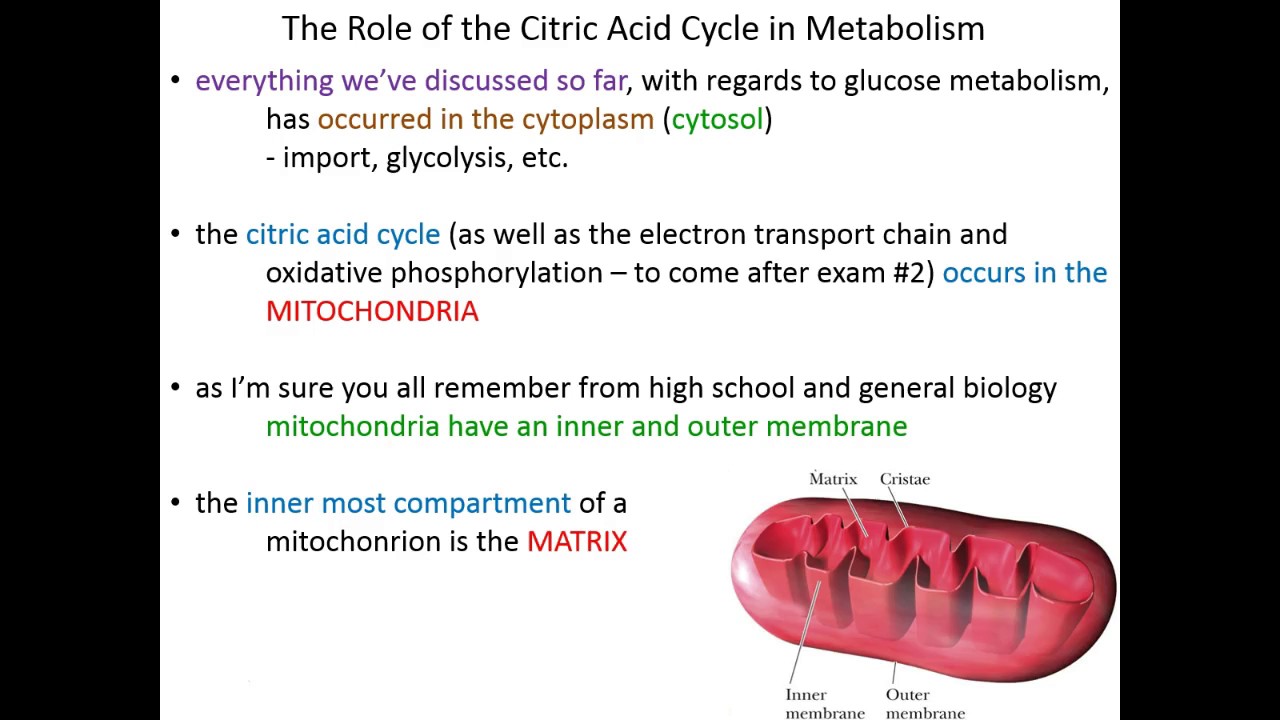
- Introduction to mitochondrial structure and the matrix.
- Key features of the citric acid cycle: redox reactions and electron carriers.
Contribution & Novelties
The lecture provides a clear and accessible introduction to the citric acid cycle, emphasizing its role as an electron-harvesting process. It effectively connects glycolysis to the cycle and highlights the central role of acetyl-CoA. The explanation of mitochondrial structure is concise and helpful. The lecture does not introduce new research but serves as a pedagogical tool.
Pour aller plus loin :
- Citric acid cycle - Wikipedia — Provides a comprehensive overview of the cycle, including its steps and regulation.
- Krebs cycle - Khan Academy — Interactive tutorial on the cycle.
- Mitochondrion - Wikipedia — Detailed information on mitochondrial structure and function.
101 words
Radar Profile
The radar profile shows high scores in quantity and quality of information, with a moderate technical level. The lecture is reliable and well-structured, making it a valuable educational resource.