Lecture 12 - Membrane Transport (Chapter 12)
Keywords
Summary
149 words
Critical Evaluation
The lecture provides a solid, clear introduction to membrane transport, suitable for an undergraduate cell biology course. The instructor’s explanations are accurate and well-structured, building logically from the basics of membrane structure to the complexities of ion transport and membrane potential. He effectively uses analogies (e.g., doorways, cellular battery) to make abstract concepts accessible. The content is scientifically sound, with no apparent errors or misleading statements. However, the lecture lacks depth in certain areas: it does not delve into the molecular mechanisms of transport proteins in detail, nor does it discuss experimental evidence or primary research. The sources cited are limited to the textbook (not explicitly named) and general knowledge, which is appropriate for a lecture but limits its value as a standalone scientific resource. The title accurately reflects the content, and the lecture fulfills its educational purpose. The presentation is engaging, with clear diagrams and examples. Overall, this is a high-quality educational resource, though not a cutting-edge scientific discussion.
160 words
Title / Content Match
The title accurately reflects the content, which is a comprehensive lecture on membrane transport mechanisms.
Quality & Reliability
8/10
The lecture is a structured educational presentation based on standard cell biology curriculum, likely from a textbook (references to figures and tables). The content is accurate and well-explained, but it lacks citations to primary literature and is presented as an introductory overview.
Key Moments
Markers derived by PSI from the transcript: the creator did not define chapters.
- Introduction to membrane transport and importance of ions
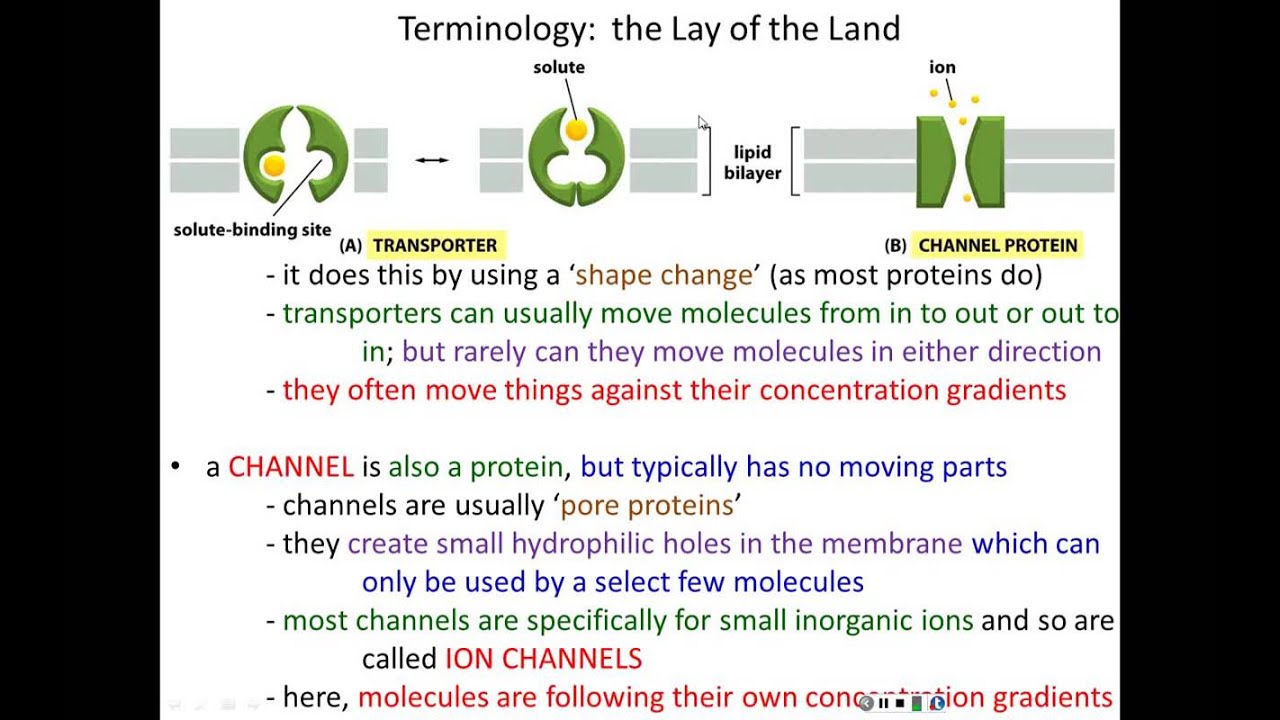
- Explanation of transport proteins and channel proteins
- Discussion of ion concentration gradients and their importance
- Introduction to the sodium-potassium pump
- Explanation of membrane potential and cellular battery concept
- Detailed discussion of ion channels and facilitated diffusion
- Summary and conclusion of the lecture
Cited Sources
- Textbook (likely 'Molecular Biology of the Cell' or similar) — The lecture references figures and tables from a textbook, but the specific title is not mentioned.
Concurring Sources
- Campbell Biology (textbook) — Standard textbook covering membrane transport concepts.
Contribution & Novelties
The lecture provides a comprehensive overview of membrane transport, emphasizing the role of ions and the distinction between channel and transporter proteins. It effectively explains the sodium-potassium pump and membrane potential, making complex concepts accessible. While not novel, it serves as a solid educational resource.
Pour aller plus loin :
- Ion channel — Overview of ion channels and their functions.
- Sodium–potassium pump — Detailed mechanism of the pump.
- Membrane potential — Explanation of electrical potential across membranes.
77 words
Radar Profile
The radar profile shows high scores in information quantity and quality, with moderate technical level. This indicates a well-structured educational lecture that is comprehensive but not overly technical, suitable for an introductory audience.