Lecture 2 Chemical Bonds and Molecules Chap 2, Pt 1
Keywords
Summary
132 words
Critical Evaluation
The lecture provides a solid foundation in chemistry for biology students. The instructor’s explanation of atomic structure and bonding is accurate and well-paced, making complex concepts accessible. The use of the periodic table to highlight elements relevant to life is effective. The distinction between covalent, ionic, and hydrogen bonds is clearly explained, with emphasis on the importance of polar covalent bonds and hydrogen bonding in biological systems. The discussion of pH is brief but sufficient for an introductory level. The lecture is well-structured, with a logical flow from atomic theory to bonding to pH. However, the lack of citations to specific sources may be a limitation for students seeking further reading. The instructor’s teaching style is engaging, and he uses mnemonics (e.g., ‘cats are positive’) to aid memory. Overall, the lecture achieves its goal of preparing students for more advanced topics in cell biology. The content is scientifically accurate and aligns with standard textbooks. The only minor critique is that the lecture could benefit from more visual aids or animations to illustrate concepts like electron shells and bonding. Additionally, the instructor occasionally makes informal remarks that, while engaging, may not be suitable for all audiences. Nevertheless, the lecture is a valuable resource for students.
204 words
Title / Content Match
The title accurately reflects the content: the lecture covers chemical bonds and molecules, specifically the first part of Chapter 2.
Quality & Reliability
8/10
The lecture is delivered by an academic instructor (Thomas Mennella) and covers foundational chemistry concepts essential for biology. The content is accurate and aligns with standard textbook material. The presentation is clear and structured, with appropriate use of diagrams and examples. The main limitation is the lack of citations to primary sources, but this is typical for an introductory lecture.
Key Moments
Markers derived by PSI from the transcript: the creator did not define chapters.
- Introduction and overview of the lecture topics.
- Discussion on the importance of chemistry in biology.
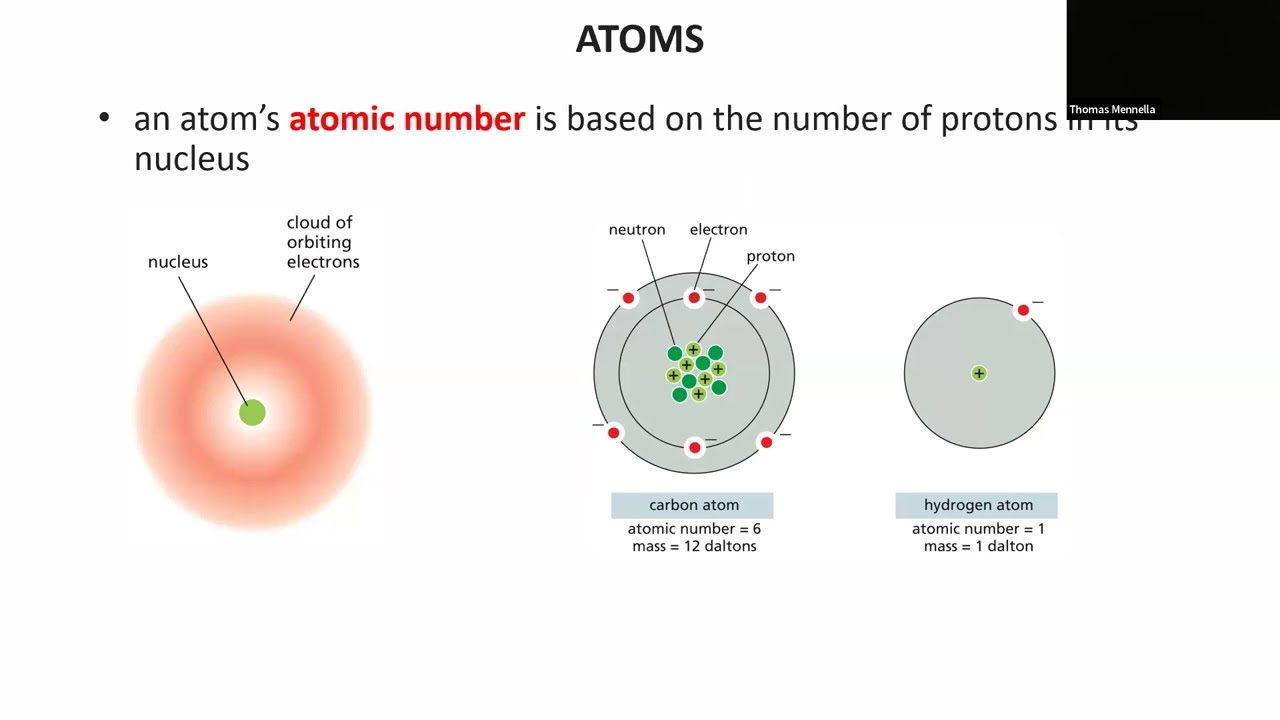
- Explanation of atoms, elements, and the periodic table.
- Review of atomic structure: protons, neutrons, electrons.
- Explanation of isotopes and ions.
- Introduction to moles and molar solutions.
- Discussion on electron shells and valence electrons.
- Explanation of covalent bonds and how they form.
- Discussion on polar covalent bonds and partial charges.
- Introduction to hydrogen bonds and their importance.
- Explanation of ionic bonds and their role in salts.
- Discussion on weak bonds and their significance.
- Introduction to pH and acids/bases.
- Conclusion and summary of key points.
Contribution & Novelties
This lecture provides a comprehensive introduction to chemical bonds and molecules, specifically tailored for biology students. It bridges the gap between chemistry and biology by emphasizing the relevance of chemical principles to living systems. The instructor’s clear explanations and use of examples make the material accessible. The lecture also highlights the importance of understanding pH and molarity for laboratory work.
Pour aller plus loin :
- Covalent bond — Provides detailed information on covalent bonding, including types and examples.
- Hydrogen bond — Explains the nature and importance of hydrogen bonds in biological systems.
- Ionic bonding — Discusses ionic bonds, their formation, and properties.
- pH — Overview of pH scale and its significance in chemistry and biology.
115 words
Radar Profile
The radar profile shows high scores in quantity and quality of information, indicating a content-rich and accurate lecture. The technical level is moderate, suitable for introductory biology students. The overall reliability is high, reflecting the instructor's expertise and the accurate presentation of foundational concepts.