Lecture 4 Proteins Chap 4, Pt 1
Keywords
Summary
174 words
Critical Evaluation
The lecture provides a solid, accurate overview of protein structure and folding, suitable for an introductory biochemistry course. The instructor’s explanations are clear and well-structured, building from basic concepts to more complex ideas. The emphasis on the hydrophobic effect as the main driver of folding is correct and appropriately highlighted. The discussion of peptide bond resonance and its implications for flexibility is accurate and important. The use of diagrams and schematics enhances understanding. However, the lecture lacks depth in some areas, such as the detailed energetics of folding (e.g., entropy and enthalpy contributions) and the specifics of chaperone action. No external sources are cited, which is typical for a lecture but limits the ability to verify claims independently. The presentation is engaging and the pace is appropriate. Overall, the content is reliable and pedagogically sound, though it does not offer novel insights beyond standard textbook material.
146 words
Title / Content Match
The title accurately describes the content: a lecture on proteins, specifically chapter 4 part 1.
Quality & Reliability
8/10
The lecture is based on a standard biochemistry textbook (pages 121-140) and covers fundamental concepts accurately. The instructor is experienced and the content is consistent with established scientific knowledge. However, no external sources are cited, and the video is a lecture rather than a peer-reviewed presentation.
Key Moments
Markers derived by PSI from the transcript: the creator did not define chapters.
- Introduction to the lecture and overview of topics to be covered.
- Discussion of the importance of proteins and the relationship between structure and function.
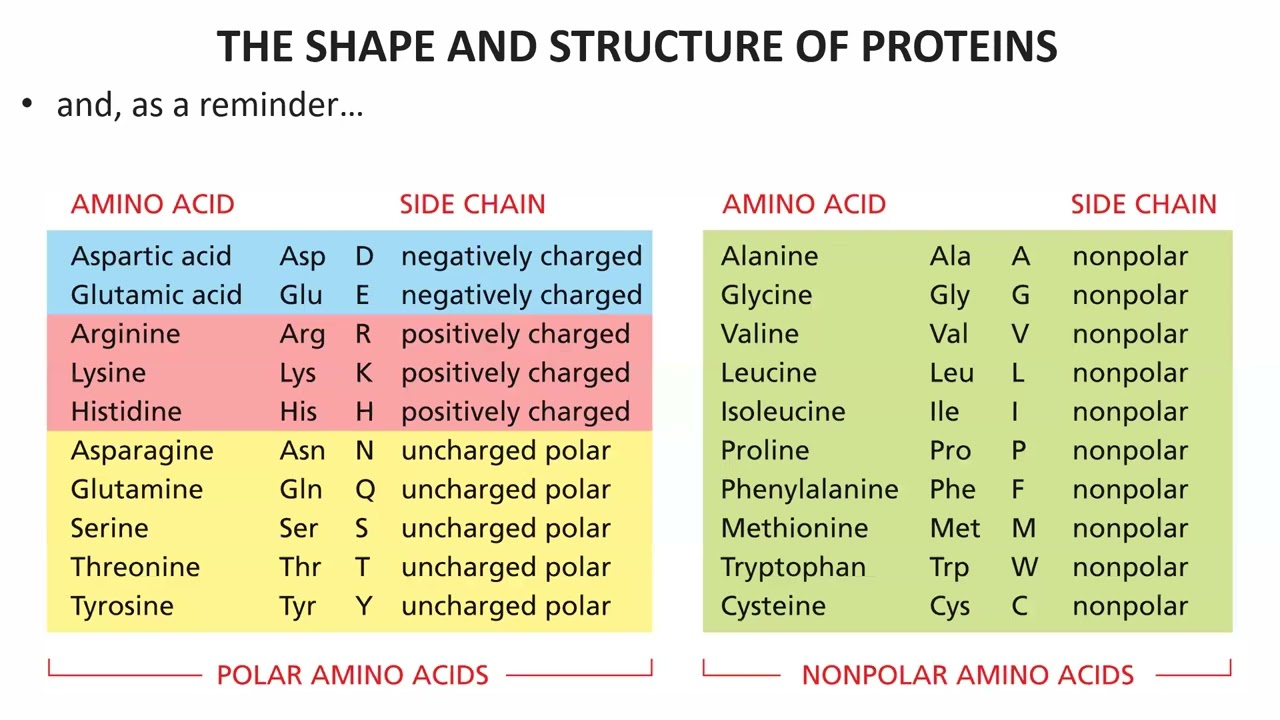
- Review of amino acid structure and the four classes of amino acids.
- Explanation of peptide bond formation and its resonance, leading to restricted rotation.
- Description of protein backbone flexibility and the ability to fold.
- Discussion of the hydrophobic effect driving protein folding in water.
- Explanation of non-covalent interactions stabilizing the native conformation.
- Introduction to denaturation and factors that cause protein unfolding.
- Mention of chaperones and their role in assisting protein folding.
- Discussion of protein families and the example of serine kinases.
Contribution & Novelties
This lecture provides a clear and structured introduction to protein structure and folding, emphasizing the hydrophobic effect and non-covalent interactions. It serves as a foundational resource for students. For further exploration, consider the following:
- Protein structure on Wikipedia — Provides a comprehensive overview of protein structure levels.
- Hydrophobic effect on Wikipedia — Explains the thermodynamic basis of hydrophobic interactions.
- Chaperone (protein) on Wikipedia — Details the role of chaperones in protein folding.
72 words
Radar Profile
The radar profile shows high scores in information quantity, quality, technical level, and reliability, indicating a well-rounded educational resource. The lecture is technically sound but not highly advanced, making it suitable for beginners.