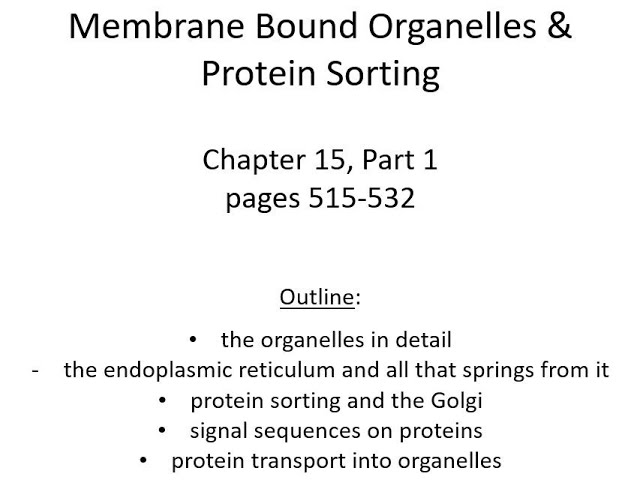
Lecture 16 Membrane Organelles and Protein Transport Ch 15 Part 1
Keywords
Summary
166 words
Critical Evaluation
The lecture provides a comprehensive and accurate overview of membrane organelles and protein transport, consistent with standard cell biology textbooks. The instructor demonstrates strong command of the subject, using clear analogies (e.g., ’the cell’s liver’ for smooth ER) and visual aids to explain complex concepts. The content is well-structured, progressing from general principles of compartmentalization to specific organelle functions and then to protein sorting mechanisms. The scientific rigor is high, as the information is based on established knowledge in cell biology. However, the lecture does not cite specific primary research articles, relying instead on textbook content, which is appropriate for an educational setting but limits its value for those seeking original sources. The pacing is appropriate for an undergraduate audience, and the instructor encourages student questions, fostering engagement. The title accurately reflects the content, and the lecture effectively covers the key topics of Chapter 15 Part 1. Overall, this is a high-quality educational resource that would benefit students seeking a solid foundation in cell biology.
165 words
Title / Content Match
The title accurately reflects the content: a lecture on membrane organelles and protein transport, covering Chapter 15 Part 1.
Quality & Reliability
8/10
The lecture is based on a standard cell biology textbook (Chapter 15) and presents well-established concepts. The instructor demonstrates deep knowledge and provides clear explanations. However, as a lecture, it lacks peer review and primary sources.
Key Moments
Markers derived by PSI from the transcript: the creator did not define chapters.
- Introduction and overview of the lecture topics.
- Discussion on the importance of compartmentalization in cells.
- Explanation of the nuclear envelope and nuclear pores.
- Description of the endoplasmic reticulum (smooth and rough) and its functions.
- Introduction to the Golgi apparatus and its role in protein processing and shipping.
- Discussion on lysosomes and endosomes in cellular digestion and recycling.
- Explanation of protein sorting and signaling sequences.
- Overview of protein transport into the nucleus, mitochondria, and ER.
Cited Sources
- Textbook Chapter 15 (not specified) — The lecture is based on Chapter 15 of an unspecified cell biology textbook, covering pages 515-532.
Concurring Sources
- Molecular Biology of the Cell (Alberts et al.) — Standard reference for cell biology, covering organelle structure and protein transport.
Contribution & Novelties
The lecture provides a clear and structured introduction to membrane organelles and protein transport, suitable for undergraduate students. It emphasizes the importance of compartmentalization and explains the mechanisms of protein sorting. The instructor uses analogies and visual aids to enhance understanding.
Pour aller plus loin :
- Nuclear pore complex — Overview of the structure and function of nuclear pores.
- Signal recognition particle — Key component in co-translational targeting to the ER.
- Endoplasmic reticulum — Detailed article on ER structure and functions.
81 words
Radar Profile
The radar profile shows high scores in quantity and quality of information, with a moderate technical level, indicating a lecture that is informative and reliable but not highly advanced. The overall reliability is strong, reflecting the textbook-based content.