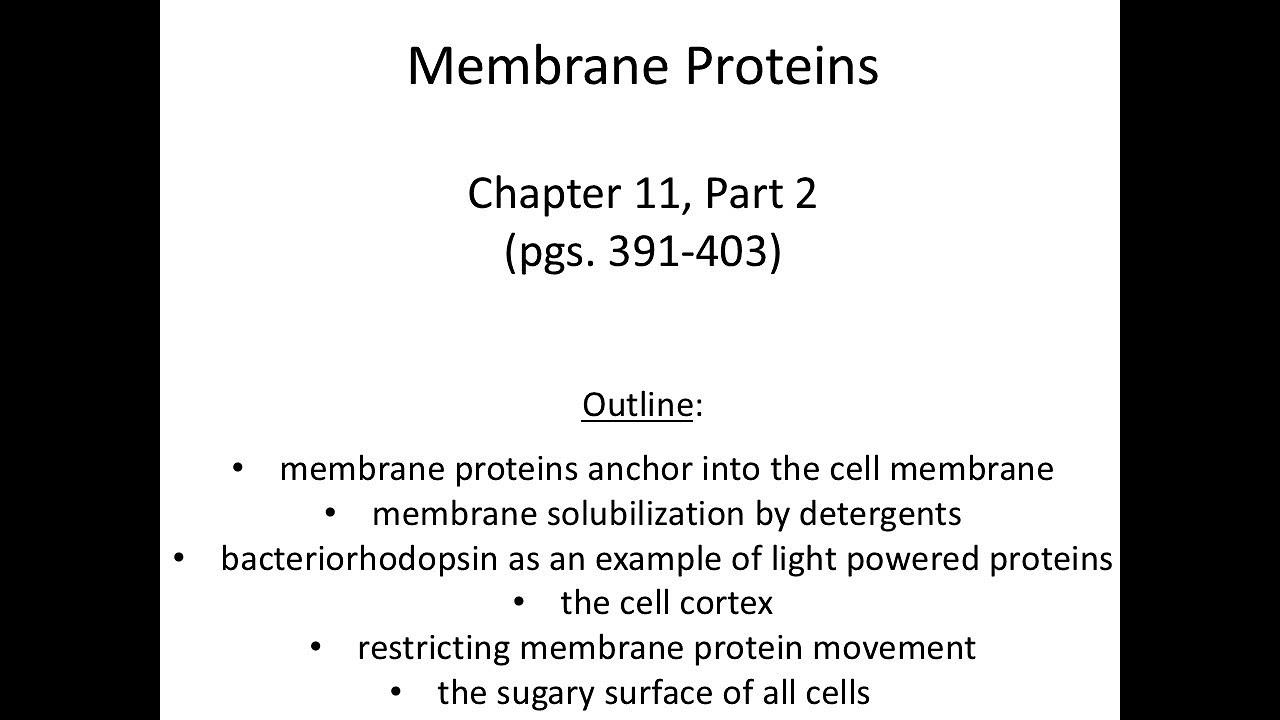
Lecture 13 Membrane Proteins Ch 11 Pt 2
Keywords
Summary
177 words
Critical Evaluation
The lecture provides a solid overview of membrane protein structure and function, appropriate for an undergraduate cell biology course. The instructor’s explanations are clear and logically structured, building from basic concepts to more complex examples. The use of bacteriorhodopsin as a case study is effective, illustrating how a membrane protein can function as a light-driven proton pump, and the discussion of detergents is practical, connecting to laboratory techniques. The content aligns with standard textbook knowledge, and the instructor demonstrates expertise. However, the lecture lacks citations to primary literature, and some simplifications are made for teaching, such as the emphasis on alpha-helical transmembrane proteins without mentioning beta-barrels. The discussion of membrane protein diffusion and the cell cortex is brief but accurate. The video is well-paced and engaging, with clear diagrams. The main limitation is the absence of references to specific studies or reviews, which would enhance scientific rigor. Overall, the lecture is informative and reliable for its intended educational purpose, but it does not offer novel insights beyond textbook material.
169 words
Title / Content Match
The title accurately reflects the content, which is a lecture on membrane proteins, specifically covering types, anchoring, detergents, and examples.
Quality & Reliability
8/10
The lecture is based on a standard textbook (Chapter 11) and presents established biological concepts accurately. The instructor demonstrates deep knowledge and uses clear examples. However, it is a didactic lecture without primary sources or citations, and some simplifications are made for teaching purposes.
Key Moments
Markers derived by PSI from the transcript: the creator did not define chapters.
- Introduction: closing out unit one, overview of topics to be covered.
- Importance of membrane proteins: they provide function, while lipids are structural.
- Classification of membrane proteins: transporters, anchoring, receptors, enzymes.
- How proteins associate with membranes: integral vs peripheral, transmembrane vs embedded.
- Introduction to detergents: amphipathic molecules, SDS and Triton X-100.
- Mechanism of detergent solubilization: bridging hydrophobic and hydrophilic.
- Bacteriorhodopsin as an example of a membrane protein and active transport.
- Cell cortex: underlying protein meshwork restricting lateral diffusion.
- Return to glycocalyx and summary of unit one.
Cited Sources
- Textbook Chapter 11 (likely Molecular Biology of the Cell or similar) — The lecture references pages 391-403 of the textbook, which covers membrane proteins.
Concurring Sources
- Molecular Biology of the Cell (Alberts et al.) — Standard textbook covering membrane protein structure and function.
Contribution & Novelties
The lecture provides a clear pedagogical explanation of membrane protein classification and detergent action, using bacteriorhodopsin as a concrete example. It reinforces concepts with analogies and practical lab connections.
Pour aller plus loin :
- Membrane protein — Overview of types and functions.
- Bacteriorhodopsin — Detailed article on this light-driven proton pump.
- Detergent — General chemistry of detergents and their uses.
60 words
Radar Profile
The radar profile shows high scores in quantity and quality of information, with a moderate technical level. This indicates a comprehensive and reliable lecture, though not highly advanced. The fiabilite is high, reflecting the accurate presentation of established knowledge.