Lecture 7A: Phosphorylation and Zymogens
Keywords
Summary
85 words
Critical Evaluation
The lecture provides a solid introductory overview of two key enzyme regulation mechanisms. The explanation of phosphorylation is clear, emphasizing its reversibility and the roles of kinases and phosphatases. The analogy to a light switch effectively conveys the toggle nature. The discussion of zymogens is also well-presented, using chymotrypsin as a classic example to illustrate the irreversible activation process. The structural changes from chymotrypsinogen to chymotrypsin are described accurately, highlighting the importance of cleavage events. The lecture’s strength lies in its pedagogical clarity and logical progression. However, it lacks depth in certain areas: it does not delve into the molecular details of kinase specificity or the regulatory networks that control phosphorylation. Additionally, while the chymotrypsin example is illustrative, the lecture could benefit from mentioning other zymogens, such as those in blood clotting. The content is scientifically accurate and aligns with standard biochemistry textbooks. The absence of citations is a minor weakness, but for an introductory lecture, it is acceptable. Overall, the lecture is informative and well-structured, suitable for students beginning their study of enzyme regulation.
175 words
Title / Content Match
The title accurately reflects the content, focusing on phosphorylation and zymogens as regulatory mechanisms.
Quality & Reliability
8/10
The lecture is a clear, well-structured educational presentation on enzyme regulation mechanisms. The content is accurate and aligns with established biochemistry knowledge. The instructor uses clear examples and analogies. However, no external sources are cited, and the presentation is a basic overview without delving into experimental evidence or recent research.
Key Moments
Markers derived by PSI from the transcript: the creator did not define chapters.
- Introduction to lecture 7 and overview of topics: phosphorylation, zymogens, active sites, and coenzymes.
- Recap of allosteric regulation and introduction to more dramatic regulation mechanisms.
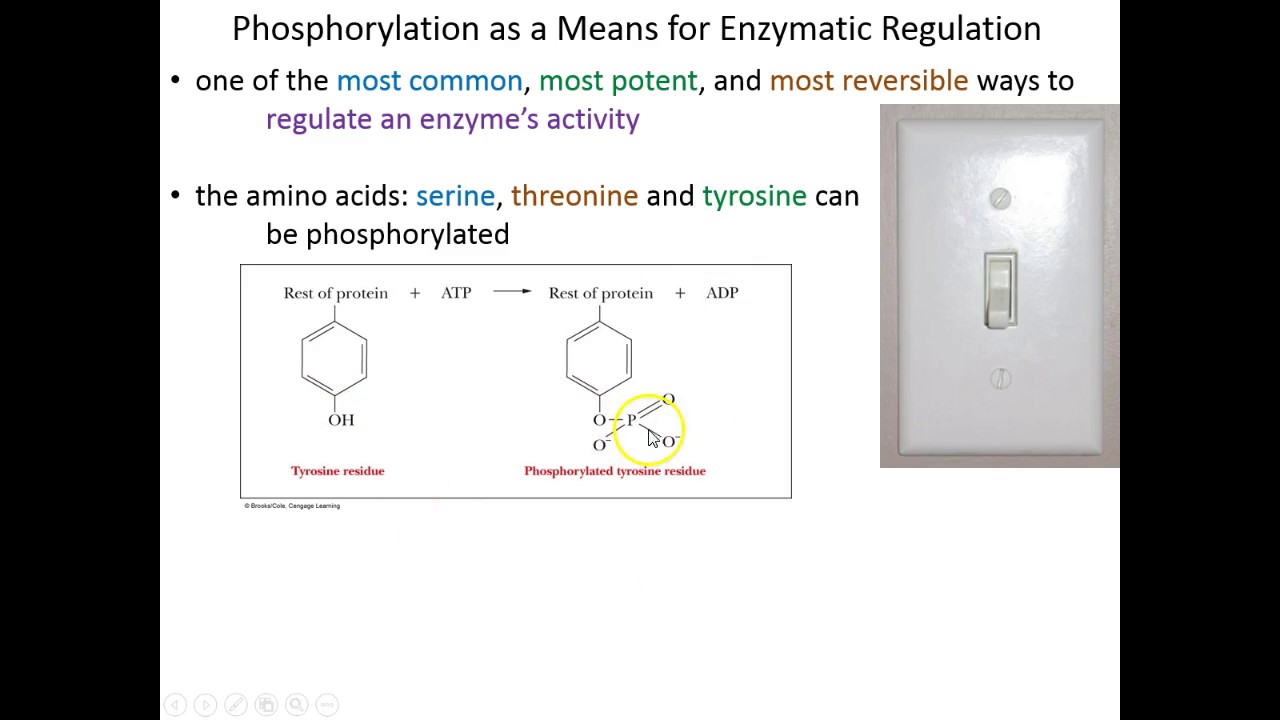
- Explanation of phosphorylation as a reversible toggle switch, with analogy to a light switch.
- Discussion of the three amino acids that can be phosphorylated: serine, threonine, and tyrosine.
- Introduction of kinases and phosphatases as enzymes that add and remove phosphate groups.
- Transition to zymogens, emphasizing their irreversible activation.
- Example of chymotrypsinogen as a zymogen and its activation by trypsin.
- Description of the conversion from chymotrypsinogen to pi-chymotrypsin and then to active chymotrypsin.
- Summary contrasting phosphorylation and zymogens, and preview of next topics.
Contribution & Novelties
The lecture provides a clear and accessible explanation of two fundamental enzyme regulation mechanisms, using effective analogies and a concrete example. It serves as a good foundation for understanding more complex regulatory processes.
Pour aller plus loin :
- Phosphorylation — Overview of phosphorylation in biological systems.
- Zymogen — General definition and examples of zymogens.
- Chymotrypsin — Detailed information on chymotrypsin structure and function.
63 words
Radar Profile
The radar profile shows a balanced distribution across scores, with slightly higher scores in quality and reliability, indicating a well-structured and accurate educational content, though with moderate depth and technicality.