CQ#3-5 - Central Dogma and Mutations
Keywords
Summary
136 words
Critical Evaluation
The video provides a clear and pedagogically effective explanation of several key concepts in molecular genetics. The instructor uses concrete examples and step-by-step reasoning, which aids understanding. The content is scientifically accurate, with correct use of terminology such as transition, nonsense mutation, frameshift, and reverse transcription. The explanations are well-structured, moving from specific questions to broader principles. The use of a genetic code table is appropriately referenced, and the instructor correctly notes that students are not expected to memorize codons. The video also encourages critical thinking by asking students to bridge concepts across units. However, the video is relatively short and does not delve deeply into the molecular mechanisms or provide extensive context. The production quality is basic, with no visual aids beyond text on screen, which might limit engagement. The instructor’s tone is conversational and supportive, which is suitable for a tutorial. The adéquation between title and content is good, as the video directly addresses the challenge questions. Overall, the video is a valuable resource for students, but it is not a comprehensive review of the topics. The lack of external sources or references is a minor weakness, but the content is based on established scientific knowledge.
198 words
Title / Content Match
The title accurately reflects the content, which covers challenge questions 3-5 on central dogma and mutations.
Quality & Reliability
8/10
The video is an educational tutorial by a biology instructor, explaining concepts of central dogma and mutations. The content is scientifically accurate, well-structured, and uses clear examples. The instructor references the genetic code and standard molecular biology concepts. However, the video is not peer-reviewed and is based on the instructor's expertise, which is appropriate for its educational purpose.
Key Moments
Markers derived by PSI from the transcript: the creator did not define chapters.
- Introduction to challenge questions 3-5, emphasizing bridging concepts.
- Question 1: Why radiation-induced recessive lethal mutations can be detected by sex ratio.
- Explanation of sex-linked recessive lethal mutations and their effect on sex ratio.
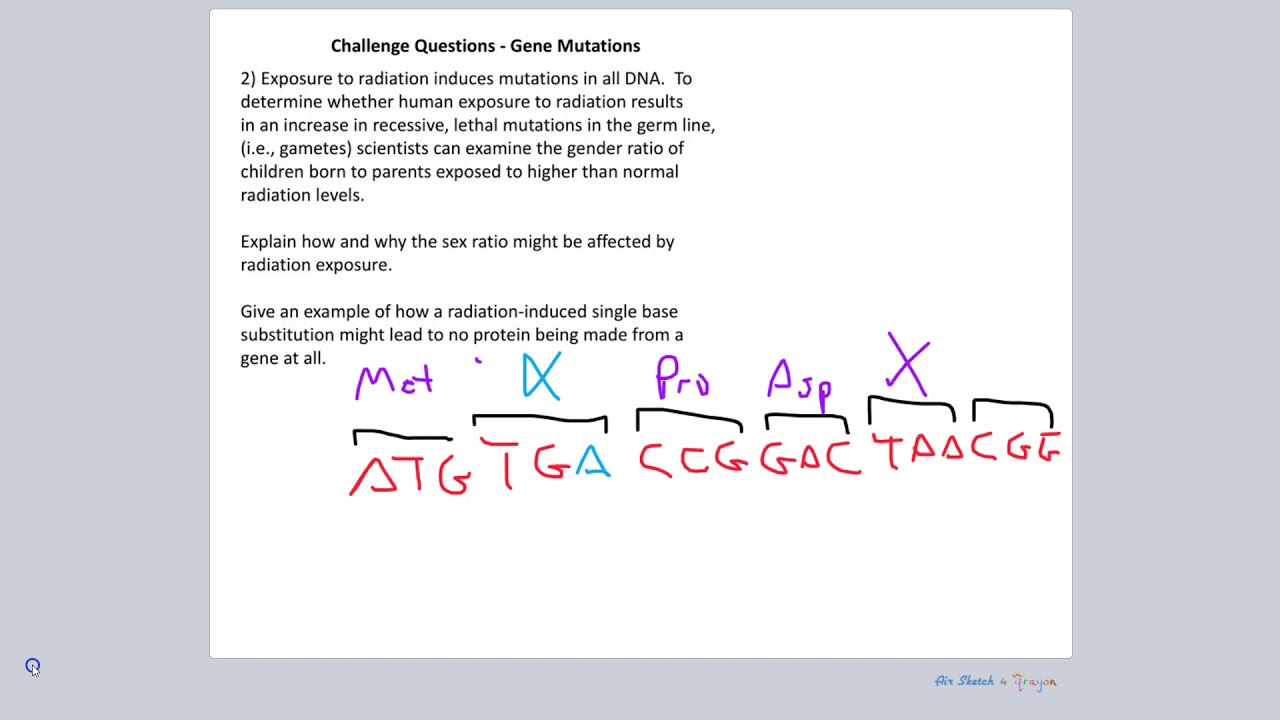
- Question 2: How a single base substitution can lead to no protein production (nonsense mutation).
- Example of a transition mutation creating a stop codon, truncating the protein.
- Question 3: Why information almost never flows backward from RNA to DNA, citing retroviruses.
- Question 4: Frameshift mutations and the benefit of a second nearby insertion/deletion (suppressor mutation).
- Conclusion and preview of next week's topic on gene regulation.
Contribution & Novelties
The video provides a clear pedagogical approach to understanding mutations and the central dogma, using specific examples and step-by-step reasoning. It emphasizes the importance of bridging concepts across units, which is valuable for cumulative learning.
Pour aller plus loin :
- Central dogma of molecular biology — Provides a comprehensive overview of the flow of genetic information.
- Nonsense mutation — Detailed explanation of this type of mutation and its consequences.
- Frameshift mutation — Discusses the mechanism and effects of insertions/deletions on the reading frame.
- Reverse transcriptase — Enzyme used by retroviruses to convert RNA to DNA.
95 words
Radar Profile
The radar profile shows a balanced performance across all dimensions, with slightly lower scores in quantity of information and technical level, reflecting the video's concise and focused nature. The high scores in quality and reliability indicate accurate and well-presented content.