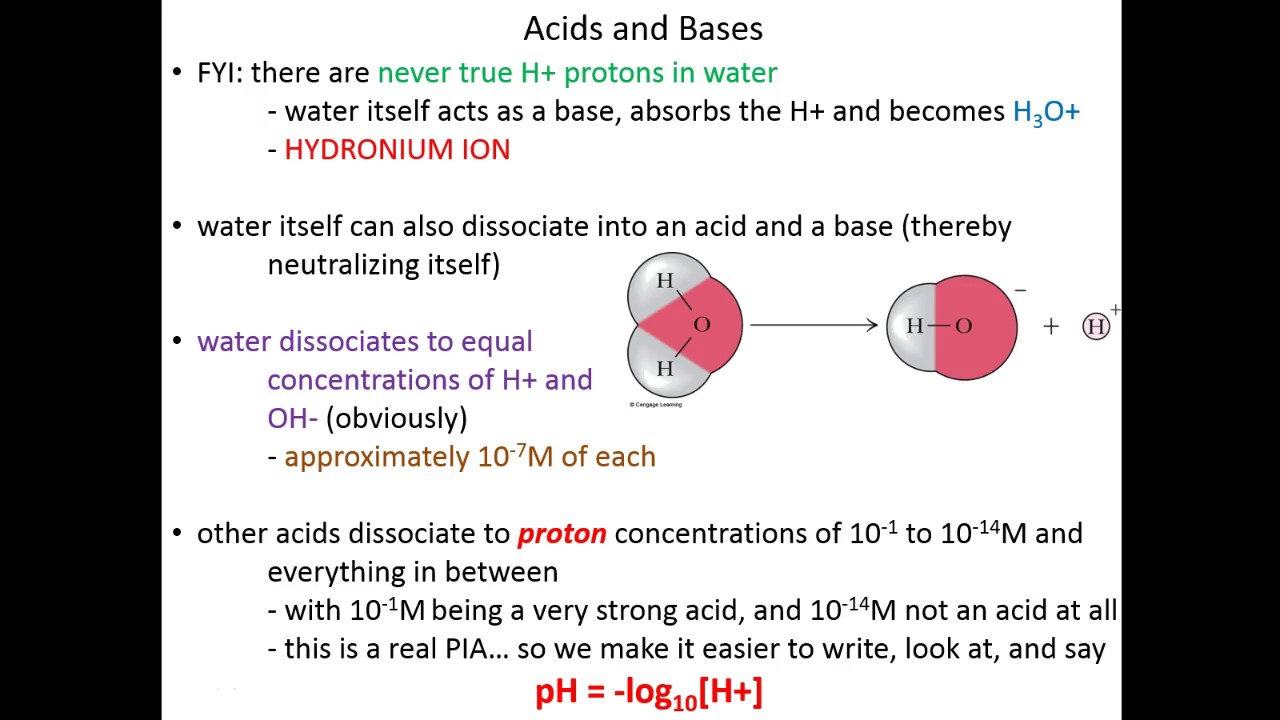
Lecture 1C - Water - Acids and Bases
Keywords
Summary
176 words
Critical Evaluation
The lecture provides a solid foundation in acid-base chemistry, which is essential for understanding biochemical processes. The content is accurate and well-explained, with clear definitions and illustrative examples. The instructor effectively uses analogies, such as comparing Ka to eye color, to reinforce the concept of a constant property. The explanation of pH calculation for strong acids and bases is particularly clear, including the common pitfall of misinterpreting hydroxide concentration. The introduction of pKa and the Henderson-Hasselbalch equation is well-motivated, and the instructor correctly emphasizes the relationship between pH, pKa, and the ratio of conjugate base to acid. However, the lecture is introductory and does not delve into more complex topics such as buffer capacity or the role of polyprotic acids. The lack of citations to primary literature or external resources is a limitation, as students may wish to explore further. The presentation is engaging and well-paced, with a focus on conceptual understanding rather than rote memorization. The instructor’s emphasis on the MCAT relevance is helpful for pre-medical students. Overall, the lecture achieves its goal of providing a clear and accurate introduction to acids, bases, and pH, and it would serve as an excellent review for students beginning their study of biochemistry.
201 words
Title / Content Match
The title accurately reflects the content, which focuses on water's role in acid-base chemistry, including pH and buffers.
Quality & Reliability
8/10
The lecture provides a clear and accurate introduction to acids, bases, pH, and the Henderson-Hasselbalch equation, with correct chemical principles and practical examples. The content is well-structured and pedagogically sound, though it lacks citations to primary literature and is limited to introductory concepts.
Key Moments
Markers derived by PSI from the transcript: the creator did not define chapters.
- Introduction to the lecture on water, acids, and bases
- Definition of acids and bases as proton donors and acceptors
- Explanation of dissociation constants (Ka) and acid strength
- Introduction to pH as negative log of proton concentration
- Calculation of pH for strong acids and bases, including common pitfalls
- Definition of pKa and its relationship to acid strength
- Introduction to the Henderson-Hasselbalch equation
- Application of Henderson-Hasselbalch to predict ionization state
- Importance of pH in biological systems and narrow pH range for biochemical reactions
Contribution & Novelties
This lecture provides a clear and accessible introduction to acid-base chemistry, emphasizing concepts essential for biochemistry. It effectively explains the relationship between pH, pKa, and the Henderson-Hasselbalch equation, which is crucial for understanding buffer systems in biological systems. The lecture’s strength lies in its pedagogical approach, using analogies and common-sense checks to reinforce understanding.
Pour aller plus loin :
- Henderson-Hasselbalch equation - Wikipedia — Provides a detailed explanation and applications of the equation.
- Acid dissociation constant - Wikipedia — Further reading on Ka and its significance.
- Buffer solution - Wikipedia — Explores how buffers maintain pH, building on the concepts introduced.
101 words
Radar Profile
The radar profile shows high scores in quality and reliability, with moderate scores in quantity and technical level. This indicates a lecture that is accurate and well-presented but limited in depth and breadth, suitable for introductory learners.