Molecular Genetics, Part II
Keywords
Summary
139 words
Critical Evaluation
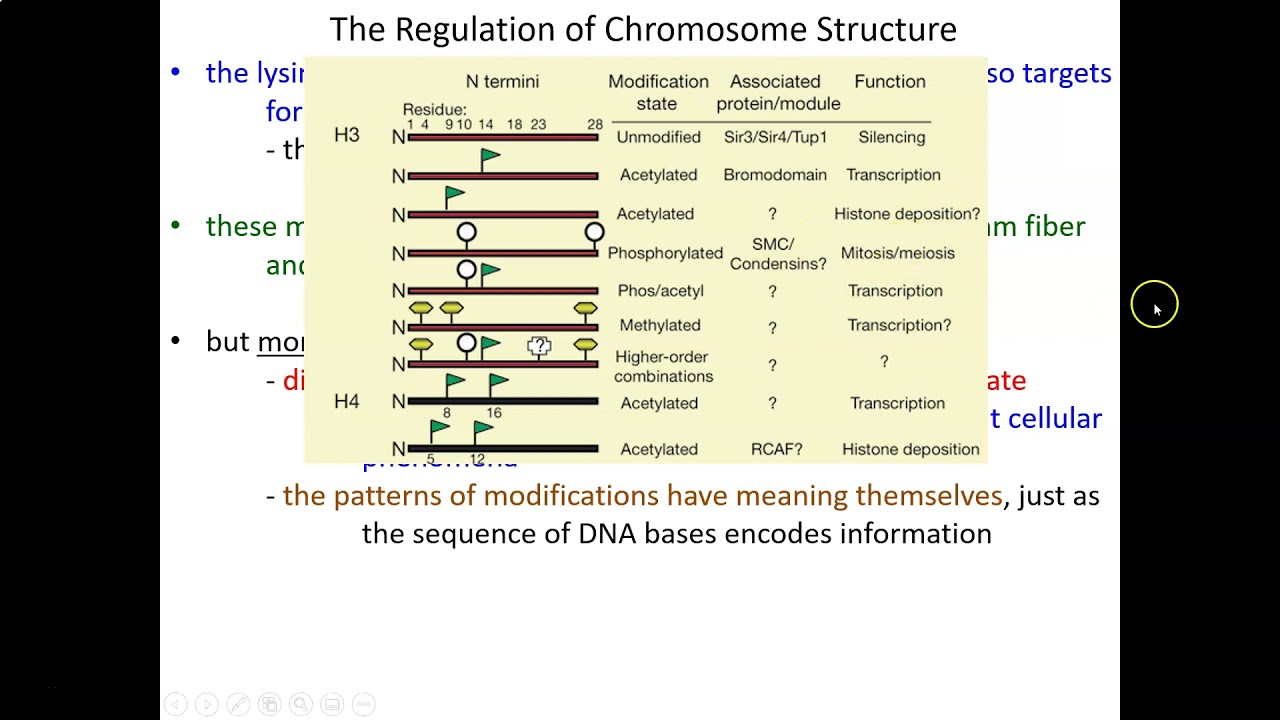
The lecture provides a comprehensive and accurate overview of chromatin remodeling and transcriptional regulation, suitable for an advanced undergraduate or graduate audience. The instructor demonstrates a strong command of the subject, explaining complex mechanisms in a clear and logical manner. The use of diagrams and analogies (e.g., the Shakespeare metaphor) enhances understanding. The content is well-structured, building from basic concepts to more advanced topics. However, the lecture lacks citations to primary literature, which is common for educational videos but limits its utility for research purposes. The discussion of the histone code is particularly valuable, as it highlights the complexity of epigenetic regulation. The lecture also effectively explains the functional significance of chromatin modifications, linking them to cellular processes like mitosis and transcription. One minor weakness is the absence of visual aids in the transcript, which might make it harder for viewers to follow the spatial aspects of chromatin remodeling. Overall, the lecture is scientifically rigorous and provides a solid foundation for understanding gene regulation. The adéquation between title and content is excellent, as the lecture directly addresses molecular genetics topics. The presentation is engaging and well-paced, making it a valuable educational resource.
192 words
Title / Content Match
The title accurately reflects the content, which covers advanced topics in molecular genetics, specifically chromatin remodeling and transcriptional regulation.
Quality & Reliability
8/10
The lecture is based on well-established molecular biology concepts, presented accurately and clearly. The instructor demonstrates deep knowledge and provides logical explanations. No citations are provided, but the content aligns with standard textbooks.
Key Moments
Markers derived by PSI from the transcript: the creator did not define chapters.
- Introduction to the lecture topics: chromatin remodeling, histone modifications, and transcriptional regulation.
- Review of nucleosome structure and histone tails.
- Explanation of chromatin remodeling complexes and ATP-dependent nucleosome movement.
- Discussion of SWI/SNF complex and its role in chromatin remodeling.
- Introduction to histone acetylation and deacetylation by HATs and HDACs.
- Explanation of the histone code and its regulatory significance.
- Discussion of transcriptional regulation and the Mediator complex.
- Overview of coordinated regulation and combinatorial control.
- Conclusion emphasizing the importance of gene regulation in cellular complexity.
Contribution & Novelties
This lecture provides a clear and structured overview of chromatin remodeling and transcriptional regulation, integrating concepts such as the histone code and the Mediator complex. It emphasizes the dynamic nature of chromatin and the importance of regulatory mechanisms in gene expression. The lecture is particularly useful for students seeking a comprehensive understanding of these topics.
Pour aller plus loin :
- Histone code — Provides a detailed overview of histone modifications and their roles.
- SWI/SNF complex — Information on the chromatin remodeling complex.
- Mediator complex — Details on the Mediator complex in transcription regulation.
93 words
Radar Profile
The radar profile shows high scores across all dimensions, indicating a well-balanced and informative lecture. The strongest aspects are the quantity and quality of information, while the technical level is appropriately high for the target audience.