Lecture 1D: Water - Buffers
Keywords
Summary
153 words
Critical Evaluation
The video provides a clear and engaging explanation of buffer chemistry, a fundamental concept in biochemistry. The instructor uses a relatable analogy (dogs and a stuffed bunny) to explain the relationship between weak acids and their conjugate bases, which effectively aids comprehension. The explanation of how buffers resist pH changes is accurate and well-illustrated with the virtual simulation. The concept of buffer capacity and ‘breaking the buffer’ is correctly presented, emphasizing that buffers have limits. The practical guidance on selecting a buffer based on pKa is valuable for students. The content is scientifically sound, with no major errors. However, the video is a lecture, not a primary research source, so it does not present new findings. The production quality is adequate, with clear visuals and audio. The title accurately reflects the content. Overall, this is a high-quality educational resource that effectively teaches the topic.
144 words
Title / Content Match
The title accurately reflects the content, which focuses on water and buffers as part of a lecture series.
Quality & Reliability
8/10
The content is scientifically accurate, well-structured, and uses clear analogies to explain buffer chemistry. The instructor demonstrates a solid understanding of the topic and provides practical examples. The video is an educational lecture, not a primary research source, but it is reliable for its intended purpose.
Key Moments
Markers derived by PSI from the transcript: the creator did not define chapters.
- Introduction to the lecture, stating it will review pKa and buffers.
- Definition of a buffer as anything that resists change, specifically pH change.
- Explanation that a buffer is a solution of a weak acid and its conjugate base.
- Analogy of dogs and a stuffed bunny to illustrate weak acids and strong conjugate bases.
- Mechanism of buffering: conjugate base absorbs added protons, weak acid neutralizes added bases.
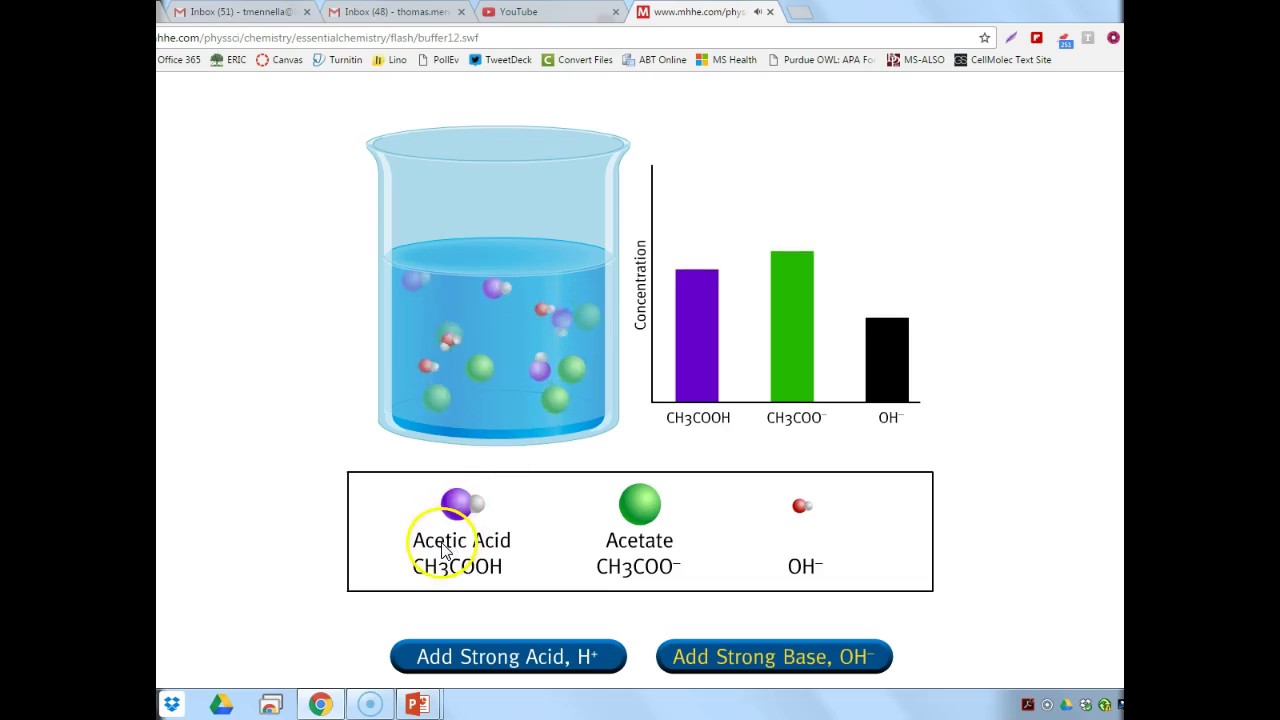
- Demonstration of a virtual buffer simulation, showing pH stability when acid or base is added.
- Explanation of 'breaking the buffer' when conjugate base is exhausted.
- Practical advice: choose a buffer with pKa near desired pH, and list of common buffers.
- Summary and conclusion of the lecture series on water.
Concurring Sources
- Buffer solution — General reference on buffers, consistent with the video's explanation.
Contribution & Novelties
The video provides a clear pedagogical explanation of buffer chemistry, using analogies and simulations to reinforce concepts. It does not present new scientific findings but offers a valuable educational resource.
Pour aller plus loin :
- Henderson-Hasselbalch equation — This equation is fundamental for calculating buffer pH and is directly related to the pKa concept discussed.
- Buffer solution — Provides a comprehensive overview of buffers, their preparation, and applications.
- Biological buffers — Lists common buffers used in biological research, including those mentioned in the video.
84 words
Radar Profile
The radar profile shows high scores in quality of information and reliability, with moderate scores in quantity and technical level. This indicates a well-structured, accurate educational video that is accessible to a general audience but may not delve deeply into advanced topics.