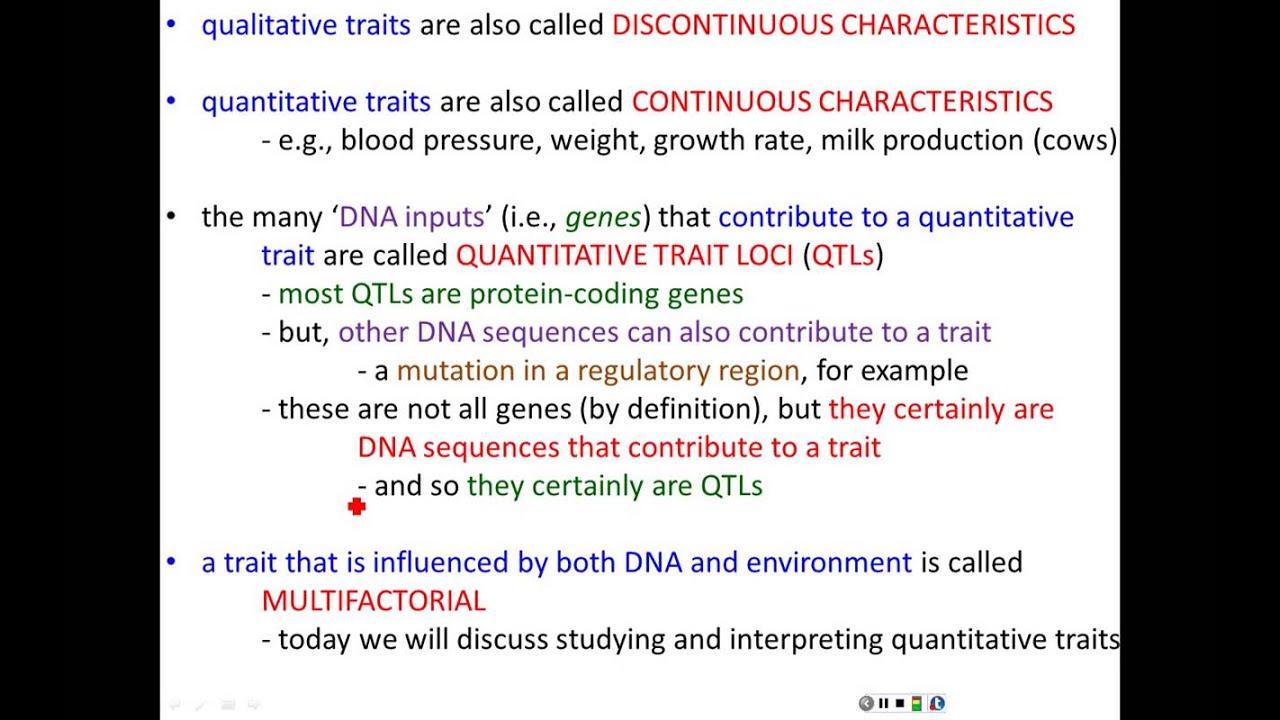
Lecture 17 - Quantitative Genetics
Keywords
Summary
168 words
Critical Evaluation
The lecture provides a solid introduction to quantitative genetics, effectively explaining key concepts such as quantitative traits, polygenic inheritance, QTLs, and heritability. The use of a simple example with three genes controlling plant height helps illustrate how multiple genes contribute to a continuous phenotype. The explanation of heritability is clear, emphasizing that it is a population-level statistic and not applicable to individuals. However, the lecture lacks depth in discussing modern methods for identifying QTLs, such as genome-wide association studies (GWAS), and does not address the complexities of gene-environment interactions beyond a basic mention. The presentation is well-structured and accessible, but it could benefit from more real-world examples and references to current research. The absence of citations to primary literature is a limitation, as it does not allow viewers to verify the information or explore further. Overall, the lecture is scientifically accurate and suitable for an introductory genetics course, but it does not offer novel insights or advanced topics.
158 words
Title / Content Match
The title accurately reflects the content, which is a comprehensive lecture on quantitative genetics.
Quality & Reliability
8/10
The lecture is a well-structured educational presentation on quantitative genetics, covering fundamental concepts with clear examples. The content is scientifically accurate and aligns with standard genetics textbooks. However, it lacks citations to primary literature and is based on established knowledge rather than new research.
Key Moments
Markers derived by PSI from the transcript: the creator did not define chapters.
- Introduction to the lecture and the topic of quantitative genetics.
- Definition of qualitative vs. quantitative characteristics.
- Explanation of continuous variation and the need for measurement.
- Introduction to polygenic inheritance and QTLs.
- Discussion of multifactorial traits and environmental influence.
- Example of plant height controlled by three genes.
- Definition of heritability and its calculation.
- Distinction between broad-sense and narrow-sense heritability.
- Limitations of heritability estimates.
- Conclusion and summary of key points.
Contribution & Novelties
The lecture provides a clear and structured introduction to quantitative genetics, emphasizing the distinction between qualitative and quantitative traits and the role of multiple genes and environment. It offers a pedagogical example of plant height to illustrate polygenic inheritance. For further exploration, the following concepts are relevant:
Pour aller plus loin :
- Genome-wide association study (GWAS) — A method used to identify genetic variants associated with quantitative traits.
- Heritability — Detailed explanation of the concept and its estimation.
- Quantitative trait locus (QTL) — Overview of QTL mapping and its applications.
90 words
Radar Profile
The radar profile shows high scores in information quantity, quality, and reliability, with a slightly lower technical level, indicating a comprehensive and accurate lecture that is accessible to a general audience.