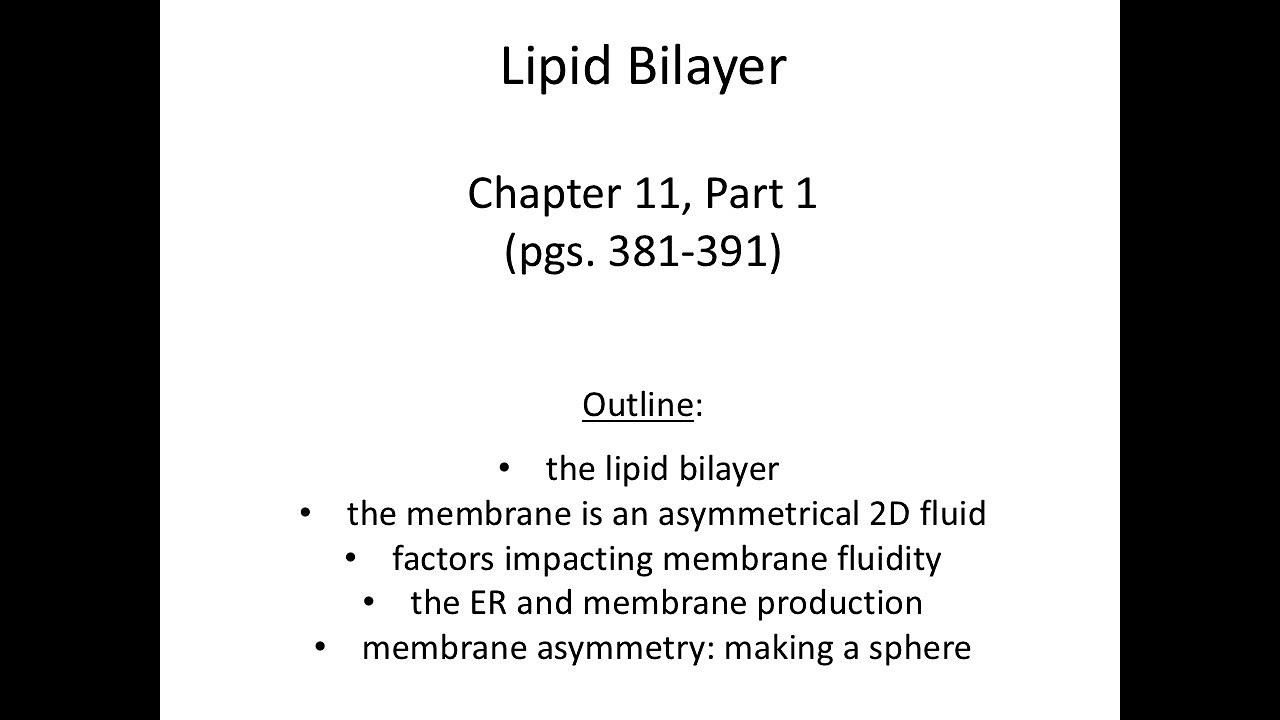
Lecture 12 Lipid Bilayer Ch 11 Pt 1
Keywords
Summary
153 words
Critical Evaluation
The lecture provides a solid introduction to the lipid bilayer, covering key concepts such as amphipathic nature of phospholipids, the hydrophobic effect, and membrane fluidity. The instructor uses clear analogies (e.g., barrier with portals, salad dressing) to make abstract concepts accessible. The scientific content is accurate and aligns with standard cell biology textbooks. However, the lecture lacks citations to primary literature, which is typical for an educational lecture but limits its use as a research source. The argumentation is logical, building from molecular properties to membrane functions. The instructor emphasizes the entropic driving forces behind membrane formation, which is a fundamental principle. The adéquation between title and content is good, as the lecture focuses on the lipid bilayer as stated. The lecture is well-structured, with a clear progression from basic structure to functional implications. Potential weaknesses include a lack of visual aids beyond static diagrams and a somewhat slow pace. Overall, the lecture is reliable for introductory learning but does not offer novel insights or advanced details.
167 words
Title / Content Match
The title accurately reflects the content: a lecture on the lipid bilayer, covering composition, diffusion, and fluidity.
Quality & Reliability
8/10
The lecture is based on standard cell biology textbook content (Chapter 11), presented by an instructor. It covers fundamental concepts accurately, with clear explanations and analogies. No citations are provided, but the content aligns with established scientific knowledge.
Key Moments
Markers derived by PSI from the transcript: the creator did not define chapters.
- Introduction: course milestones, topic overview, and chapter scope.
- Importance of plasma membrane as a barrier and portal.
- Functions of membrane proteins: import/export, receptors, and cell motility.
- Membrane self-healing and mechanical properties.
- Membrane diversity and organelle-specific functions.
- Lipid bilayer structure: hydrophilic heads and hydrophobic tails.
- Hydrophobic effect and spontaneous bilayer formation.
- Amphipathic nature of phospholipids and water interactions.
- Entropic driving forces and self-assembly of membranes.
- Factors affecting membrane fluidity: fatty acid saturation and cholesterol.
Contribution & Novelties
This lecture provides a clear educational overview of the lipid bilayer, reinforcing foundational concepts. It does not present new research but serves as a pedagogical resource. For deeper exploration, consider the following:
Pour aller plus loin :
- Fluid mosaic model — The model describing membrane structure and dynamics.
- Lipid bilayer — Detailed article on bilayer properties and formation.
- Membrane fluidity — Overview of factors influencing fluidity.
66 words
Radar Profile
The radar profile shows high scores in quality and reliability, moderate in quantity and technical level, indicating a well-explained but not overly dense lecture.