Lecture 19 - Cell Communities - Part 1 - Chapter 20
Keywords
Summary
161 words
Critical Evaluation
The lecture provides a solid overview of the extracellular matrix and cell junctions, essential topics in cell biology. The instructor’s explanations are clear and well-structured, building on previous knowledge. He effectively uses analogies, such as comparing the ECM to a cytoskeleton, to make complex concepts accessible. The content is accurate and aligns with standard textbook material, though it lacks depth in some areas, such as the molecular details of collagen synthesis and the diversity of ECM components. The discussion of stem cells is brief and introductory, which is appropriate given the lecture’s scope. The sources cited are not explicitly mentioned, but the lecture likely draws from a standard cell biology textbook, such as Alberts et al. The instructor’s credibility is high, as he is an academic lecturer. The video’s production quality is basic, with slides and narration, but it serves its educational purpose. The title accurately reflects the content, and the lecture is well-paced for a classroom setting. Overall, the lecture is informative and reliable for introductory cell biology, though it may not satisfy advanced learners seeking deeper mechanistic insights.
180 words
Title / Content Match
The title accurately reflects the content, which focuses on cell communities, tissues, and stem cells, as part of a chapter on cellular communities.
Quality & Reliability
8/10
The lecture is a structured educational presentation by an academic instructor, covering foundational concepts in cell biology with clear explanations and references to textbook material. The content is consistent with established biological knowledge, though it is not peer-reviewed and relies on the instructor's expertise.
Key Moments
Markers derived by PSI from the transcript: the creator did not define chapters.
- Introduction to the lecture and overview of topics: ECM, collagen, polysaccharide gels, cell junctions, and stem cells.
- Explanation of the hierarchical organization of multicellular organisms: cells to tissues to organs to organ systems.
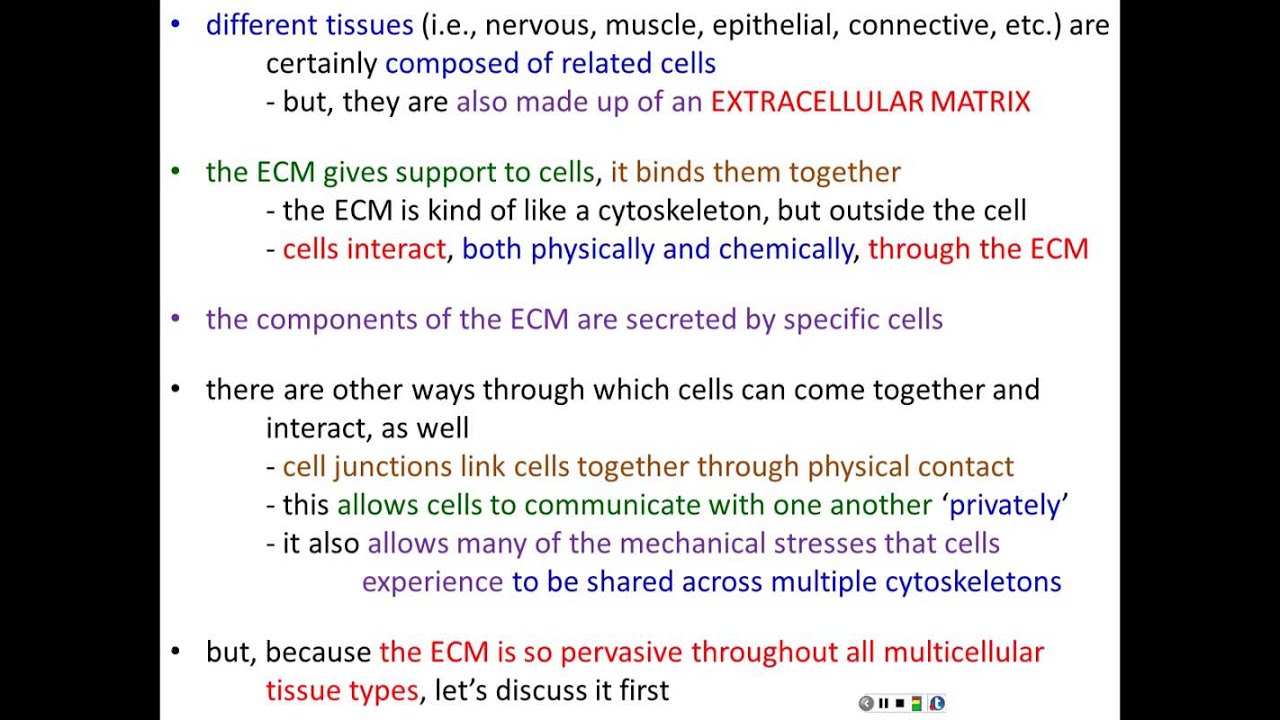
- Definition of the extracellular matrix (ECM) and its role in supporting cells and providing tensile strength.
- Discussion of collagen as the main component of the ECM and its structural properties.
- Explanation of polysaccharide gels and how they help cells resist compression.
- Introduction to cell junctions: tight junctions, adherens junctions, desmosomes, and gap junctions.
- Discussion of how cell junctions facilitate cell-cell communication and mechanical stress distribution.
- Brief introduction to stem cells and their role in tissue regeneration and repair.
- Conclusion and preview of the next lecture on cancer.
Concurring Sources
- Molecular Biology of the Cell (Alberts et al.) — Standard textbook covering ECM and cell junctions in detail.
Contribution & Novelties
This lecture provides a comprehensive introduction to the extracellular matrix and cell junctions, synthesizing concepts from previous lectures. It emphasizes the functional diversity of ECMs across different tissue types and the importance of cell junctions in tissue integrity. The lecture also introduces stem cells, linking them to tissue repair and setting the stage for cancer biology.
Pour aller plus loin :
- Extracellular matrix — Overview of ECM components and functions.
- Collagen — Detailed information on collagen structure and types.
- Cell junction — Comprehensive article on various cell junctions and their roles.
- Stem cell — Introduction to stem cell types and applications.
101 words
Radar Profile
The radar profile shows high scores in quantity and quality of information, with a moderate technical level, indicating a well-balanced educational lecture. The reliability is also high, reflecting the instructor's expertise and the established nature of the content.
💬 Sur les 0 commentaires analysés, aucune tendance n'est disponible.