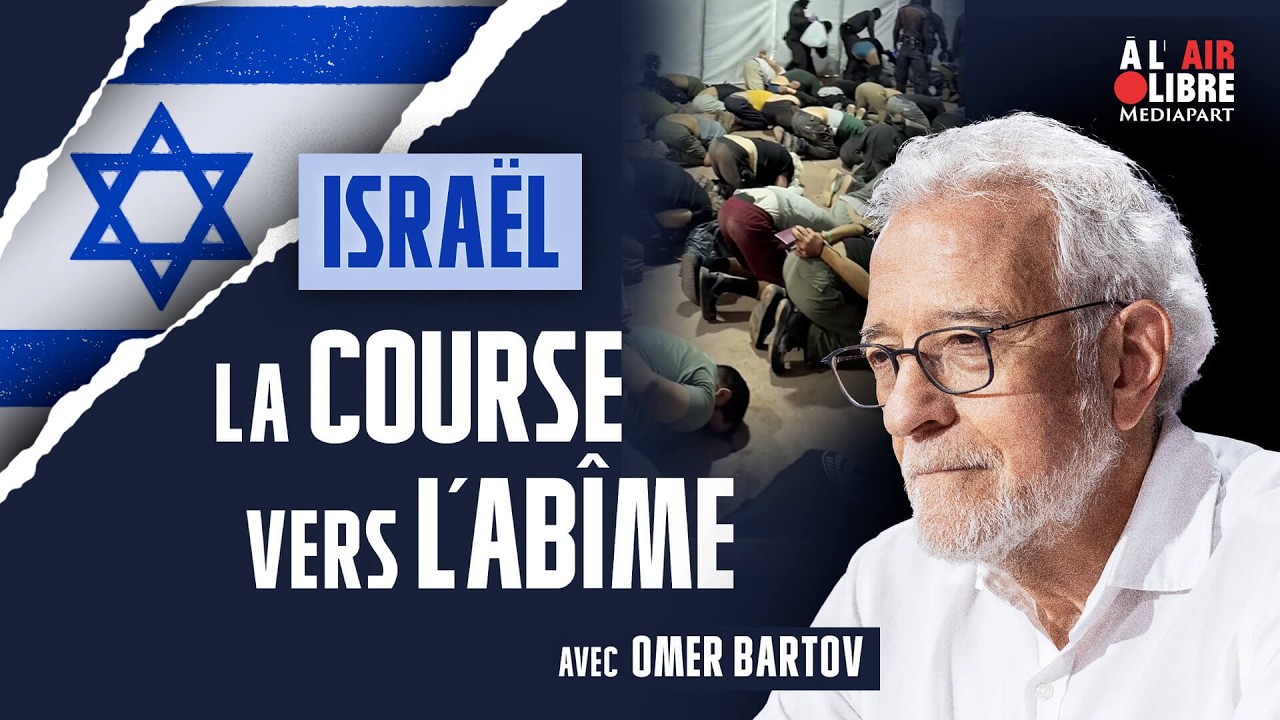
Gaza « Les dirigeants européens qui refusent de parler de génocide accordent une impunité à Israël »
Keywords
Summary
153 words
Critical Evaluation
The interview provides a compelling and authoritative analysis of the Gaza conflict from a scholar with deep expertise in genocide studies. Bartov’s arguments are well-supported by historical evidence and his personal experience as an Israeli citizen and former soldier. He effectively connects the current situation to long-term processes of dehumanization and ideological radicalization, offering a nuanced perspective that goes beyond simplistic condemnations. The discussion is intellectually rigorous, with Bartov carefully distinguishing between historical analogies and direct comparisons, while still drawing meaningful parallels. The interviewer, Mathieu Magnaudeix, skillfully guides the conversation, allowing Bartov to elaborate on complex points without oversimplification. The sources cited, including Bartov’s own publications and Mediapart’s investigative pieces, lend credibility to the discussion. However, as an opinion piece, the interview presents a particular viewpoint that may not fully represent the range of perspectives on the conflict. Nonetheless, the quality of the argumentation and the depth of analysis make this a valuable contribution to public discourse. The title accurately reflects the central theme, and the content delivers on its promise. Overall, this is an excellent interview that offers profound insights into one of the most pressing issues of our time.
191 words
Title / Content Match
The title accurately reflects the core theme of the interview: European leaders' reluctance to label the situation in Gaza as genocide, which Bartov argues grants impunity to Israel.
Quality & Reliability
9/10
The interview features Omer Bartov, a renowned historian of genocide, providing expert analysis grounded in historical scholarship. The discussion is well-contextualized and references specific events and documents. The source is Mediapart, an independent investigative outlet known for rigorous journalism. The content is opinion-based but informed by deep expertise.
Key Moments
Markers derived by PSI from the transcript: the creator did not define chapters.
- Introduction of Omer Bartov and topic of the interview.
- Bartov discusses Israel's perpetual war and Netanyahu's role.
- Discussion on European leaders' response to Gaza and impunity.
- Bartov recounts his 1987 letter to Yitzhak Rabin comparing Israeli army to Wehrmacht.
- Bartov explains the evolution of Zionism and dehumanization of Palestinians.
- Analysis of the genocide in Gaza and international reactions.
- Discussion on the impact of occupation on Israeli society.
- Bartov addresses accusations of antisemitism and defends his comparisons.
- Conclusion and final remarks on the need for accountability.
Cited Sources
- Flottille pour Gaza : la violence d’Israël indigne, enfin — Mediapart article referenced in the description, related to the flotilla incident.
- Vidéo de Ben Gvir : quand les prisonniers sont palestiniens, l’Occident regarde ailleurs — Mediapart article referenced in the description, related to Ben Gvir's actions.
- Comprendre la guerre au Proche-Orient (dossier) — Mediapart dossier referenced in the description, providing background on the conflict.
Concurring Sources
- I'm a Genocide Scholar. I Know It When I See It. — Bartov's op-ed in the New York Times where he argues that the situation in Gaza constitutes genocide.
External References
Contribution & Novelties
This interview offers a unique perspective from a leading genocide scholar, providing historical context and moral clarity on the Gaza conflict. Bartov’s analysis of the evolution of Zionism and the dehumanization of Palestinians adds depth to public understanding. His personal experiences and scholarly expertise lend credibility to his claims.
Pour aller plus loin :
- Omer Bartov’s book ‘Anatomy of a Genocide’ — Provides detailed historical analysis of a genocide, relevant to understanding the dynamics in Gaza.
- International Criminal Court — The ICC is the body that could potentially investigate and prosecute alleged war crimes and genocide, relevant to the discussion of accountability.
- UN Office on Genocide Prevention — Offers definitions and resources on genocide prevention, useful for understanding the legal and political dimensions.
123 words
Radar Profile
The radar profile shows high scores in information quantity, quality, and technical level, with a slightly lower but still high score in global reliability. This indicates a well-informed, expert-driven discussion with strong factual grounding and minimal bias.
💬 Très positif. Sur les 30 commentaires analysés, la grande majorité exprime un soutien enthousiaste à l'interview et à Omer Bartov, saluant son courage et son honnêteté intellectuelle, avec quelques critiques virulentes envers les gouvernements occidentaux.