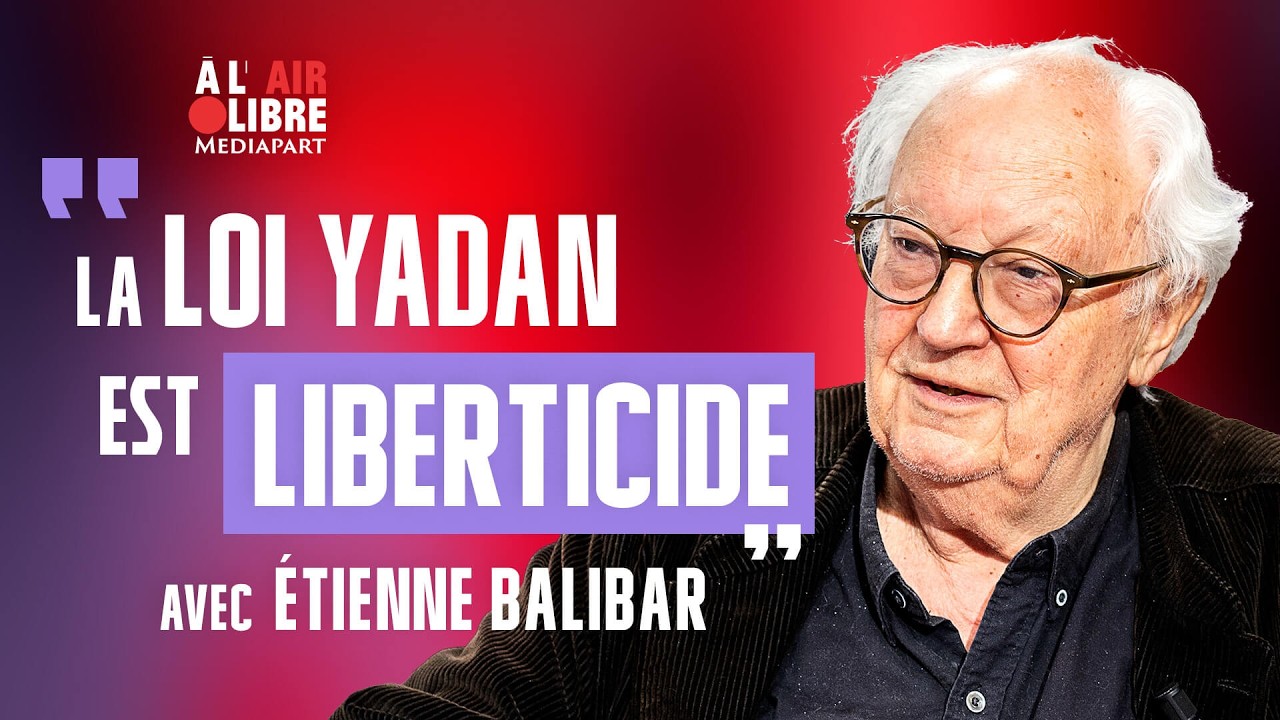
Loi Yadan : « Il s’agit de rendre illégale la discussion sur ce qu’est devenu l’État d’Israël »
Keywords
Summary
137 words
Critical Evaluation
The interview provides a rigorous philosophical and legal analysis of the Loi Yadan, offering a critical perspective that is often absent from mainstream discourse. Balibar’s argument is well-structured, drawing on historical context and legal specifics to demonstrate how the law could undermine freedom of expression. He carefully distinguishes between antisemitism and legitimate criticism of Israel, a distinction that is crucial for democratic debate. The discussion is balanced, acknowledging the reality of antisemitism while warning against the dangers of conflating it with political dissent. The sources cited, primarily Mediapart articles, are credible and relevant, though they may not represent a diversity of viewpoints. The interview’s strength lies in its depth and the expertise of the guest, but it may be seen as one-sided, as it does not include perspectives from supporters of the law. Overall, the content is intellectually stimulating and contributes to a nuanced understanding of a complex issue, though it could benefit from a more balanced presentation.
158 words
Title / Content Match
The title accurately reflects the core argument of the interview, focusing on the law's potential to criminalize discussions about the state of Israel.
Quality & Reliability
8/10
The video features a renowned philosopher (Étienne Balibar) providing a nuanced analysis of a controversial law, grounded in legal and historical context. The channel Mediapart is known for investigative journalism, and the discussion is balanced, acknowledging the existence of antisemitism while critiquing the law's potential impact on freedom of expression. Sources cited are from Mediapart's own articles, which are credible but not independent.
Key Moments
Markers derived by PSI from the transcript: the creator did not define chapters.
- Introduction of the topic and guest Étienne Balibar.
- Balibar discusses the existence of antisemitism and the need to combat it.
- Explanation of the law's initial proposal and its evolution.
- Analysis of the law's articles and their potential impact on freedom of expression.
- Discussion on the slogan 'From the river to the sea' and its historical origins.
- Balibar argues that the law is liberticidal and a moral fault.
- Examination of the political context and the role of the CRIF.
- Discussion on the distinction between anti-Zionism and antisemitism.
- Balibar emphasizes the need to protect democratic freedoms.
- Conclusion and final thoughts on the law's implications.
Cited Sources
- Loi Yadan : aux sources du problème — Mediapart article providing background on the law.
- Antisémitisme et critique d’Israël : à l’Assemblée, la mobilisation monte d’un cran contre la loi Yadan — Mediapart article on the mobilization against the law.
- Le débat sur l’antisémitisme et la critique d’Israël revient à l’Assemblée — Mediapart article on the debate in the Assembly.
Concurring Sources
- Ligue des droits de l’homme — Organization that has criticized the law.
- Commission nationale consultative des droits de l’homme — Advisory body that has raised concerns about the law.
Dissenting Sources
- Caroline Yadan — The law's sponsor, who argues it is necessary to combat antisemitism.
External References
Contribution & Novelties
The interview provides a unique philosophical perspective on the Loi Yadan, highlighting the dangers of conflating antisemitism with criticism of Israel. Balibar’s analysis offers a nuanced understanding of the law’s potential impact on freedom of expression and democratic values.
Pour aller plus loin :
- Étienne Balibar — Background on the philosopher’s work and ideas.
- Antisemitism — Overview of antisemitism and its historical context.
- Freedom of speech — General concept of freedom of expression and its limits.
76 words
Radar Profile
The radar profile shows high scores in information quality and reliability, reflecting the depth and credibility of the analysis. The lower score in technical level indicates that the content is accessible to a general audience, while the high scores in information quantity and quality suggest a comprehensive and well-supported discussion.
💬 Levée de boucliers: The comments overwhelmingly oppose the law, with many expressing concerns about its impact on freedom of expression and its perceived targeting of criticism of Israel. The sentiment is strongly negative towards the law and supportive of the interview's critical stance.