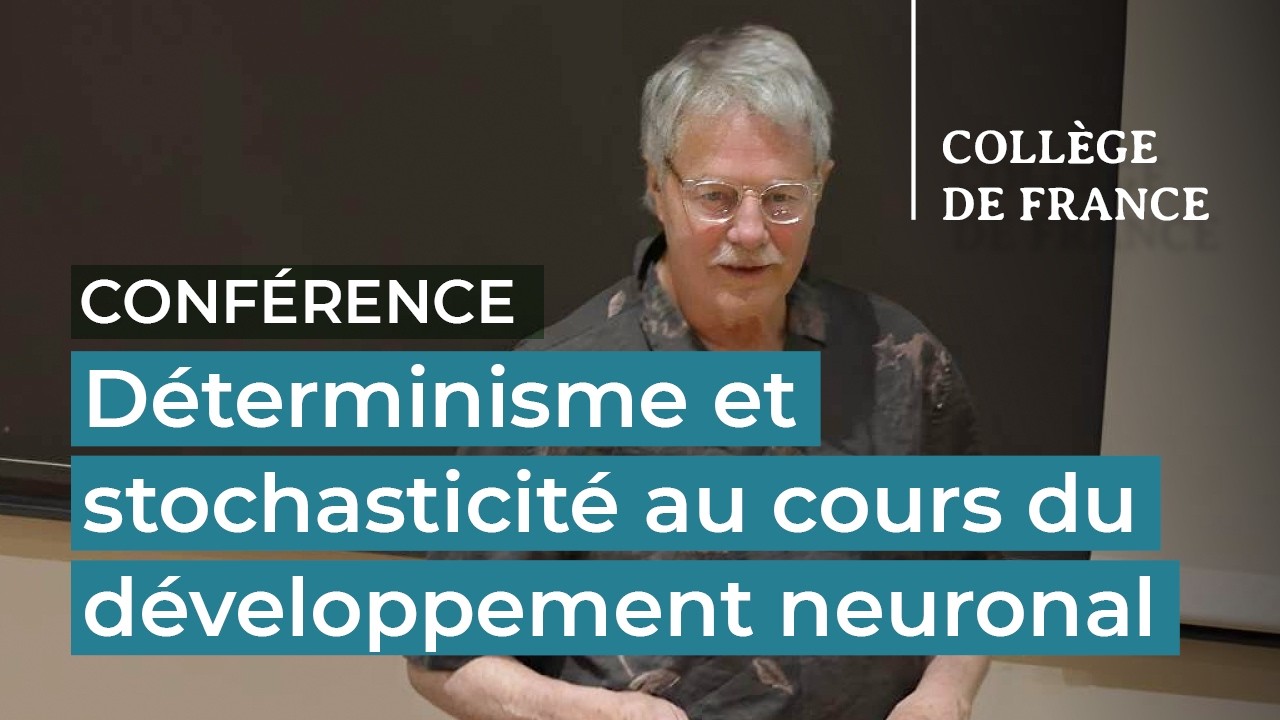
Claude Desplan (3) - Denis Duboule (2025-2026)
Keywords
Summary
135 words
Critical Evaluation
The lecture provides a comprehensive and insightful overview of how stochasticity contributes to neuronal diversity, using well-chosen examples from sensory systems. Desplan’s argumentation is solid, building from simple cases (bacteria, worms) to more complex ones (color vision, mushroom body). He effectively communicates the concept that identical cells can differ in function due to stochastic expression of a single gene, and he links this to evolutionary adaptations. The scientific rigor is high, as he cites specific examples and mechanisms, though he does not provide detailed references during the talk. The sources cited in the description are institutional (Collège de France) and provide context for the lecture series. The title accurately reflects the content, as it is the third lecture in the series. The lecture is well-structured and accessible, though it assumes some background in developmental biology. Overall, it is an excellent presentation of current research in the field.
147 words
Title / Content Match
The title accurately reflects the content: a lecture by Claude Desplan in the context of Denis Duboule's seminar series.
Quality & Reliability
9/10
Lecture by a leading developmental biologist at the Collège de France, based on established research and published work. The content is rigorous, well-structured, and presented with appropriate scientific nuance.
Key Moments
Markers derived by PSI from the transcript: the creator did not define chapters.
- Introduction and recap of previous lectures on deterministic and stochastic specification of neurons.
- Introduction to the concept of cells that are identical but differ by a single gene, using examples from bacteria and worms.
- Discussion of sensory receptors as examples of stochastic gene expression, focusing on olfactory receptors.
- Transition to the visual system: fish tetrachromacy and the evolution of color vision in mammals.
- Explanation of how primates re-evolved trichromatic vision and the stochastic distribution of photoreceptors in the human retina.
- Discussion of how color perception relies on comparing signals from different cone types, with low resolution for color.
- Introduction to the insect mushroom body and its role in learning and memory.
- Comparison of mushroom body evolution in eusocial insects and the mammalian cortex.
- Summary and concluding remarks on the interplay of determinism and stochasticity in neural development.
Cited Sources
- Collège de France - Conference series page — Official page for the lecture series, providing context and access to recordings.
- Collège de France - Denis Duboule chair page — Information about the chair holder and related teachings.
- YouTube playlist of the lecture series — Playlist containing all lectures in the series.
Concurring Sources
- Collège de France - Conference series page — Official page for the lecture series, providing context and access to recordings.
External References
Contribution & Novelties
This lecture provides a clear synthesis of how stochastic gene expression can generate cellular diversity, particularly in sensory systems. It highlights the mushroom body as a model for understanding the evolution of complex neural circuits. The lecture offers a comparative perspective between insects and mammals, which is valuable for understanding general principles of neurogenesis.
Pour aller plus loin :
- Mushroom body — Overview of the insect brain structure involved in learning and memory.
- Stochastic gene expression — General concept of randomness in gene expression and its biological implications.
- Color vision evolution — Evolutionary history of color vision in vertebrates.
99 words
Radar Profile
The radar profile shows high scores across all dimensions, indicating a lecture that is rich in information, technically sound, and highly reliable. The balance between quantity and quality of information is excellent, with a strong emphasis on scientific rigor.