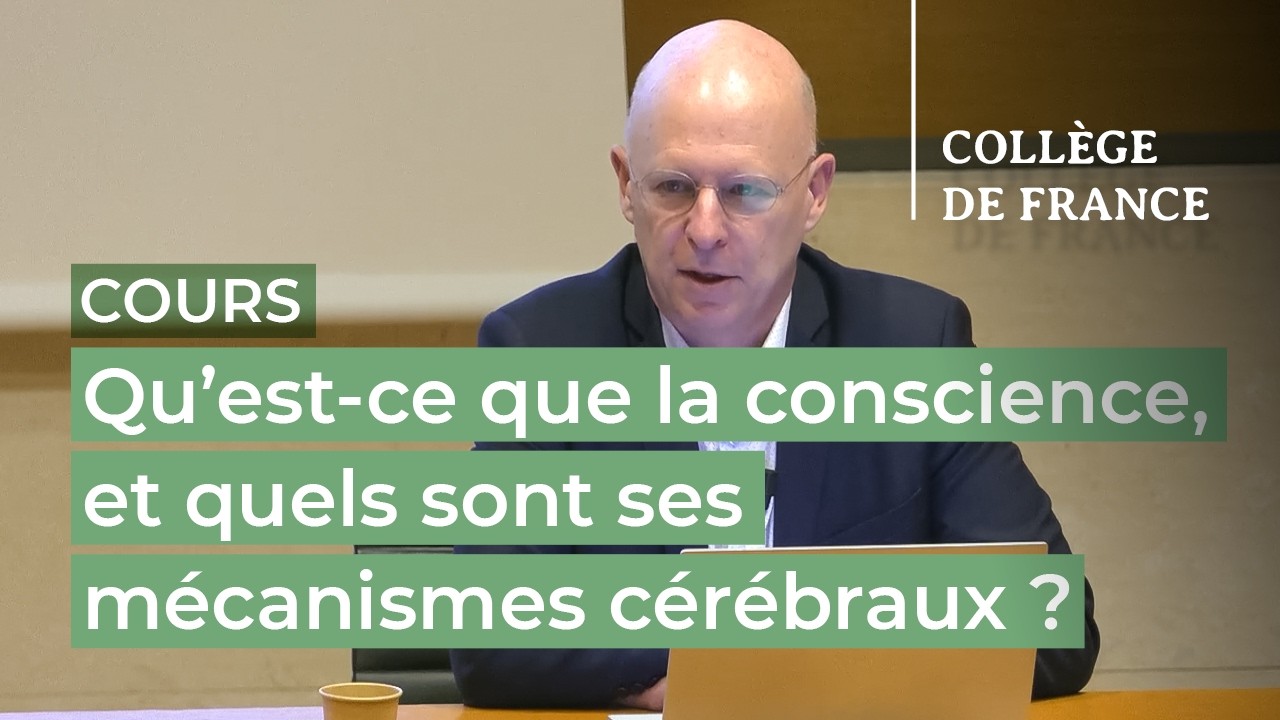
Qu’est-ce que la conscience, et quels sont ses mécanismes cérébraux ? (6) - S. Dehaene (2025-2026)
Keywords
Summary
165 words
Critical Evaluation
This lecture is a masterclass in cognitive neuroscience, delivered by one of the field’s leading experts. Dehaene’s presentation is rigorous, well-structured, and grounded in cutting-edge research. He systematically builds on his global neuronal workspace theory, providing clear predictions and then testing them with elegant experiments. The use of non-human primate models with advanced recording techniques (two-photon microscopy, electrophysiology) allows for detailed neural analysis that is not possible in humans. The findings from Liping Wang’s lab on orthogonal subspaces in the prefrontal cortex are presented with clarity, and the new experiment on subliminal stimuli directly addresses the question of whether unconscious information can enter working memory. The results are compelling: while unconscious stimuli can evoke a brief, transient response, they do not lead to sustained activity or flexible routing, supporting the idea that consciousness is necessary for flexible working memory. Dehaene also discusses clinical applications, such as coma and disorders of consciousness, highlighting the potential for these findings to inform diagnosis and treatment. The lecture is well-paced, with clear visuals and explanations. The only minor critique is that some sections may be dense for a non-specialist audience, but this is a university lecture, not a popular science talk. Overall, this is an excellent, authoritative presentation of the current state of research on consciousness and working memory.
215 words
Title / Content Match
The title accurately reflects the content, which focuses on consciousness and its brain mechanisms, specifically the relationship with working memory.
Quality & Reliability
9/10
Lecture by a leading cognitive neuroscientist at Collège de France, based on peer-reviewed research, with rigorous methodology and clear presentation.
Key Moments
Markers derived by PSI from the transcript: the creator did not define chapters.
- Introduction to the lecture and definition of working memory.
- Predictions from the global neuronal workspace theory.
- Discussion of Liping Wang's work on neural coding in prefrontal cortex.
- Description of the new experiment on subliminal stimuli and working memory.
- Results showing that unconscious stimuli do not enter working memory.
- Clinical applications for disorders of consciousness.
- Summary and conclusions.
Cited Sources
- Collège de France - Course page — Official course page for the lecture series.
- Stanislas Dehaene's chair page — Information about the professor's chair.
- YouTube playlist of the course — Playlist containing all lectures of the course.
Concurring Sources
- Collège de France — Institution hosting the lecture.
External References
Contribution & Novelties
This lecture provides an up-to-date synthesis of recent research on the neural basis of consciousness and working memory, particularly highlighting the work of Liping Wang’s lab on neural coding in the prefrontal cortex. It presents a novel experiment that directly tests whether unconscious information can enter working memory, showing that it cannot, thus supporting the global neuronal workspace theory. The lecture also bridges basic research and clinical applications, discussing how these findings can inform the diagnosis and treatment of disorders of consciousness.
Pour aller plus loin :
- Global Neuronal Workspace Theory — Overview of the theory proposed by Dehaene and colleagues.
- Working Memory — General overview of working memory concepts.
- Neural decoding — Explanation of techniques used to decode neural activity.
121 words
Radar Profile
The radar profile shows high scores in information quantity, quality, and reliability, with a slightly lower but still strong score in technical level. This indicates a lecture that is rich in content, scientifically rigorous, and accessible to a knowledgeable audience.
💬 No comments were provided for analysis.