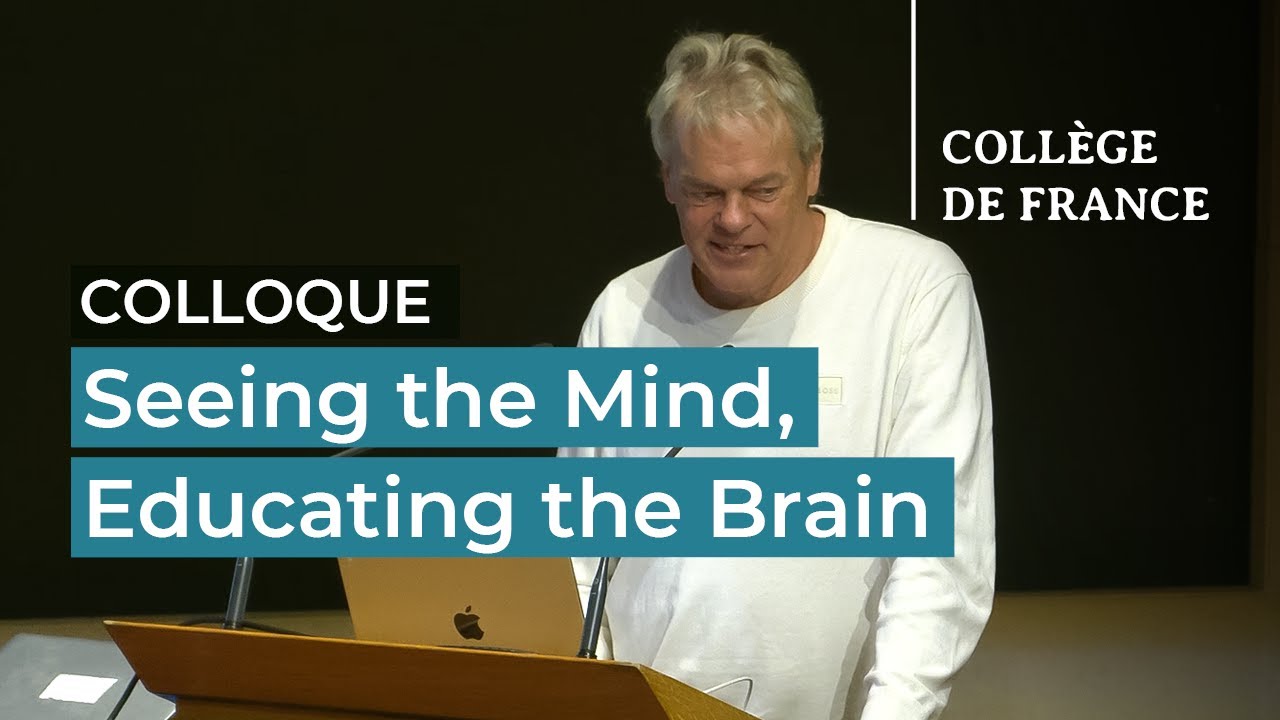
Seeing the Mind, Educating the Brain (22) - Stanislas Dehaene (2025-2026)
Keywords
Summary
183 words
Critical Evaluation
The lecture is a masterclass in systems neuroscience, delivered by a leading expert. Moser provides a clear historical narrative, from Tolman’s theoretical proposals to the empirical discoveries of place and grid cells. He effectively uses visual demonstrations and analogies to explain complex concepts, such as the torus topology of grid cell activity. The scientific rigor is exemplary: he presents quantitative analyses (persistent homology) and discusses the implications for theoretical models (continuous attractor networks). The sources are primarily his own published research, which is appropriate for a lecture summarizing his work. The lecture is aimed at a specialized audience, but Moser’s explanations are accessible. The title accurately reflects the content. The only minor weakness is the brevity of the discussion on the link to memory, which is mentioned but not deeply explored. Overall, this is an outstanding scientific presentation, deserving a perfect score.
142 words
Title / Content Match
The title accurately reflects the content: a lecture within a symposium on cognitive neuroscience, focusing on brain mechanisms of space and memory.
Quality & Reliability
9/10
Lecture by Nobel laureate Edvard Moser at Collège de France, presenting peer-reviewed research on grid cells and spatial navigation. High scientific rigor, based on decades of experimental work, with clear methodology and references to published studies.
Key Moments
Markers derived by PSI from the transcript: the creator did not define chapters.
- Introduction and tribute to Stanislas Dehaene's 60th birthday.
- Historical context: Tolman's cognitive maps and the controversy.
- Discovery of place cells by John O'Keefe in 1971.
- Discovery of grid cells in the medial entorhinal cortex in 2005.
- Grid cell modules and the square root of 2 scaling.
- Modern techniques: Neuropixels probes and large-scale recordings.
- Dimensionality reduction reveals a torus structure in grid cell activity.
- Persistent homology confirms the torus topology.
- Stability of the torus across sleep and behavior, supporting continuous attractor models.
Cited Sources
- Collège de France - Seeing the Mind, Educating the Brain — Official symposium page with program and resources.
- Stanislas Dehaene - Chaire Psychologie cognitive expérimentale — Chair page for the host professor.
- Collège de France - YouTube Playlist — Playlist of Dehaene's lectures.
Concurring Sources
- Hafting et al. (2005) - Microstructure of a spatial map in the entorhinal cortex — Original paper describing grid cells.
- Moser et al. (2014) - Grid cells and cortical representation — Review of grid cell research.
External References
Contribution & Novelties
This lecture provides an up-to-date synthesis of the latest research on grid cells, highlighting the discovery of a toroidal topology in the population activity of grid cells. This is a significant advance in understanding the neural code for space. The use of persistent homology to characterize the topology is a novel methodological contribution. The lecture also emphasizes the stability of this representation across different behavioral states, suggesting a hardwired neural map.
Pour aller plus loin :
- Grid cell - Wikipedia — Overview of grid cells and their properties.
- Place cell - Wikipedia — Overview of place cells and their discovery.
- Entorhinal cortex - Wikipedia — Brain region where grid cells are located.
- Persistent homology - Wikipedia — Mathematical technique used to analyze topological features.
- Continuous attractor network - Scholarpedia — Theoretical model for grid cell activity.
136 words
Radar Profile
The radar profile shows high scores across all dimensions, with a slight dip in quantity of information due to the lecture's concise format. The overall shape is balanced, indicating a well-rounded and reliable scientific presentation.
💬 No comments were provided for analysis.