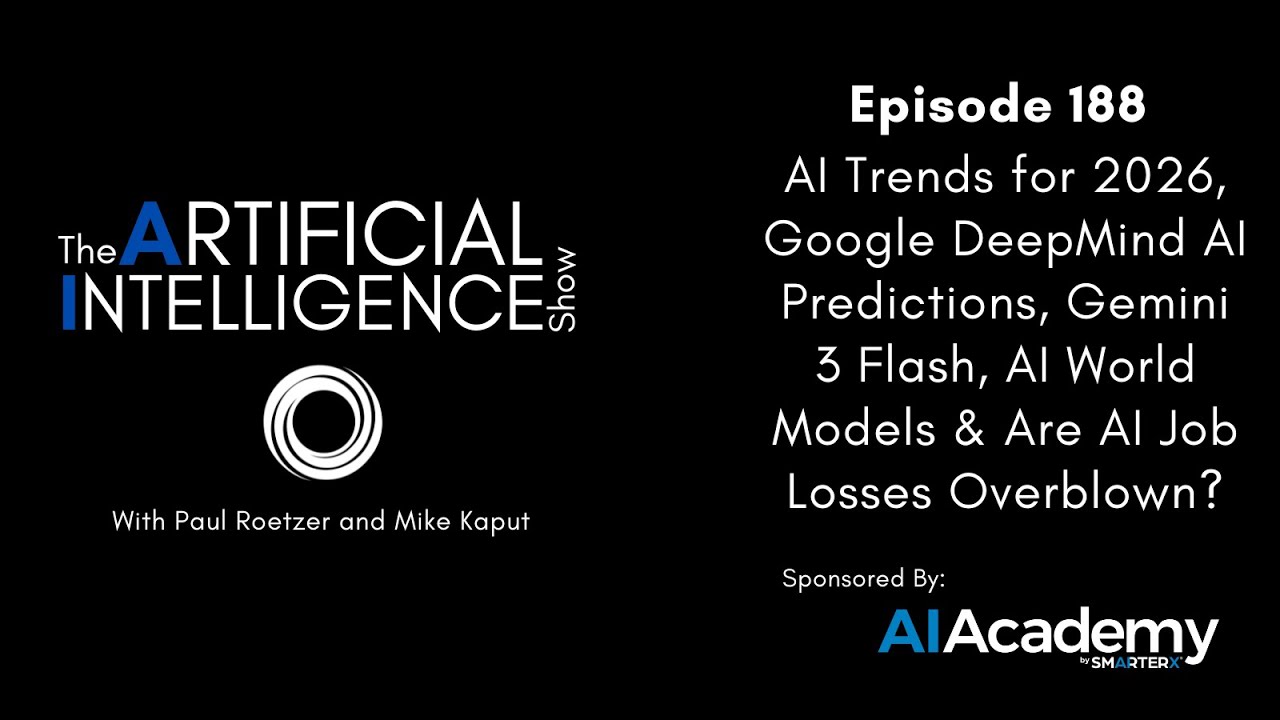
Ep.# 188: AI Trends for 2026, Gemini 3 Flash, AI World Models & Are AI Job Losses Overblown?
Keywords
Summary
126 words
Critical Evaluation
Value of the Information & Strength of the Argument
The episode provides valuable insights into AI trends and their potential societal impact, drawing on expert opinions and recent reports. The hosts argue that agent-to-agent communication and personalized AI will become more prevalent, and they emphasize the need for AI verification and literacy. They present a balanced view on job displacement, acknowledging both the potential for disruption and the current lack of significant impact. The argumentation is generally solid, though some claims are based on anecdotal evidence or personal observations rather than rigorous data.
Scientific Rigor, Source Quality, Title Accuracy
The hosts reference credible sources such as Demis Hassabis and Shane Legg’s interviews, Metr’s research on AI task completion, and reports on AI’s employment impact. They also mention Karen Hao’s correction to her book, showing attention to accuracy. The title accurately reflects the content. The episode includes a sponsored segment for AI Academy, which is disclosed. Overall, the sources are reputable, and the hosts demonstrate a good understanding of the topics, though some claims could benefit from more detailed citations.
179 words
Title / Content Match
The title accurately reflects the episode's content, covering AI trends for 2026, Gemini 3 Flash, world models, and job loss debates.
Quality & Reliability
7/10
The hosts provide a balanced overview of AI trends and news, citing specific reports and interviews (e.g., Demis Hassabis, Shane Legg) and referencing sources like the Metr scaling law. However, the discussion is largely opinion-based and lacks deep technical verification, and some claims (e.g., job loss impact) are presented without rigorous data analysis.
Chapters
- Intro
- AI Pulse
- AI Trends to Watch in 2026
- Demis Hassabis on the Future of Intelligence
- DeepMind Co-Founder on the Arrival of AGI
- Are AI Job Fears Overblown?
- Gemini 3 Flash
- OpenAI Eyes Billions in Fresh Funding
- OpenAI Releases New ChatGPT Images
- Karen Hao Issues AI Book Correction
- AI Keeps Getting Political (Roundup)
- AI World Models
- US Government Launches Tech Force
Cited Sources
- AI Academy by SmarterX — Sponsored segment promoting AI Academy courses and membership.
- Podcast website — Main website for the podcast, containing show notes and additional resources.
- AI Pulse — Interactive polls for audience engagement, referenced during the episode.
- Show notes for episode 188 — Detailed show notes with links to sources and topics discussed.
- SmarterX LinkedIn — Company LinkedIn page for updates and community.
- Marketing AI Institute newsletter — Newsletter subscription for AI insights and resources.
- Marketing AI Institute resources — Webinars and resources for AI education.
- Marketing AI Institute Slack community — Community Slack group for discussion and networking.
Concurring Sources
- Metr's research on AI task completion — Supports the discussion on AI reliability for long-horizon tasks.
- Demis Hassabis interview — Referenced in the episode for his views on AGI and societal impact.
Dissenting Sources
- Report on AI job impact — The episode mentions a report suggesting generative AI hasn't significantly disrupted employment, but the hosts debate its implications, with some arguing that job losses may be overblown while others see potential for future disruption.
Contribution & Novelties
The episode offers a forward-looking perspective on AI trends for 2026, synthesizing expert opinions and recent developments. It provides practical insights for businesses on adopting AI, emphasizing the need for verification and literacy. The hosts’ discussion on agent-to-agent communication and personalized AI assistants is particularly relevant.
Pour aller plus loin :
- World Models — Foundational concept for AI systems that simulate physical reality.
- Metr’s research on AI task completion — Empirical data on AI’s ability to perform long-horizon tasks.
- Demis Hassabis on AGI — Background on DeepMind’s co-founder and his views on AGI.
- Shane Legg on AGI — Co-founder of DeepMind and his predictions on human-level AI.
107 words
Radar Profile
The radar profile shows high scores in information quantity and quality, reflecting the episode's comprehensive coverage of AI trends and news. The technical level is moderate, suitable for a general audience. The overall reliability is good, though some claims are based on opinions rather than rigorous data.