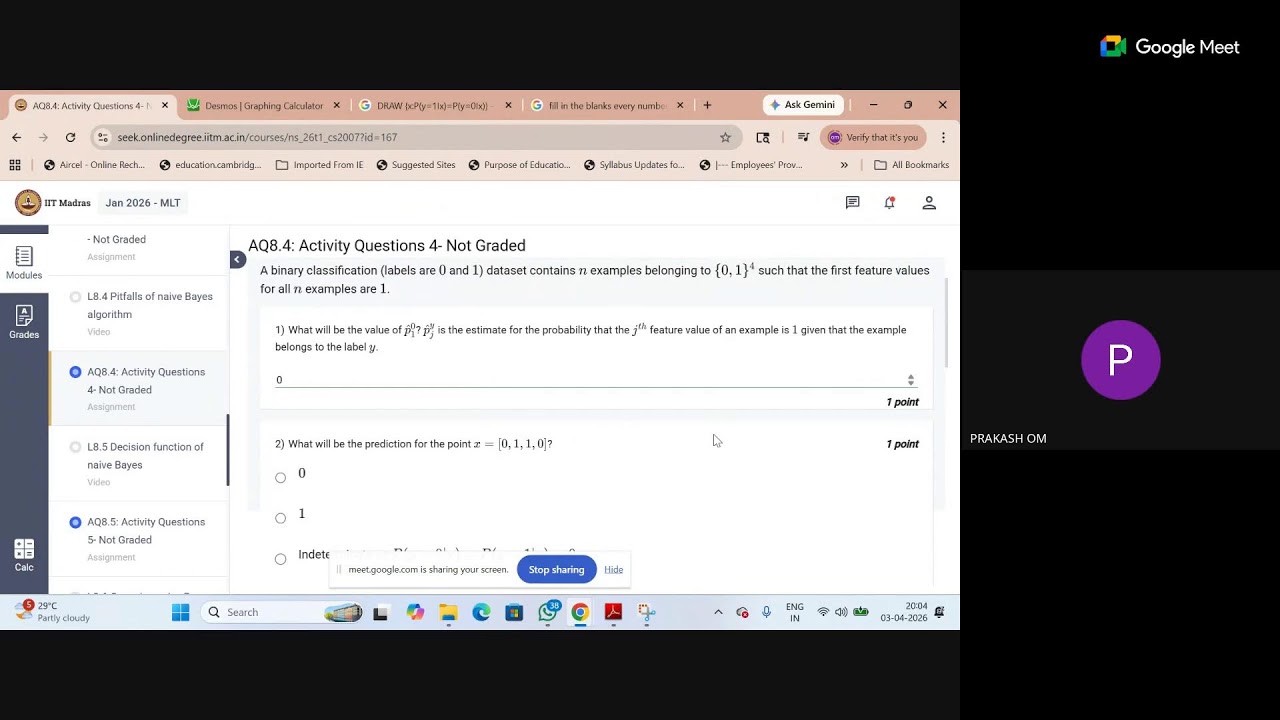
MLT - Week 8 | Session- 2
Keywords
Summary
182 words
Critical Evaluation
Value of the Information & Strength of the Argument
The session provides a solid, step-by-step derivation of the Naive Bayes classifier, from the generative story to the prediction rule. The instructor emphasizes the conditional independence assumption and the parameter counting, which is crucial for understanding the model’s complexity. The numerical example is well-chosen to illustrate the estimation of parameters from data. The argumentation is clear and logical, building intuition through the derivation and example. However, the session is primarily a review and problem-solving session, so it does not introduce new concepts or advanced variations of Naive Bayes.
Scientific Rigor, Source Quality, Title Accuracy
The scientific rigor is adequate for a tutorial: the instructor correctly applies Bayes’ theorem and the Naive Bayes assumption, and the parameter estimation follows standard maximum likelihood principles. No external sources are cited, which is typical for a course session. The title accurately reflects the content, as it is a session in a Machine Learning Techniques course. The adéquation titre/contenu is good, though the title is generic and could be more descriptive.
175 words
Title / Content Match
The title accurately reflects the content: a session in a Machine Learning Techniques course, focusing on Naive Bayes.
Quality & Reliability
7/10
The session is a live tutorial with interactive Q&A, covering the mathematical foundations of Naive Bayes classification. The instructor derives formulas step-by-step and works through a numerical example, but the lack of formal citations and the informal setting limit the score.
Key Moments
Markers derived by PSI from the transcript: the creator did not define chapters.
- Introduction and review of the generative story for Naive Bayes.
- Discussion on the number of parameters (2d+1) and the conditional independence assumption.
- Derivation of the prediction rule using Bayes' theorem and cancellation of the denominator.
- Explanation of the product form for the likelihood of a test point.
- Numerical example: computing the prior p_hat and conditional probabilities from a small dataset.
- Clarification on complementary probabilities and parameter counting.
- Further Q&A on the formulas and parameter estimation.
Contribution & Novelties
The session provides a clear, pedagogical walkthrough of the Naive Bayes classifier, reinforcing the mathematical foundations and parameter estimation. It is particularly useful for students who need to solidify their understanding of the model’s assumptions and computations. The interactive format allows for immediate clarification of doubts.
Pour aller plus loin :
- Naive Bayes classifier - Wikipedia — Overview and variations.
- Bayes’ theorem - Wikipedia — Foundational probability rule.
- Maximum likelihood estimation - Wikipedia — Principle behind parameter estimation.
78 words
Radar Profile
The radar profile shows a balanced performance across all dimensions, with slightly higher scores in information quantity and technical level, reflecting the tutorial's focus on detailed derivation and example. The lower scores in information quality and reliability are due to the lack of formal citations and the informal setting.