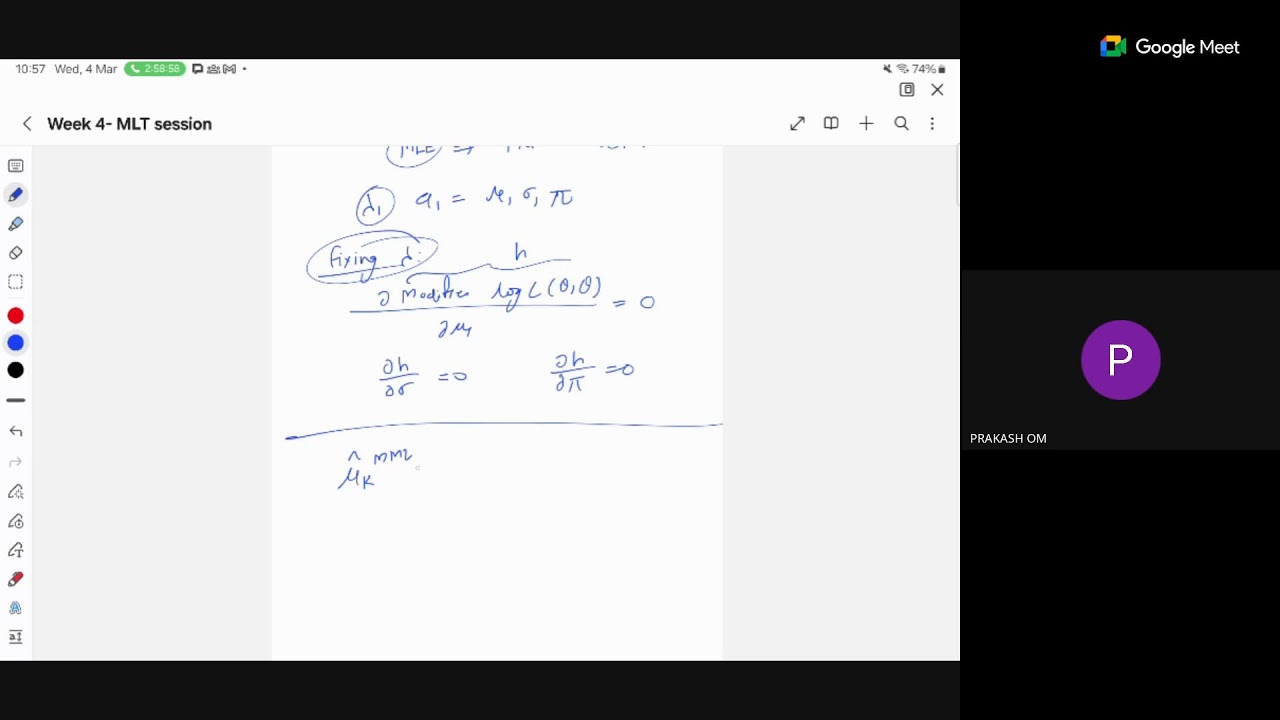
MLT | Week-4 | Session-1
Keywords
Summary
230 words
Critical Evaluation
Value of the Information & Strength of the Argument
The lecture provides a solid conceptual foundation for understanding Gaussian Mixture Models and the EM algorithm. The instructor effectively recaps K-means clustering, highlighting its limitations as a hard clustering method, and motivates the need for probabilistic models like GMM. The explanation of Maximum Likelihood Estimation is clear, with a step-by-step derivation of the likelihood function for an exponential distribution, illustrating the general principle. The argumentation is logical and builds on prior knowledge, making it accessible to students. However, the session does not delve deeply into the EM algorithm itself, as it is only introduced at the end. The value lies in the clear explanation of the statistical prerequisites and the motivation for GMM, but the lack of concrete examples or applications limits the practical insight. The interactive nature of the lecture helps address student doubts, but the overall argumentation is more pedagogical than rigorous, with no formal proofs or references.
Scientific Rigor, Source Quality, Title Accuracy
The lecture is scientifically sound in its presentation of standard machine learning concepts, but it lacks formal citations or references. The instructor mentions statistical concepts like MLE and conjugate priors but does not provide sources. The title accurately reflects the content, as it is a week 4 session on GMM and EM. The content is consistent with established theory, but the absence of sources reduces its reliability as a standalone reference. The lecture is part of a course, so students are expected to have supplementary materials. The title is appropriate and does not mislead. The session does not include any advertising or sponsored content.
269 words
Title / Content Match
The title accurately reflects the content: a week 4 session on Gaussian Mixture Models and the EM algorithm, with a recap of K-means.
Quality & Reliability
6/10
The session is a live lecture covering Gaussian Mixture Models and the EM algorithm, with a recap of K-means clustering. The instructor explains concepts clearly but relies on interactive Q&A and does not provide formal citations or references. The content is consistent with standard machine learning theory, but the lack of sources and the informal setting limit its standalone reliability.
Key Moments
Markers derived by PSI from the transcript: the creator did not define chapters.
- Introduction and recap of Week 3: K-means clustering.
- Detailed explanation of K-means algorithm steps: initialization, distance calculation, assignment, and update.
- Discussion on hard vs soft clustering, introducing the need for probabilistic models.
- Introduction to Gaussian Mixture Models and the EM algorithm.
- Recap of Maximum Likelihood Estimation (MLE) and its importance.
- Derivation of the likelihood function for an exponential distribution.
- Explanation of log-likelihood and maximization approach.
- Discussion on conjugate priors and Bayesian estimation.
- Q&A session addressing student doubts on course logistics and content.
- Further elaboration on the EM algorithm and its connection to GMM.
Contribution & Novelties
The lecture provides a clear pedagogical introduction to Gaussian Mixture Models and the EM algorithm, building on a recap of K-means clustering. It emphasizes the transition from hard to soft clustering and explains the statistical foundations, particularly Maximum Likelihood Estimation. The interactive format helps clarify common misconceptions. However, the session does not present novel research or advanced techniques; it is a tutorial for students.
Pour aller plus loin :
- Gaussian Mixture Model (Wikipedia) — Provides a comprehensive overview of mixture models, including GMM.
- Expectation-Maximization Algorithm (Wikipedia) — Detailed explanation of the EM algorithm and its applications.
- Maximum Likelihood Estimation (Wikipedia) — Covers the theory and examples of MLE.
- K-means Clustering (Wikipedia) — Background on the K-means algorithm, which is compared to GMM.
122 words
Radar Profile
The radar profile shows a balanced performance across all dimensions, with slightly higher scores in information quantity and technical level, reflecting the lecture's focus on theoretical foundations. The lower scores in information quality and global reliability are due to the lack of formal sources and the informal, interactive nature of the session.