MLT | Week-4 | Session-2
Keywords
Summary
185 words
Critical Evaluation
Value of the Information & Strength of the Argument
The session provides a clear and accessible introduction to GMM and EM, with a strong focus on building intuition. The instructor uses a step-by-step approach, starting from the generative process and gradually introducing the mathematical formulations. The value lies in its pedagogical effectiveness: it clarifies common confusions, such as the difference between mixture and component, and the roles of prior and posterior probabilities. The argumentation is solid, as the instructor consistently ties the theory back to the underlying probabilistic model and uses a concrete example to demonstrate the concepts. However, the session is primarily a tutorial, so it does not delve into advanced topics or provide rigorous proofs. The interactive format, while beneficial for engagement, occasionally leads to digressions, but the instructor manages to keep the focus on the core material.
Scientific Rigor, Source Quality, Title Accuracy
The session is scientifically sound in its presentation of GMM and EM, with no apparent errors in the mathematical derivations. However, the instructor does not cite any external sources, and the description provides no references. The title accurately reflects the content, as it is a session in a machine learning course. The lack of formal citations is typical for a tutorial, but it limits the ability to verify the information independently. The instructor’s explanations are consistent with standard treatments of GMM and EM, and the interactive Q&A helps address potential misunderstandings. Overall, the scientific rigor is adequate for an introductory tutorial, but it would benefit from references to textbooks or papers for further study.
260 words
Title / Content Match
The title accurately reflects the content: a session in a machine learning course covering Gaussian Mixture Models and the Expectation-Maximization algorithm.
Quality & Reliability
7/10
The session is a live tutorial with interactive Q&A, providing a solid but informal introduction to GMM and EM. The instructor demonstrates a clear understanding of the concepts, but the lack of formal references and the conversational nature limit its standalone reliability.
Key Moments
Markers derived by PSI from the transcript: the creator did not define chapters.
- Introduction and overview of the session: reviewing GMM notation and transitioning to EM algorithm.
- Explanation of GMM notation: number of components K, mixture probabilities pi_k, means mu_k, variances sigma_k^2.
- Discussion on latent variables and the generative process of GMM: choose a component, then sample a data point.
- Clarification of probability density functions (PDF) and probability mass functions (PMF) in the context of GMM.
- Example of a two-component GMM with means at -1 and 1, variances 1/20 and 1/4, and visualization of the resulting mixture density.
- Derivation of the GMM density using the law of total probability and expansion of the joint density.
- Introduction to the EM algorithm: motivation and overview of the iterative steps.
- Detailed explanation of the E-step: computing posterior probabilities of component membership.
- Detailed explanation of the M-step: updating parameters (pi, mu, sigma) based on the posterior probabilities.
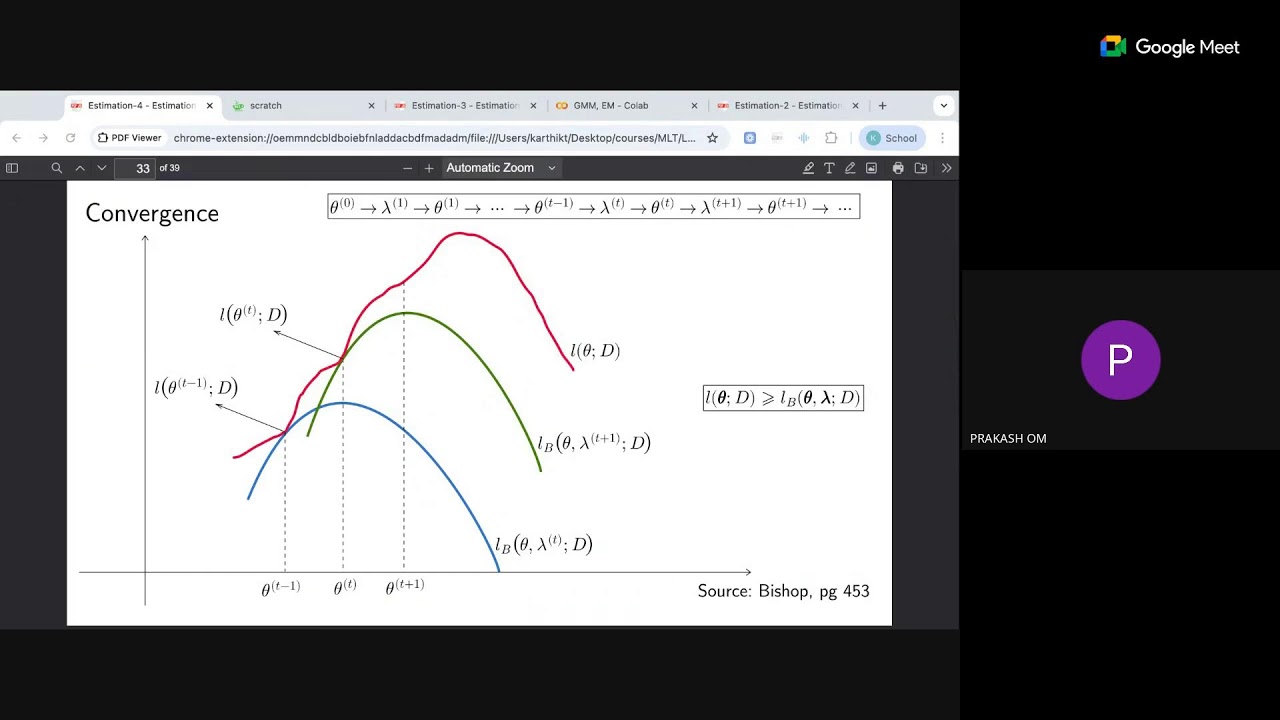
- Discussion on the convergence of EM and practical considerations.
Contribution & Novelties
The session provides a clear pedagogical introduction to GMM and EM, with a focus on building intuition through notation and examples. It is particularly useful for beginners in machine learning who need to understand the probabilistic foundations of these methods. The interactive format allows for immediate clarification of doubts, which enhances the learning experience.
Pour aller plus loin :
- Gaussian mixture model - Wikipedia — Overview of mixture models, including GMM.
- Expectation–maximization algorithm - Wikipedia — Detailed explanation of the EM algorithm.
- Pattern Recognition and Machine Learning by Christopher Bishop — Comprehensive textbook covering GMM and EM in depth.
99 words
Radar Profile
The radar profile shows a balanced performance across all dimensions, with slightly higher scores in information quantity and reliability, reflecting the session's comprehensive coverage and the instructor's expertise. The technical level is moderate, suitable for an introductory audience.