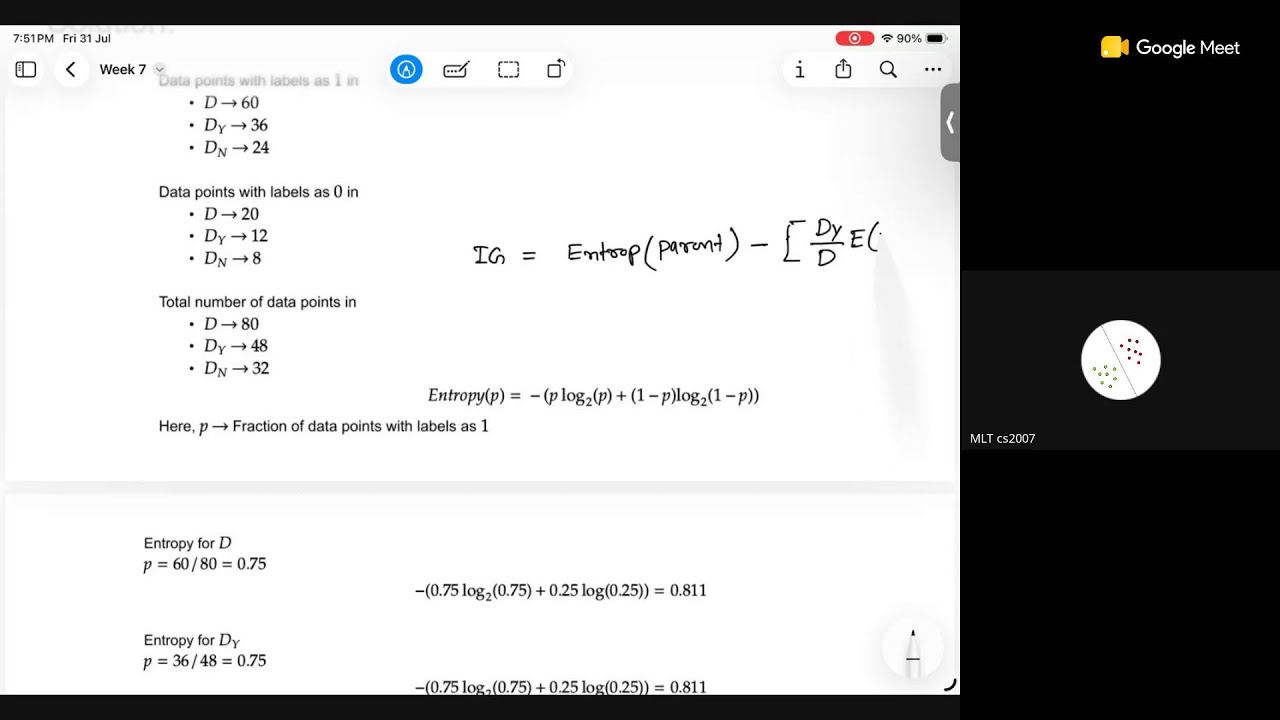
MLT | Week-7 | Solve with us-Decision Tree and K-NN
Keywords
Summary
161 words
Critical Evaluation
Value of the Information & Strength of the Argument
The video provides valuable practical insights into K-NN and decision trees through worked examples. The instructor’s explanations are clear and intuitive, especially when illustrating the effect of K on predictions and the importance of distance metrics. The argumentation is solid, as he uses concrete examples and analogies (e.g., the grid for Manhattan distance) to justify his reasoning. However, the video lacks depth in theoretical foundations, such as the mathematical derivation of information gain or the bias-variance tradeoff. The focus is on solving specific problems rather than general principles, which limits its value for advanced learners.
Scientific Rigor, Source Quality, Title Accuracy
The video is a tutorial session without formal citations or references. The instructor relies on standard knowledge of machine learning algorithms, which is generally accurate. The title accurately reflects the content, as it is indeed a problem-solving session for Week 7 on Decision Trees and K-NN. The video does not cite any external sources, and the description contains no links. The content is consistent with standard machine learning pedagogy, but the lack of sources reduces its scientific rigor. The instructor’s explanations are logically sound, but the absence of formal references means the video is not suitable as a primary academic source.
211 words
Title / Content Match
The title accurately reflects the content: a problem-solving session for Week 7 covering Decision Trees and K-NN.
Quality & Reliability
7/10
The video is a tutorial session solving practice problems on K-NN and decision trees. The explanations are clear and pedagogically sound, but the content is limited to worked examples without deep theoretical grounding or references. The instructor handles student questions well, but the video lacks formal citations and rigorous mathematical derivations.
Key Moments
Markers derived by PSI from the transcript: the creator did not define chapters.
- Introduction to classification vs regression and overview of K-NN and decision trees.
- Solving Question 1: K-NN with Manhattan distance and K=1.
- Discussion on tie-breaking in K-NN and effect of K=2.
- Solving Question 2: K-NN with K=900 on 1000 points, showing majority class dominance.
- Solving Question 3: Conceptual question on K-NN with K=1 and balanced classes.
- Brief introduction to decision trees and information gain.
- Solving additional decision tree problems.
- Wrap-up and final remarks.
Contribution & Novelties
The video offers a practical, problem-solving approach to understanding K-NN and decision trees, which is valuable for students. It clarifies common misconceptions, such as the effect of large K values and tie-breaking. However, it does not introduce new concepts or original research. For deeper understanding, one can explore the following:
- K-nearest neighbors algorithm - Wikipedia — Provides a comprehensive overview of K-NN, including distance metrics and algorithmic details.
- Decision tree learning - Wikipedia — Explains decision tree algorithms, including information gain and pruning.
- Information gain in decision trees - Wikipedia — Focuses on the concept of information gain, a key criterion for splitting in decision trees.
106 words
Radar Profile
The radar profile shows moderate scores across all dimensions, indicating a balanced but not exceptional tutorial. The video provides useful practical examples but lacks depth in theoretical rigor and source citation.